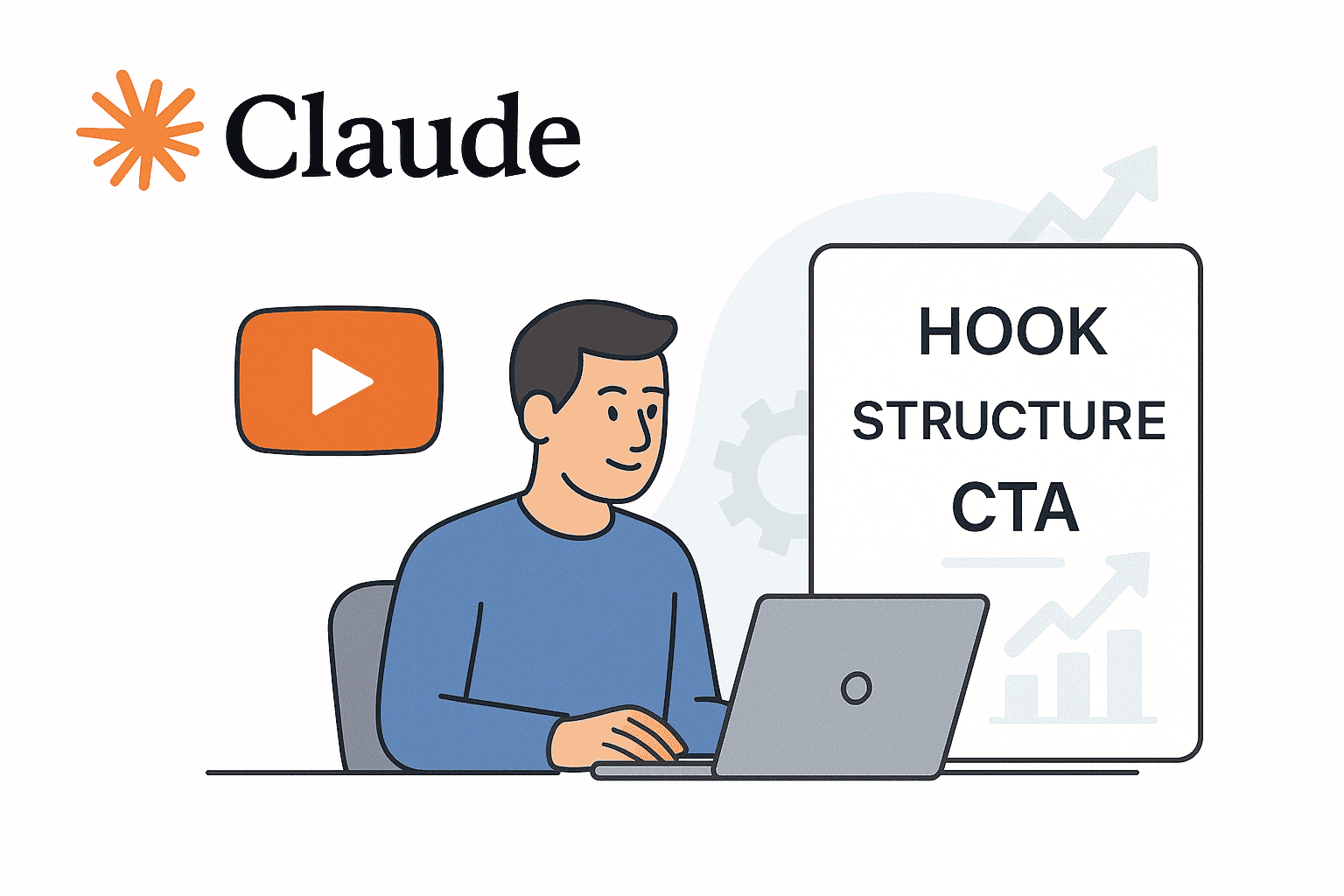

Crafting a compelling YouTube video script is crucial for engaging viewers – especially for faceless educational or explainer-style videos where narration and visuals carry the entire message. With recent AI advances, Anthropic Claude (a powerful language model) can automate much of the scriptwriting process through its API.
This article provides a comprehensive, step-by-step guide (with examples and code) to using Claude for generating high-retention YouTube scripts – from attention-grabbing hooks and structured outlines to scene-by-scene narration, visual (B-roll) cues, and effective CTAs. We focus on technical and educational content creators (developers, tech educators, etc.) looking to streamline script generation programmatically in a precise, instructional style.
Modern “faceless” YouTube channels – where creators narrate over stock footage, slides, or animations – are on the rise. They cover topics like AI tutorials, tech breakdowns, productivity how-tos, scripted commentary, and research-based explainers without showing a presenter on camera.
These channels can be quite successful and can leverage AI tools to speed up production; even industry guides suggest using AI like ChatGPT or Claude for scriptwriting. In fact, faceless channels have become easier to create “with AI-powered tools” that make video production faster.
The catch is that script quality remains paramount – a faceless video lives or dies by its script’s ability to hold viewer attention. To compete with on-camera personalities, your script needs a strong hook, logical structure, well-timed pacing, and engaging narration with visuals.
Achieving this manually can take many hours, whereas Claude can generate a solid first draft in minutes. Used properly, an AI-generated script with built-in retention mechanisms can even improve viewer retention (e.g. one creator saw completion rates jump from ~42% to 68% after applying a structured AI-generated script framework).
Before diving in, let’s clarify the target video format and why an AI-driven approach helps:
Target Video Types: Faceless Educational & Explainer Videos
The techniques here apply to faceless YouTube videos – those built on narration and supporting media rather than a talking-head presenter. Examples include:
- AI Tutorials & Tech How-Tos – Explaining how to use a tool or API, with screen recordings or slides.
- Technology Breakdowns – Deep-dives into how a technology or gadget works, using graphics and voiceover.
- Productivity Tips & Life Hacks – Listicle-style advice delivered via voice narration over stock footage or text.
- Scripted Commentary – Commentary on news, analysis, or storytelling (e.g. history, true crime) told via narration and visuals.
- Research-Based Explainers – Educational videos presenting research or complex topics in simple terms, often with animations or infographics.
In such videos, the script is the backbone. It provides the narrative arc, factual content, and even guidance for what viewers see on screen (since there’s no face-to-camera presenter improvising). A well-structured script will enumerate the key points to cover, the sequence of scenes, and where to insert visual aids or text overlays.
Faceless content creators who are technically inclined (e.g. software developers making coding tutorials) often struggle with scriptwriting – it’s a different skill than coding. They know their subject but might not know how to hook viewers or structure content for YouTube’s algorithmic retention. This is where Claude can help by providing a “scaffolding” for your creativity.
Using Claude via its API, you can programmatically generate a detailed script outline and even full narration, then refine it with your personal voice. The goal is to automate the heavy lifting (structure, initial wording) so you can focus on tweaking the details that make the script yours. As one AI prompt engineer noted, without structure, you either spend hours writing scripts or end up with AI-generated content that sounds robotic and doesn’t hold attention – a structured Claude workflow avoids both pitfalls.
Setting Up Claude API Integration (Python)
To use Claude programmatically for scriptwriting, you’ll need access to the Anthropic Claude API. Start by obtaining an API key from Anthropic’s developer console and installing their Python SDK. Then, instantiate the API client in your script or notebook. For example:
# Install the Anthropic SDK first:
!pip install anthropic

# Import and initialize the Claude client with your API key
from anthropic import Anthropic
client = Anthropic(api_key="YOUR_API_KEY")
As shown above, the anthropic library makes it straightforward to connect to Claude. Once authenticated, you can call Claude with a prompt via the client.messages.create() method, specifying a model and your prompt message. For instance, a simple test call might look like:
response = client.messages.create(
    model="claude-2",  # or the specific Claude model ID you have access to
    messages=[{"role": "user", "content": "Hello, Claude!"}],
    max_tokens=256  # limit output length (tokens) if needed
)
print(response.content)
This sends a user message to Claude and prints the assistant’s reply. The Claude API follows a chat paradigm similar to OpenAI’s: you supply a list of messages with roles (typically a single user prompt for single-turn calls), and you receive a completion with response.content. You can also set parameters like max_tokens to control length and temperature to control creativity/randomness. In the context of script generation, a lower temperature (e.g. 0.2–0.5) can yield more straightforward, consistent text, while a higher temperature might produce more varied phrasing. You will also want to use the model that best fits your needs – for lengthy scripts, Claude’s models with large context windows (like Claude 100k token versions) are ideal, but Claude Instant can be used for faster, shorter outputs.
With the API set up, let’s walk through generating each component of a YouTube video script using Claude. We will cover prompt design and show Python snippets for each part: the Hook, the Outline, the Narration (scenes), suggestions for B-roll/visuals, and the CTA/Outro. Finally, we’ll provide a full script template that combines these elements, which you can directly use as a single prompt or adapt into your workflow.
Step 1: Develop a Structured Outline of Key Points
Every good video needs a roadmap. We begin by asking Claude to generate a structured outline for the video. This outline will list the main sections or points, ensuring the content is logically organized and covers everything important. It’s useful to include the expected video length or duration so the AI can gauge how much content to produce and how to pace it. You should also tell Claude what type of content and tone you’re aiming for (tutorial, review, educational, etc.) and who the target audience is (so the detail level can be adjusted).
Prompt Example (Outline): “Create a detailed outline for a 6-minute YouTube video about [How quantum computing works] aimed at a general tech-savvy audience. Include sections for an introduction, 3-4 main points explaining key concepts, and a conclusion. Provide approximate timings for each section so that the total is ~6 minutes.”
In this prompt, we specified the topic, the target length, the general audience, and the desired number of main sections. Claude will then produce an outline with labeled sections and even rough time stamps. For example, one might get back an outline like:
- Hook (0:00–0:15) – A question or scenario to intrigue viewers about quantum computers
- Intro (0:15–0:45) – Briefly introduce what will be covered and why it matters
- Point 1: Qubits Explained (0:45–2:00) – Discuss classical bits vs qubits… (and so on)
- Point 2: Superposition (2:00–3:00) – …
- Point 3: Entanglement (3:00–4:00) – …
- Conclusion (5:00–6:00) – Recap key insights and real-world implications
(The above is a hypothetical example for illustration.)
Using the Claude API, you can generate such an outline with a call like:
topic = "how quantum computing works"
prompt_outline = (
    f"Create a structured outline for a 6-minute educational YouTube video about '{topic}'. "
    "Include an intro, 3-4 main explanatory sections, and a conclusion. "
    "Provide estimated timestamps for each part so the total runtime is about 6 minutes."
)
response = client.messages.create(model="claude-2", messages=[{"role":"user","content": prompt_outline}], max_tokens=300)
print(response.content)
Claude’s output will list the sections and their sub-points. This gives you a high-level view of the script’s structure before diving into the details. In fact, some prompt templates explicitly ask for an outline with timestamps for each section, as this helps plan pacing and ensures the content fits the desired length. By requesting (and later adhering to) timestamps, you can control scene length – for example, if the outline suggests Section 1 should be ~1 minute, you will keep that in mind when generating the narration for that section.
Why outline first? An outline ensures your script has a logical flow and covers all key insights. It’s much easier to revise a short outline than a 1500-word script, so this step lets you catch structural issues early. It also gives Claude context on where the script is headed, which can improve the relevance of the content it generates in later steps.
Step 2: Craft an Attention-Grabbing Hook
With an outline in hand, the next critical element is the hook – the first ~10–15 seconds of the video. The hook is what convinces a viewer not to click away in those opening moments. A great hook might present a surprising fact, ask a provocative question, or paint a compelling scenario. Claude can help generate a punchy hook tailored to your topic.
Prompt Example (Hook): “Write a 2-3 sentence opening hook (around 15 seconds) for a faceless [tech explainer video on quantum computing]. It should grab attention with a surprising fact or question and make viewers curious to learn more, without giving away the whole explanation.”
In this prompt, we clearly state the purpose (an opening hook), the format (faceless video, meaning narration only), the approximate length, and the strategy (use a surprising fact or question). For example, Claude might return a hook like:
“What if the next supercomputer wasn’t a machine of silicon at all, but something stranger? Quantum computers defy the rules of classical physics – and in the next 5 minutes, you’ll see why they could revolutionize everything from medicine to encryption.”
This example hook poses an intriguing scenario and promises an explanation, which is a classic technique. In practice, you might iterate on the hook a couple of times with Claude to get the tone and intrigue just right. It’s wise to remember that **the first 10 seconds determine if viewers stay or bounce】, so don’t hesitate to fine-tune this part. Claude’s suggestions can be a great starting point – you can always edit the hook to better match your personal style or to punch up a particular phrase.
From a programmatic standpoint, generating the hook could be done as a separate API call, or you could include it as part of a single prompt that asks for the full script. Separating it can give you more control. For instance, you might do:
prompt_hook = (
    "Generate an attention-grabbing opening hook (10-15 seconds) for a faceless video about quantum computing. "
    "It should surprise viewers and spark curiosity about how quantum computers work."
)
hook_resp = client.messages.create(model="claude-2", messages=[{"role":"user","content": prompt_hook}], max_tokens=100)
print(hook_resp.content)
This yields a concise hook. If it’s too long or not punchy enough, you can adjust the prompt (e.g. “make it catchier” or specify a style: dramatic, mysterious, etc.) and call again. Claude is quite capable of adapting tone when you explicitly instruct it – for example, you could add “Tone: use an enthusiastic and curious tone” to the prompt to shape the delivery.
Tips for Hooks: Claude (and other AI) respond well to guidance on how to approach a hook. Common successful hook formulas you can try (and even feed Claude as options) include: Pattern Interrupt (start with a shocking or unexpected statement), Question Hook (pose a burning question), Result Preview (tease an impressive outcome or benefit), or Story Opening (begin a quick anecdote). For example, telling Claude “Use a bold, surprising fact as the hook” will lead it to generate something attention-grabbing. If you know a striking statistic or statement, you can insert it into the prompt for Claude to build on. Always aim for a hook that creates a “curiosity gap” – the viewer should feel that if they click away, they’ll miss out on something fascinating.
Step 3: Write the Scene-by-Scene Narration (Main Script)
Once the outline and hook are defined, the bulk of the work is writing the scene-by-scene narration – essentially, the full script content that the voiceover will read. Claude can generate this in a structured way, following the outline sections. There are two ways you can approach this: all at once or section by section.
Approach A: One-shot full script generation. You can give Claude a single prompt that includes the outline (or at least lists the sections to cover) and asks for the complete script. For example:
“Using the following outline, write the full script for a 6-minute YouTube video on [quantum computing]. The script should be in a clear, explanatory style suitable for a general audience. Include an introduction, sections for each main point (with examples or analogies for clarity), and a conclusion. Integrate the hook at the start and end with a brief call-to-action. Also insert visual cues in brackets (e.g. [Visual: brief description]) wherever relevant to suggest B-roll or on-screen graphics. Outline: [then list bullet points of the outline].”
Claude will then produce a complete script, typically with each section fleshed out into paragraphs of narration, and including the hook and conclusion as requested. If you’ve asked for visual cues, it might add lines like “[Visual: image of an electron orbiting nucleus]” inline with the text. You should review the script for coherence and length. One advantage of a one-shot approach is that Claude can maintain context across sections – it knows what it already said in section 1 when writing section 3, for example. However, the output might be very lengthy (depending on video length), so ensure your max_tokens is set sufficiently high or use a Claude model with an ample token limit. Claude’s 100k-token context models are well-suited for very long outputs (e.g. a 20-minute script).
Approach B: Section-by-section refinement. This involves multiple smaller prompts and gives you fine-grained control over each part of the script. For instance, you can take each main point from the outline and ask Claude to expand it into a segment of the script. This is similar to a prompt chain technique: you iterate through outline points. You might start with the intro after the hook: “Write a 60-second introduction expanding on the hook and outlining what the video will cover. It should flow naturally from the hook and give viewers a roadmap of the video.” Then for section 1: “Now write the narration for Section 1: Qubits Explained, roughly 1 minute long. Explain what qubits are and how they differ from classical bits, using a simple analogy (no visuals yet). End this section with a short transition sentence to the next topic.” You would do similar calls for section 2, section 3, etc., each time providing the section title or main idea as context. Because Claude remembers prior messages if you include them, you could build the script progressively in one conversation by sending the outline and previous sections each time (or using a fresh call each time with the outline as part of the prompt for context). This method ensures each section stays within the intended length (you explicitly say “1-2 minutes each” in the prompt) and allows you to adjust tone or depth per section.
For example, using the API in a loop pseudocode:
sections = [
    "Introduction – what we will cover and why quantum computing matters",
    "Qubits vs Bits – explain the concept of qubits",
    "Superposition – describe what it means for qubits",
    "Entanglement – explain this phenomenon and its significance",
    "Conclusion – recap key insights and tease future developments"
]
script = ""
for sec in sections:
    prompt_section = f"Write the narration for the section: '{sec}'. " \
                     "Length ~1 minute. Use clear, conversational language. " \
                     "Include an example or analogy if helpful, and end with a transition if not the last section."
    resp = client.messages.create(model="claude-2", messages=[{"role":"user","content": prompt_section}], max_tokens=400)
    script += f"\n\n### {sec}\n" + resp.content
(This code concatenates each section’s result, and prefixes section titles as markdown headings just for clarity. In a real usage, you might not include the titles in the final script output, instead directly combining the narration text.)
Whether one-shot or iterative, ensure that the overall script length matches your target. A useful heuristic is ~150 words of script per minute of video. Claude is aware of this if you mention duration – for example, if you said a section should be “1 minute”, it will usually keep it around ~150 words. You can always trim or ask Claude to shorten a section if it’s too long. Likewise, to control pacing, instruct Claude to vary sentence length and use natural pauses. The script shouldn’t be a monotone wall of text; including directions like “(pause)” or ellipses “…” can indicate rhythm, and Claude can insert them if you ask for a more speech-like script format. For instance, you can add to your prompt: “Format the script for voiceover: use ellipses or dashes for pauses where appropriate, and mark any off-screen instructions in [brackets].” This way, the output is closer to a ready-to-read voiceover script, complete with pacing cues.
During narration generation, also keep an eye on tone. Our target here is an informative yet engaging tone (since we’re aiming at technical education without being too casual). Claude can emulate an “instructional/documentation-style tone” as requested – meaning it will be clear and factual, avoiding slang or overly personal language. You control this by the wording of your prompt and by explicit tone instructions. For example: “Tone: professional and explanatory, as if speaking to an intelligent beginner.” In our experience, Claude follows such tone directives well, resulting in a script that isn’t overly friendly or jokey, but still accessible and not dry.
After generating the narration for all scenes/sections, you should have a full draft script from hook to conclusion. The next steps will refine it by adding visual cues (B-roll markers) and final call-to-action lines.
Step 4: Incorporate B-Roll and Visual Cue Suggestions
In faceless videos, B-roll footage, graphics, or on-screen text are what keep viewers visually engaged while the narrator talks. It’s important to plan these visuals alongside the script. Claude can assist by either embedding visual cues in the script text or by producing a separate list of suggested visuals for each part of the narration.
If you followed Approach A (one-shot) above and already asked for inline visual cues, you may have script content that looks like:
“(explanation sentence)… <br> [Visual: animation of binary 0/1 converting to a blurred quantum wave] <br> (next sentence) …”
Those bracketed segments are B-roll calls indicating what the editor should show. When prompting Claude, you might phrase this as: “Add [Visual cue: …] notes in the script to suggest what to show on screen (B-roll or diagrams) during each part.” As one scripting expert noted, embedding such cues means “your editor shouldn’t have to guess when to cut to B-roll” – it’s all planned in the script. This is extremely helpful in post-production.
If you took Approach B (section-by-section) or didn’t include visuals yet, you can do an additional pass. For example, after the full narration is compiled, feed it back into Claude with a prompt like: “Review the above script and insert suggestions for B-roll or on-screen graphics in bracketed form at appropriate points. Ensure these visual cues align with the narration (e.g., when discussing an atom, suggest an atom graphic).” Claude will then return the script marked up with visual suggestions. Alternatively, you can ask for a summary list, e.g.: “List 5 key moments in the script and suggest a B-roll or visual for each.” This might produce output such as a list of timestamps or sections with descriptions (“0:45 – Show a simple graphic of a qubit (spinning sphere)”). Use whichever format fits your workflow. Some creators prefer inline cues in the script text, others prefer a separate shot list – Claude can generate both.
Here’s an example of asking Claude for separate B-roll suggestions via the API:
full_script = script  # (the narration text we got from previous steps)
prompt_broll = "Given the following video script, suggest B-roll or visual imagery for each section:\n\n" + full_script
broll_resp = client.messages.create(model="claude-2", messages=[{"role":"user","content": prompt_broll}], max_tokens=200)
print(broll_resp.content)
Claude might reply with something like a list of scenes and visuals. Always review these suggestions – they are ideas to help you, but you’ll need to confirm that footage or graphics are actually available and suitable. The AI might suggest “show a famous quantum computer chip” which is a good prompt for you to find a stock photo or diagram. It’s ultimately your job to source or create the visuals, but Claude can jump-start the brainstorming process so you’re not staring at the script wondering what to show. Incorporating these notes early also ensures your narration and visuals are synchronized (which is key for viewer understanding and retention).
In terms of controlling pacing and length via visuals: One useful trick is to utilize timestamps and durations for sections. Earlier, our outline had times for each section. If you notice, say, Section 2 was supposed to be 1:00 minute but your narrated script text would clearly take 2:00 to read, that’s a sign you need to trim or split it. Including those time markers in the script or notes helps catch pacing issues before recording. Claude can be asked to provide an estimated word count or duration for each part – for example, some prompts have it calculate Total Word Count and Estimated Speaking Time at the end of the script. This can be very handy for verifying length. (Claude knows that ~150 words ≈ 1 minute at normal speech.)
Finally, visual variety itself can aid retention, so ensure your script has cues for changing visuals periodically. A rule of thumb from video script optimization: introduce some kind of visual change or “pattern break” at least every 30-60 seconds. If not, viewers might zone out on a static image. Claude’s suggestions and your own instincts can work together to pepper the script with sufficient visual changes.
Step 5: Add a Strong CTA and Outro
Every YouTube video benefits from a clear Call-To-Action (CTA) at the end (and sometimes a smaller one mid-video). Since our focus is script generation, we want Claude to also draft these segments so we don’t forget them. A CTA typically encourages the viewer to subscribe, like, share, or perhaps visit a link or try a product, depending on the channel’s goals. The key is to make it feel natural and valuable, not overly pushy.
For the outro of a faceless video, you usually want to: (a) Recap or highlight the key insights covered (to reinforce learning or benefits), (b) deliver on any promise made in the intro, and (c) smoothly lead into the CTA (e.g. thanking viewers and then prompting an action). Claude can generate a conclusion that includes these elements.
Prompt Example (Conclusion & CTA): “Write a conclusion for the video that summarizes the main points about [quantum computing] in 2-3 sentences, reinforcing why it matters. Then add a 20-second call-to-action encouraging viewers to subscribe for more tech explainers and to check out related content, phrased in a helpful, non-pushy way.”
From such a prompt, Claude might produce something like:
“In just a few minutes, we’ve seen how quantum computers use qubits, superposition, and entanglement to tackle problems classical computers never could. The takeaway? This futuristic tech is quickly becoming reality – and it could transform computing as we know it.
If you found this explanation useful, consider subscribing to our channel. We dive into exciting tech topics like this every week. And hit the like button if you learned something new – it really helps us out. For more on cutting-edge computing, check out the links in the description. Thank you for watching, and see you in the next video!”
Notice how this wraps up the content and then includes a friendly CTA (“consider subscribing”, “hit the like button”) without sounding too forceful. It also hints at related content (“links in the description”), which is a good practice to keep people engaged with your channel. If you have a specific desired action (e.g., “sign up for my newsletter” or “try our product”), you can instruct Claude to include that instead. Just be explicit in the prompt: “prompt viewers to [desired action].” For example, “prompt the viewer to download the free guide linked below”. Claude will weave that into the CTA statement.
When automating via the API, you can generate the conclusion/CTA in one go (as above) or separately generate a CTA snippet. AirOps provides a useful Claude prompt example for a standalone CTA: “Write an engaging 20-30 second call-to-action for the end of my YouTube video about [topic]. Include a natural mention of [keyword] and prompt viewers to [desired action]. The CTA should feel valuable, not pushy.”. You can adapt that template to your needs. For instance:
prompt_cta = (
    "Now write the outro and call-to-action for the video. "
    "Recap the main points in one sentence, then encourage viewers to subscribe to the channel for more content. "
    "Also mention they can find related videos or links in the description. Keep the tone appreciative and confident."
)
cta_resp = client.messages.create(model="claude-2", messages=[{"role":"user","content": prompt_cta}], max_tokens=150)
print(cta_resp.content)
This will yield a conclusion + CTA that you can append to the script. Be sure it aligns with your actual channel messaging and that any specific things you promise (like “links in description” or a next video) are things you will indeed include. It’s easy for AI to say “check out our other video on XYZ” – if you have one, great, if not, you might remove that. In our running example, since it’s a generic topic, the CTA focused only on subscribing and liking, which is safe.
At this point, you should have all the pieces of a complete script: Hook -> Introduction -> Main Sections (scene narration) -> Conclusion -> CTA/Outro, along with any inline cues for visuals and possibly engagement prompts (somewhere mid-script you might have inserted a quick “If you’re enjoying this, feel free to like this video!” line, which Claude could also generate if asked). The next section provides a template combining these elements.
Step 6: Complete Script Template for Claude (Reusable Prompt)
For convenience, here is a script structure template that you can use directly with Claude (via the API or Claude’s chat interface). This template is inspired by proven YouTube scripting frameworks and is tailored for faceless educational videos. You can fill in the specifics (in [brackets]) and present it to Claude as a single prompt. Claude will then generate a full draft script following this structure.
You are a professional YouTube scriptwriter AI with experience writing high-retention faceless video scripts.

Generate a **full video script** based on the information below. The script should include all standard sections (Hook, Intro, Main content sections, Key insights, Conclusion/Outro, etc.), with engaging narration and cues for visuals.

## Video Details:
- **Title/Topic**: [Your video topic or title here]
- **Target Length**: [Desired total duration, e.g. 5-8 minutes]
- **Content Type/Style**: [Educational explainer, tutorial, commentary, etc.]
- **Target Audience**: [Who the video is for – e.g. "beginner programmers" or "tech enthusiasts"]
- **Tone**: [Instructional, professional, upbeat, casual, etc. – choose what fits]

## Script Structure:
**[HOOK]** – *First 10-15 seconds to grab attention.*
[Write a compelling opening that intrigues the viewer: use a question, surprising fact, or bold statement related to the topic. Clearly hook the viewer without fully answering it.]

**[INTRODUCTION]** – *Next ~30-45 seconds introducing the video.*
- Welcome the viewers (if appropriate) and introduce the topic.
- Explain what the video will cover and **why the viewer should keep watching** (the value proposition).
- Provide a quick overview of the main points or what they will learn (to build anticipation).

**[MAIN SECTIONS]** – *Core content of the video.*
Divide the content into clear sections or points. For each section:
- **Section [#]: [Title of Section]** (approximately X minutes)
  - Narration for this section: explain the point in depth, using examples, analogies, or data as needed:contentReference[oaicite:26]{index=26}. Keep the language clear and engaging.
  - [Visual Cue: ...] Add a suggestion for what viewers should see (B-roll, graphic, etc.) during this section to reinforce the narration.
  - (If applicable, include a brief **engagement prompt**. *Example*: “Comment below if this is the first time you hear about this!”)
  - **Transition**: a short sentence or two that smoothly leads to the next section (unless it’s the final section).

*(Repeat the above sub-bullets for each main section of the outline, adjusting length as needed. Ensure the total of all sections fits in the target length.)*

**[KEY INSIGHTS / RECAP]** – *Quick summary of takeaways.*
- Bullet-point the 3-5 most important insights or facts the viewer should remember:contentReference[oaicite:27]{index=27}. (This helps reinforce the knowledge.)

**[CONCLUSION & CTA]** – *Final 30-60 seconds.*
- Wrap up the narrative: revisit the initial hook or question and **deliver a satisfying conclusion** that ties it together.
- Thank the viewer for watching.
- **Call to Action**: Prompt the viewer to take an action:
  - Primary CTA: [e.g. *“Subscribe for more videos on [topic/field]”*].
  - Secondary CTA (optional): [e.g. *“Check out our [related video/resource] linked in the description.”*].
- End with a friendly sign-off (and perhaps a hopeful statement or teaser for future content).

**[END SCREEN]** (if needed for YouTube end screen visuals) – e.g. *“Don’t forget to watch our other video on XYZ – it should be on screen now!”* (Keep this brief.)

**Production Notes:** *(for the creator’s reference, not part of spoken script)*
- **Estimated Word Count**: ~[xxxx] words (≈ [yy] minutes speaking time):contentReference[oaicite:28]{index=28}.
- **B-roll/Visual Suggestions**: [List any additional ideas for visuals or footage for key moments, if not already covered above.]
- **Audio/Music Notes**: [Any suggestions for background music or sound effects, if applicable.]
To use this template, fill in the bracketed sections with your video’s details (topic, audience, etc.), then provide it as the prompt to Claude. The structure ensures Claude knows exactly what components to include. The result will be a fully drafted script following this format. You’ll notice we included areas for Key Insights/Recap – this is where Claude will likely bullet out the main points again, which is great for viewer retention and also for you to verify that the script stayed on point.
We also explicitly included visual cue placeholders and production notes, which Claude will try to fill in (it might list some B-roll ideas or an estimated word count). Those production notes are optional, but they demonstrate how you can ask Claude to calculate or summarize aspects of the script for you.
This kind of prompt template draws on best practices for YouTube scripting – hooking early, keeping viewers engaged throughout, and ending with a clear CTA. By using Claude to generate the script from such a template, you “remove the structural guesswork” from your process. Think of it as a first draft generator that already has the right outline; you no longer start from a blank page, and the heavy lifting of structure and flow is done in seconds.
Final Tips and Next Steps
Using Claude to automate your YouTube scriptwriting can save enormous time – some creators report cutting hours of work down to minutes by using AI-driven workflows. However, remember that the AI’s output is a draft. Human review and editing are essential. You should read through the script Claude gives you and adjust it to ensure it’s accurate (especially for technical content), matches your personal voice, and feels natural.
Claude might occasionally use phrasing that is correct but not how you would say it; feel free to reword those parts. It may also include generic lines that you’ll want to tweak to be more specific or creative. This editing step is where you infuse your unique perspective – the AI provides the framework and content, and you polish it into something that truly resonates with your audience. As one expert wisely put it, “The structure stays. The words change.” – Claude gives you the structure and plenty of words to start with, but you should refine those words as needed.
When editing, pay attention to the tone and energy. If the script is too formal, lighten it up; if it’s too monotonous, inject some enthusiasm or humor where appropriate (or instruct Claude to do another pass in a different tone). Over time, you’ll get better at prompting Claude in ways that require minimal editing.
You can iteratively improve your template prompt based on what Claude tends to get wrong – for instance, if you find it always over-explains a certain point, modify the prompt to say “keep this section brief”. Claude is quite responsive to such nuanced instructions.
Finally, consider that Claude (and any AI) is a tool to augment your creativity, not replace it. Use it to overcome writer’s block, to generate options, and to handle routine formatting. But always ensure the final script has the human touch that connects with viewers.
By combining Claude’s speed and structure with your personal expertise and style, you can produce high-quality YouTube scripts efficiently and consistently – scripts that educate, engage, and keep your viewers watching until the very end.