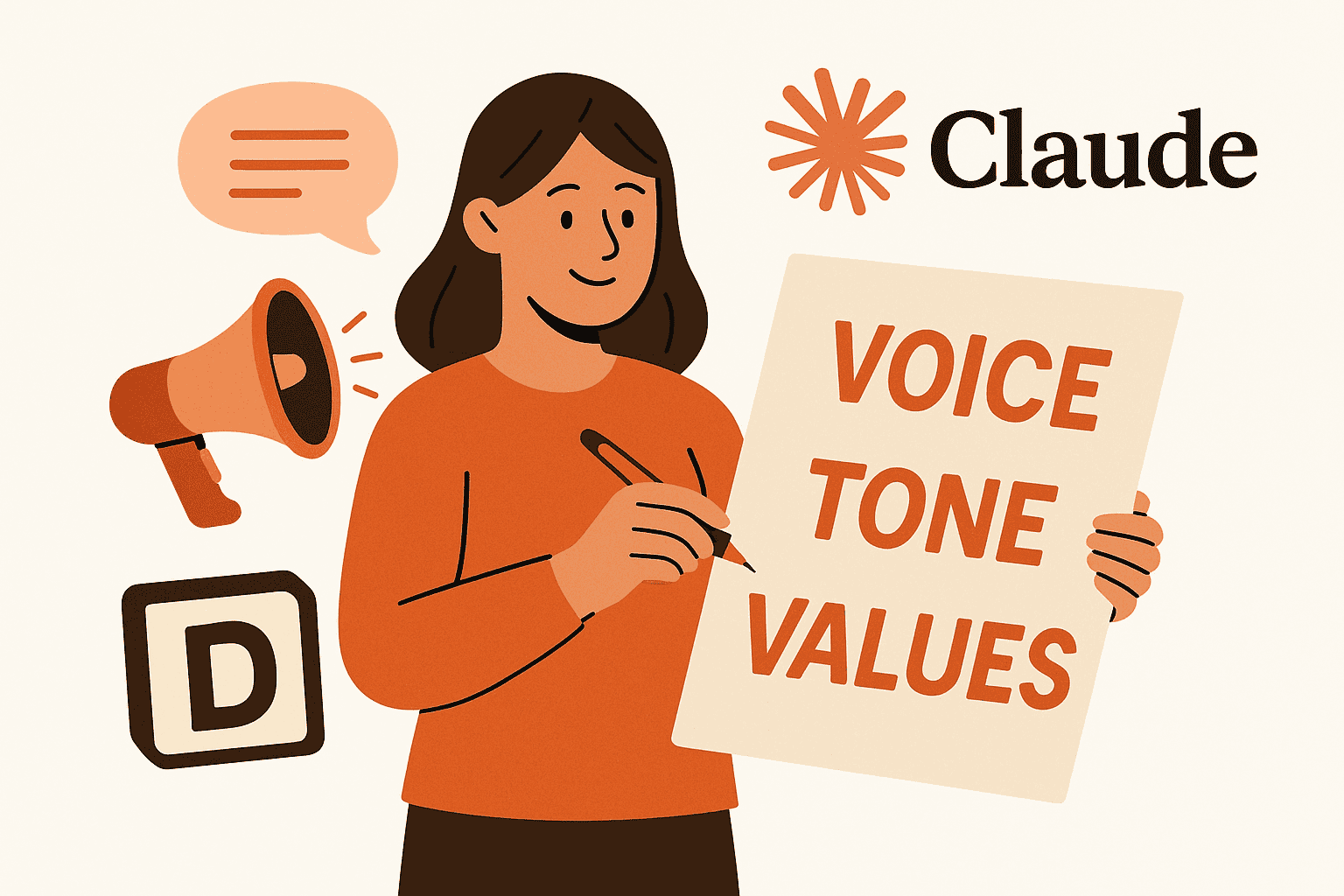

Branding is more than just a logo or tagline – it’s about crafting a consistent voice, tone, and message that resonate with your audience. Claude, Anthropic’s AI assistant, has emerged as a powerful partner for branding teams, founders, marketers, and copywriters. It can help develop a distinctive brand voice, define tone guidelines for different contexts, generate compelling value propositions, build messaging frameworks, and even create detailed brand personas.
This comprehensive guide will show you how to leverage Claude (primarily via its easy-to-use web interface) to accelerate and enhance your branding work, with prompt templates and examples you can apply right away.
The target readers for this guide are content-focused professionals – branding teams, marketing strategists, startup founders, and copywriters – who may be tech-savvy but are more concerned with messaging and brand identity than programming. We’ll start with why Claude is an ideal “branding assistant,” then dive into using the Claude Web UI for key branding tasks.
We also provide ready-to-use prompt templates (with variables like {{brand}}, {{audience}}, {{product}}, {{tone}}) for defining brand voice, crafting tone of voice guidelines, generating value propositions, and aligning messaging with personas.
Finally, we’ll touch on advanced uses of Claude’s API/CLI for organizations looking to build branding pipelines or automate large-scale content generation. By the end, you’ll understand how to turn Claude into your branding co-pilot – speeding up the creation of voice/tone documents, value props, and persona-driven messaging while maintaining creativity and consistency.
Why Use Claude for Brand Development?
Recent advances in AI have transformed the branding process. Platforms like Claude can handle complex strategic and creative tasks that once took agencies weeks – reducing development time by up to 60–80% while improving consistency.
Rather than replacing human creativity, Claude amplifies it by taking over time-consuming groundwork (like drafting documentation, initial messaging explorations, and competitive analysis). This frees up brand strategists to focus on high-level creative direction and fine-tuning the outputs.
Claude is particularly well-suited for branding tasks due to its nuanced understanding of context and ability to process detailed instructions. In fact, brand strategists leverage Claude for tasks such as:
- Comprehensive brand positioning – analyzing audiences and competitors to find a distinct market position.
- Audience persona development – generating rich customer personas with psychological insights and needs.
- Brand voice guidelines – formulating detailed voice and tone documents with examples for consistency.
- Messaging frameworks & value propositions – crafting value prop statements and key messaging pillars that differentiate the brand.
- Brand architecture & storytelling – (for advanced cases) planning brand hierarchies or developing brand narrative frameworks.
One reason Claude shines in these areas is its capacity for “extended reasoning.” Claude can produce long, structured outputs (even up to thousands of words) while maintaining coherence. This means it can draft an entire brand guidelines document or a multi-section messaging framework in one go. It also has a large context window, so you can feed it substantial background info (e.g. existing brand materials or research) and it will incorporate those details into the output.
Perhaps most importantly, Claude has been noted to deliver more nuanced and strategic branding outputs than some other AI tools. As a recent analysis explains, “Claude typically produces more nuanced brand positioning strategies and voice guidelines with sophisticated audience understanding and competitive differentiation”.
In practice, marketing teams find that well-engineered prompts with Claude result in detailed, on-point brand materials that feel almost like agency-quality work. It’s also capable of maintaining consistent brand voice across different pieces of content, a crucial factor for branding.
AI as Branding Partner, Not Replacement: It’s worth noting that while Claude can generate excellent first drafts of brand guidelines or value props, these outputs work best as starting frameworks. Successful brand teams often use a hybrid approach – use AI to overcome the “blank page” and produce a comprehensive draft, then refine it with human insight and specific market knowledge.
The result is a significantly accelerated workflow without sacrificing authenticity. In short, Claude can be your tireless branding assistant, handling the heavy lifting of research and drafting, while you retain creative control and make final adjustments.
Getting Started: Claude Web Interface for Branding Tasks
The easiest way to use Claude for branding work is through the Claude Web UI (the chat interface at claude.ai). This requires no coding or technical setup – you can simply start a new conversation and interact with Claude like you would with a colleague. For branding teams, the Web UI offers a friendly, collaborative environment to brainstorm and refine messaging.
Here are some tips to set yourself up for success in Claude’s chat interface:
- Prepare Your Brand Inputs: Before prompting Claude, gather key information about your brand. This includes your target audience, brand values, mission or USP, product features, and any tone preferences or examples of existing content. The more specific context you provide, the better Claude can tailor its output. In fact, prompts that include clear details about brand personality traits, audience preferences, and even competitor positioning yield much stronger results than generic requests. For example, instead of asking “Give me brand voice guidelines for a coffee shop,” you’d get a better result with something like: “We are a family-owned coffee shop targeting young professionals; we value sustainability and friendliness, and we stand out by sourcing rare organic beans. Develop our brand voice guidelines…”
- Use a Structured Prompt: When giving Claude branding tasks, it helps to structure your prompt clearly. You can even format it with bullet points or sections (Claude doesn’t mind!). Start by instructing Claude what you want (e.g. “Develop a tone of voice guide”), then provide the background info (audience, values, etc.), and finally specify the deliverable details (what sections or format to include). This approach is demonstrated in our prompt templates below.
- Leverage Claude’s Iterative Nature: The Web UI allows back-and-forth dialogue. You can ask Claude for an outline first, or request it to expand on a certain section, or adjust the style (“make it more playful,” “simplify the language,” etc.). Don’t hesitate to refine the output by conversing with Claude. For instance, after getting a draft of voice guidelines, you might say “Great, now add a ‘We are not…’ column to the table for clarity” and Claude will comply.
- Extended Mode for Depth: Claude has modes that allow deeper reasoning when needed. If you’re on a paid plan, you might utilize an “Extended” or “Think deeper” mode for complex tasks like developing comprehensive personas or multi-channel messaging frameworks. In standard mode it can already do a lot, but extended reasoning can produce more detailed analysis when required (at the cost of a bit more time).
- Save and Version Your Outputs: As you fine-tune prompts, keep copies of successful ones. Claude’s answers might vary slightly with re-prompts, so once you get an output you like (say a well-written brand story or value prop), save that text as part of your brand documentation. You can also iterate by feeding that output back in for further improvements.
In summary, the Claude Web interface is an accessible starting point for most branding work – it’s interactive, forgiving, and powerful. Next, we’ll explore specific branding tasks and how to prompt Claude for each, complete with templates you can adapt.
Claude can greatly accelerate the process of defining a clear brand voice. By providing Claude some background about your brand and audience, you can ask it to produce a Brand Voice Guidelines document or a summary of your brand’s voice.
This typically includes: key voice characteristics, do’s and don’ts (things your brand would say vs would never say), and example phrases that capture the voice. Claude’s strength in understanding nuance allows it to incorporate subtle cues (like “we want to sound friendly but not goofy” or “authoritative but not condescending”) into the guidelines.
Prompt Template – Brand Voice Definition: Use the following template to have Claude generate a comprehensive brand voice profile. Replace the placeholders in {{braces}} with your details:
**Prompt:**
We need to establish a **Brand Voice** for **{{brand_name}}**, a {{industry}} company. Here’s our context:

- **Target Audience:** {{description of your audience (e.g. demographics, interests, needs)}}
- **Audience Problem/Need:** {{what problem do you solve for them?}}
- **Core Values:** {{3-5 core values your brand stands for}}
- **Brand Personality Traits:** {{if your brand were a person, 3-5 adjectives (e.g. witty, trustworthy, bold)}}

Now, *develop a detailed Brand Voice guide* for **{{brand_name}}**. Include:
1. **Voice Characteristics:** 3-5 key traits that define our voice (with a brief explanation each).
2. **Tone Variations:** How the tone might change in different scenarios (e.g. social media vs. formal press release) while still reflecting our voice.
3. **Vocabulary Guidelines:** Preferred words or phrases we use a lot, and any words/phrases to **avoid**.
4. **Writing Guidelines:** The style of sentences and grammar we use (e.g. short sentences? Active voice? Use of humor or not?).
5. **"We Are / We Are Not":** A table of DOs and DON’Ts – what our brand voice should sound like **vs** what it should never sound like. (For example, “We are friendly but **not** childish.”)
6. **Examples:** Provide 3-5 sample snippets of content (like a tweet, a support email line, an about-us intro) showing the brand voice in action, compared to a generic version.

**Output:** Please format the response as a structured brand voice guideline document with clear headings, bullet points, and the requested table.
This prompt guides Claude to produce a very detailed voice profile. Let’s break down why it’s effective. We start by giving Claude specific inputs about the brand and audience – this is crucial. As experts note, the best AI prompts for brand voice combine clear personality attributes with specific usage contexts.
By listing target audience details, brand values, and personality traits, we anchor Claude’s response in our unique situation (ensuring it doesn’t return generic advice).
We then explicitly list the sections we want, which helps Claude organize the output. Notice we requested a “We Are/We Are Not” table – this is a powerful way to define the boundaries of your voice. For instance, Claude might output something like:
We Are: Informal and friendly – we use first names and light humor to put customers at ease.
We Are Not: Slapstick or childish – humor is fine, but we never undermine our credibility.
Including example content (“before and after” voice examples) further ensures the guidelines are practical. Claude can generate these examples to illustrate how a generic piece of text can be transformed using the brand voice. For instance, if a generic sentence is “Thank you for your purchase,” Claude might revise it to “Thanks for choosing us – we appreciate you!” to reflect a friendly, casual voice, and explain why that fits the voice.
Real-World Example – Personal Brand Voice: To illustrate, imagine a personal brand for a leadership coach. Let’s call her Dr. Jane Doe, an expert in technology and business coaching. She wants a voice that is authoritative (to show expertise and credibility) yet warm and motivational (to inspire and connect with her audience). By feeding Claude details like “target audience: mid-career tech managers; core values: empowerment, integrity, innovation; personality: mentor-like, empathetic, confident,” Claude can generate voice guidelines for Jane.
The output might specify that Jane’s brand voice uses empathetic language (“I understand the challenges you face…”) combined with expert tone (“Research shows that…”), avoids overly academic jargon (to keep it relatable), and maintains an optimistic tone even when addressing problems. It would likely include a Do/Don’t list such as: “We are encouraging and positive – celebrating small wins.
We are not overly critical or negative.” After reviewing this, Jane could ask Claude to adjust any aspect (e.g., “make it slightly more playful, less stiff”) and quickly arrive at a voice profile that feels just right.
Claude’s ability to iterate and refine text is akin to having a branding copywriter on call. Once your brand voice is defined, you can use it as a foundation for all content – and you can even provide it to Claude in future prompts to ensure its outputs stay in character.
For example, you might prepend future requests with: “Using the established brand voice guidelines [and paste a summary], write XYZ…” This helps maintain that consistent persona across everything Claude generates for you.
Crafting Tone & Style Guidelines with Claude
While “voice” describes your brand’s overall personality, tone refers to the subtle shifts in style and attitude depending on context. Your brand voice remains stable, but the tone can become more formal, casual, enthusiastic, or reserved based on where the communication appears and who it’s addressing. Claude can help you develop detailed tone guidelines to ensure your team knows how to adapt the voice in different scenarios without losing consistency.
When working on tone, it’s useful to think in terms of scenarios or channels. For example, how should your tone differ between a social media post and a legal policy document? Or between an email to a customer vs. a press release? Claude can generate a guide that maps out these differences clearly.
Prompt Template – Tone Guidelines by Scenario: Here’s a template to prompt Claude for tone-of-voice guidelines across various situations:
**Prompt:**
Using our established **brand voice** (voice traits: {{summarize key traits, e.g. friendly, professional, witty, etc.}}), create **Tone Guidelines** for different communication scenarios. We want to maintain our core voice but adjust the tone appropriately for each context. Specifically cover these scenarios:

- **Website/Homepage Copy:** (This is our “default” tone) – describe how we sound on our website to all visitors.
- **Social Media Posts:** – how our tone might be more {{e.g. playful or casual}} on platforms like Twitter/Instagram while still staying on-brand.
- **Customer Support Emails:** – the tone for one-on-one customer interactions (e.g. empathetic, helpful, apologetic when needed, etc.).
- **Investor/Press Communications:** – the tone for press releases or investor updates (e.g. more formal, confident, avoiding slang).
- **Internal Communications:** – optional, if relevant, how the tone might be when talking to employees (e.g. warm and open but still professional).

For each scenario, provide: the desired tone traits (e.g. level of formality, emotion, humor), a brief example or guideline sentence, and any **consistency rules** to keep it aligned with our overall brand voice. Also mention what **to avoid** in each context (tone missteps that would feel off-brand).

**Output:** A section for each scenario with the tone description and do’s/don’ts or examples.
This prompt ensures Claude considers multiple contexts side by side. The output will likely be a well-structured tone guide – essentially an extension of your brand voice guidelines. For instance, Claude might say for Social Media: “Tone is playful, trendy, and upbeat, using emojis or informal language occasionally to engage followers.
Example: ‘We just dropped our latest update – have you tried it yet?’ Avoid overly technical jargon or formality on social media; keep it conversational.” Then for Investor Communications it might contrast: “Tone is professional and factual. Use confident language and back up statements with data.
Example: ‘In Q4, our user base grew 30%, reflecting strong market adoption.’ Avoid slang, jokes, or overly casual language in these reports.” By laying these out, you get a tone “spectrum” that ranges from casual to formal, all unified by the same voice.
One technique Claude handles well is the tone slider or spectrum. You can ask Claude to describe your tone on a scale (e.g., from 1 = very casual to 5 = very formal) for each scenario, or compare how the tone should dial up or down certain qualities.
The key is that all tones should still feel like they come from the same brand. Claude’s output will remind you of those consistency rules (for example, even in formal communications you might “remain friendly and approachable, just without the humor,” whereas in casual posts you “can be witty but never offensive,” etc.).
A great use of Claude here is also to generate tone by emotion or situation. You could ask, “If responding to a customer complaint vs. a customer compliment, how should our tone differ?” and incorporate that into guidelines. Claude might advise an apologetic yet solution-focused tone for complaints, versus a celebratory, grateful tone for compliments – all while staying true to the brand’s personality.
Real-World Example – E-commerce Tone: Consider an e-commerce brand “GreenThreads” that sells sustainable fashion. Their brand voice is described as “upbeat, eco-conscious, and inclusive.” They use Claude to develop tone guidelines. Claude might output that on product pages and the website, GreenThreads’ tone should be informative and enthusiastic (to convey product details with excitement about sustainability).
On social media, the tone can be more playful and community-driven – using first-person plural (“we”) to invite customers into the movement, maybe asking questions or using exclamation points. In customer service chats, however, the tone shifts to empathetic and reassuring, especially if someone has an issue with an order – maintaining positivity but focusing on solving the problem. By following Claude’s tone guide, GreenThreads ensures that every tweet, product description, and email feels consistent and on-brand, even though the tone adapts to each channel’s needs.
Establishing these tone variations with Claude’s help means your team (or even future AI-generated content) can always check against a reference: Is this how we sound on Twitter? Does this support email strike the right tone? Over time, this consistency builds a strong, recognizable brand presence.
And whenever in doubt, you can literally paste a piece of content into Claude and ask, “Does this adhere to our tone guidelines? If not, what’s off?” – a nifty way to do a tone audit using AI.
Generating Compelling Value Propositions with Claude
A value proposition is a concise statement that highlights the unique value a product or company delivers to customers – essentially, why a customer should choose you over others. Crafting a good value prop is critical for messaging frameworks, website headlines, sales decks, and more. Claude can assist by turning raw information (features, benefits, differentiators) into polished, customer-centric value propositions.
When using Claude for value propositions, the goal can range from creating one strong overarching value statement (for a company or product) to generating multiple tailored value props (for different audience segments or product features). Here’s how Claude can help:
- Turning Features into Benefits: Often, we have a list of product features, and we need to translate these into clear benefits that matter to customers. Claude can do this transformation adeptly. By feeding it a list of features and details about your audience, you can prompt Claude to output benefit statements that answer “what’s in it for the customer.”
- Highlighting the USP (Unique Selling Proposition): Claude can help identify what sets your brand or product apart. If you provide information on competitors or your special approach, Claude can articulate a unique selling point within the value prop – ensuring it’s not just generic marketing speak.
- Differentiation Messages: Beyond the main value prop, you might want a few supporting messages that differentiate you on specific aspects (price, quality, service, innovation, etc.). Claude can generate these as bullet points or sub-messages under a broader value proposition framework.
Prompt Template – Value Proposition Generation: Below is a template to guide Claude in generating a strong value proposition. Adjust the inputs to fit your brand:
**Prompt:**
I need help crafting a **Value Proposition** for **{{product_or_service}}** by **{{brand_name}}**. Please consider the following details:

- **Target Audience:** {{who is the customer? e.g. small business owners, busy parents, enterprise IT managers, etc.}}
- **Customer’s Main Needs/Pain Points:** {{what problems or pain points does our product address? list a few}}
- **Key Features:** {{list 3-5 key features of the product/service}}
- **Our Differentiators:** {{what makes us unique? e.g. fastest solution, patented technology, 24/7 support, eco-friendly materials}}
- **Competitors/Alternatives:** {{optional: who are the main competitors or current solutions?}}

Now, generate a **clear value proposition message** for **{{product}}** that would convince our target audience. It should:
1. **Headline Value Proposition:** A one-sentence statement that captures the biggest benefit or outcome the customer gets. (E.g. “The only [industry] tool that [does X] so you can [achieve Y].”)
2. **Supporting Bullets:** 3-4 bullet points elaborating on this value – covering the most important benefits **in customer-centric language**. Tie features to benefits (e.g. “Feature A → saves time by doing...”).
3. **USP Angle:** Make sure it’s clear why this solution is unique or better than the alternatives. Emphasize our differentiators in at least one of the bullets or within the headline.
4. **Tone:** {{tone style, e.g. bold and confident, or friendly and helpful, etc., aligning with our brand voice}}.

**Output:** Provide the value proposition headline and the bullet list of supporting benefit statements.
With this prompt, you’re guiding Claude to not only come up with a statement but to structure it properly (headline + bullets). The content we provided (audience, pain points, features, differentiators) gives Claude the raw ingredients to work with. Claude excels at analyzing such inputs and formulating them into persuasive messaging.
In many cases, Claude will produce a compelling one-liner that combines an emotional or aspirational benefit with a clear nod to your unique strength. For example, “AcmeAnalytics – Turn your data chaos into business clarity in minutes.
Our platform automates analysis with AI (so you don’t have to), saving you 10+ hours a week and uncovering insights your team would miss.” Then it will follow with bullets like: “- Work smarter, not harder: Automated reports highlight trends and anomalies instantly, eliminating manual number-crunching.
- Stay ahead of the competition: Our predictive algorithms (unique to AcmeAnalytics) forecast opportunities and risks before they appear…”, and so on.
Notice how the example we imagined speaks to a SaaS B2B audience (time savings, competitive edge). The prompt’s placeholders let you adapt to any scenario. If this were an e-commerce product aimed at consumers, the tone might be more casual and the benefits more emotional (e.g. “look great, feel confident, without breaking the bank” for a fashion item). Claude can easily pivot if you specify those tonal cues or audience differences.
It’s also beneficial to have Claude generate multiple versions or options. You could say, “Give me three alternative value proposition statements with slightly different angles,” and it will do so. From those options, you might mix and match the best phrasing. Claude can even mimic famous frameworks (like XYZ statement: “We help X do Y by doing Z”) if you prompt it to use a certain formula.
Interestingly, Claude can produce multi-level value propositions – meaning it can articulate the value at the company level, product level, and feature level, ensuring a cohesive message across all. One prompt from a branding library asks Claude to “develop distinct but connected value propositions at three levels: company-level, product-level, and feature-level, including emotional and functional benefits and proof points”. This advanced usage is great for fleshing out a full messaging hierarchy. However, even just doing the single product/service value prop as in our template is a big win for most branding needs.
Real-World Example – SaaS Value Prop: Let’s say we have a fictional SaaS startup called DataMagic that offers a data analytics platform for non-technical users. The features include drag-and-drop dashboards, AI insights, and collaboration tools.
DataMagic’s differentiator is that it’s extremely easy to use compared to big enterprise BI tools. By feeding Claude info like “Target: small business owners; Pain point: overwhelmed by complex data, no time to analyze; Key feature: one-click AI report; Differentiator: no tech skills needed – anyone can get insights instantly,” Claude could generate a value proposition such as:
Headline: “DataMagic – Insights at your fingertips, without the analyst.”
Bullets:
- No experts required: Turn your raw data into visual reports in seconds, powered by our AI (so simple anyone on your team can do it).
- Save hours every week: Automated insights identify trends and anomalies for you, freeing you to focus on decisions, not data crunching.
- Collaboration built-in: Easily share interactive dashboards with your team or clients – no downloads or technical setup needed.
- Unique simplicity: Unlike traditional BI tools, DataMagic’s intuitive design means zero learning curve and instant value from day one.
This output hits the pain points (no analysts, save time), emphasizes the USP (unique simplicity), and presents it in a confident yet accessible tone. As a branding team, you can take such an AI-generated draft and refine wording or add specific proof (e.g. “save 5 hours a week” if you have that data). But notice how much of the heavy lifting Claude did – turning a list of facts into a narrative of value.
Claude can similarly help create value propositions for different buyer personas or market segments if you ask for it. For instance, DataMagic might have one messaging angle for small business owners (time-saving, ease of use) and another for IT managers (security, integration). You could prompt Claude with persona specifics to tailor the value prop for each. This brings us to aligning messaging with personas.
Aligning Messaging with Brand Personas using Claude
A brand persona (often called buyer persona or audience persona) is a semi-fictional profile of your ideal customer segment – including their demographics, needs, goals, and behaviors. Effective branding speaks directly to these personas. Claude can assist both in creating rich persona profiles and in aligning your messaging to each persona’s needs, ensuring your brand communications hit the right notes for different segments of your audience.
Creating Audience Personas
If you haven’t already defined your personas, Claude can generate them from scratch based on your target market descriptions. It’s capable of producing detailed, lifelike persona write-ups when given some background. A good Claude prompt for persona creation should include the industry, the types of customers you serve, and any distinctions you want (e.g. a persona for each major segment or use case).
For example: “Develop 3 detailed audience personas for our brand: one for a tech-savvy millennial consumer, one for a busy working mom, and one for a retired hobbyist, all of whom might buy our smart home product.
For each persona, include details like age, occupation, goals, pain points related to home technology, what they value, and how they make purchase decisions.” Claude will likely generate three personas with names (e.g. “Techie Tina, 29, a software engineer who wants the latest gadgets to streamline her life but struggles with products that aren’t user-friendly…” and so on). It will list their motivations, frustrations, and what messaging might appeal to them.
Claude’s outputs for personas tend to be quite comprehensive. In fact, you can instruct it to follow a structure: demographic info, psychographics (values, lifestyle), challenges/pain points, what they seek in a solution, etc.
A thorough persona prompt might yield something like: “Persona A: The Pragmatic Innovator – 35-year-old product manager; Values efficiency and staying ahead of trends; Pain points: too much data, not enough insight; Needs solutions that are quick and proven…”, touching on many facets. Such depth ensures that when you craft messaging, you truly understand each persona’s perspective.
Prompt Template – Persona Profiles: Here’s a concise template to get persona profiles:
**Prompt:**
Create **{{number of personas}} audience personas** for **{{brand or product}}** in the **{{industry}}** space. The personas should represent key customer segments we target. For each persona, include:
- **Name & Basic Demographics:** (e.g. “Marketing Mary, 34-year-old marketing manager at a mid-sized tech company”)
- **Goals & Aspirations:** what are they trying to achieve relevant to our product?
- **Pain Points/Challenges:** especially those our brand/product can help with.
- **Values & Motivations:** what do they care about, what influences their decisions?
- **Preferred Channels:** how do they typically engage with brands or seek info (social media, email, in-store, etc.)?
- **Key Messaging Angle:** Given their profile, what type of message would resonate most with them from our brand?

Make each persona distinct and realistic, not generic. Aim for about a paragraph or two per persona.
After running this, you’ll get a set of personas that you can refine. Always sanity-check AI-generated personas against your real customer knowledge and research – but it’s a fantastic way to jumpstart the process or fill in details you might not have articulated before. Claude might surface insights like emotional needs or decision factors that you can then validate.
Aligning Messaging to Personas
Once you have personas (whether generated by Claude or defined by your team), you should align your value propositions and messaging framework to each persona. Claude can help by taking a persona and crafting tailored messaging or even whole campaign ideas for that persona.
For example, you can pick one persona and ask Claude: “Using the persona below, write a brief messaging framework that would appeal to them. Focus on how our product solves their specific problems and fits their values. Include an elevator pitch, 3 key benefit messages, and a tagline suggestion that would speak to this persona.” Then repeat for other personas. This way, you ensure your brand can speak in a targeted way to different slices of your audience.
Prompt Template – Persona-Based Messaging: You might combine both steps (persona creation and messaging) or do them separately. Here’s a template focusing on aligning to an existing persona:
**Prompt:**
Below is an audience persona for our brand. Use it to create a **messaging framework** targeted specifically at that persona:

**Persona:** {{Insert a persona profile here – or a summary: e.g. "Marketing Mary: 34, marketing manager, wants easy-to-use analytics, frustrated by complex tools, values efficiency and reliability."}}

Now, develop messaging tailored for **this persona**, including:
- **Key Pain Points:** (list or restate the 2-3 biggest pain points from her perspective that our product can address).
- **Core Messaging:** Write an **elevator pitch** (2-3 sentences) that directly speaks to Mary’s needs and how our solution helps.
- **Benefit Messages:** 3 bullet points highlighting specific benefits or outcomes Mary cares about (e.g. saving time, looking good to her boss, peace of mind, etc.), each linked to something our product provides.
- **Tone:** Describe the tone to use when communicating with Mary (e.g. reassuring and expert, or upbeat and casual, etc. based on her personality).
- **Tagline/Slogan (optional):** Propose a short tagline that might grab Mary’s attention, in line with the above messaging (optional but nice to have).

**Output:** Clearly structured as requested, making sure the language used would resonate with Mary.
This prompt effectively asks Claude to play matchmaker between the persona’s concerns and the brand’s value. The result is a mini messaging guide for that persona. If you do this for each of your major personas, you’ll have a tailored set of talking points and angles for each segment. This is extremely useful for targeted campaigns or segmented content (for instance, landing pages addressing different industries or ads targeting different demographics).
Claude’s strength in understanding context means it will likely phrase things in the persona’s “language.” For instance, if a persona is a busy mom, the messages might use phrases like “chaos of your day-to-day” or “finally have a moment to breathe” to show empathy. If the persona is a data-driven CFO, the messaging might include words like “ROI” or “mitigate risk” to align with their mindset. These nuances help your brand messaging connect rather than feeling one-size-fits-all.
Real-World Example – Multiple Personas: Let’s revisit our fictional SaaS DataMagic. Suppose they have two key personas: “Startup Steve” (a founder at a small startup, concerned with speed and growth) and “Corporate Cathy” (a manager at a large enterprise, concerned with security and integration). Claude can generate detailed profiles for Steve and Cathy. Then, for Steve, Claude might craft messaging that emphasizes agility, quick setup, and how DataMagic gives him enterprise-level analytics without a big team (tone: excited, visionary).
For Cathy, Claude’s messaging might focus on reliable results, compliance, fitting into existing enterprise systems, and making her department look good (tone: professional, assuring). The core product is the same, but the angle and language differ. Claude can even help identify positioning frameworks for each – essentially how to position the same product differently to each persona by highlighting different aspects. This ensures your brand communication is relevant to whoever is on the receiving end.
By aligning brand voice, tone, and value propositions with well-defined personas, you’re effectively building a messaging framework that is both unified and targeted. Claude has essentially helped create a blueprint: you have your universal brand voice/tone guidelines and your specific persona-based messages. Branding teams often spend weeks researching and writing these frameworks – but with Claude’s assistance, you can get a strong draft in a fraction of the time, then refine it with your team’s insights.
Advanced Usage: Claude API & CLI for Branding Pipelines
Most of this guide has focused on using Claude through its web interface, which is ideal for interactive development of branding materials. However, larger organizations or agencies might want to integrate Claude into their content pipelines or use it for automated batch tasks. This is where the Claude API and CLI (Command-Line Interface) come into play.
Claude’s API allows you to access the AI model programmatically. This means you can build custom tools or scripts that use Claude’s capabilities – effectively creating your own “branding AI assistant” integrated with your systems. For example:
- Batch Content Generation: Using the API, you could input a spreadsheet of product features and have Claude generate value proposition statements for each product automatically. Or produce dozens of social media captions for different products, all in the defined brand voice, in one go.
- Automated Tone Checking: You might integrate Claude into your CMS or editing workflow. Each time a piece of content is created, Claude’s API could be invoked to review the text and compare it to your brand voice/tone guidelines. It could then flag any off-brand language or suggest edits. (E.g., “This paragraph sounds too formal for our playful brand voice; consider rephrasing…”)
- Personalization at Scale: If you have multiple audience segments, an API script could generate personalized email copy variants for each segment using the persona-tailored messaging Claude helped create. This way, you maintain consistency in voice but nuance in message across thousands of communications.
Setting this up requires some developer effort, but it can unlock serious efficiency for large content operations or agencies managing many brands. Anthropic provides an API documentation for Claude; essentially you’d send the same prompts via an API call and get the response in your application.
One tip from experts: use the Claude web interface to prototype your prompts, then implement the successful ones via the API in your marketing automation tools. This ensures you fine-tune the prompt wording in the chat UI (which is faster to iterate), before baking it into code.
There’s also an official Claude CLI tool, primarily geared towards developers. The Claude CLI lets you interact with Claude through the terminal (originally designed for coding tasks, but it can handle any text prompts).
The CLI is useful for scripting and automation because it can be integrated into shell scripts or CI/CD pipelines. For instance, a branding agency’s tech team could set up a CLI script that every week generates a content calendar draft (prompts Claude with upcoming dates, themes, etc.), or a script that periodically summarizes brand mentions online in the brand’s tone. The CLI basically offers the same power as the web interface, but in a scriptable form, enabling automation.
Key advantages of using the CLI/API for branding work include:
- Automation: You can schedule or trigger prompts automatically (e.g., generate a weekly social media content plan every Monday morning).
- Consistency at Scale: By codifying your prompts (and even including your brand guidelines as a constant input), you ensure that every output is generated with the same parameters, which can tighten consistency.
- Integration: Claude can be integrated with other tools – for example, pulling data from your databases or content management system, processing with Claude, then saving results, all in one workflow.
- Speed: For large batches, the API can handle volume faster than doing it manually in the UI, since you can run requests in parallel up to certain limits.
A hypothetical example of a branding pipeline using Claude API: Suppose a large retailer has 500 new products for their e-commerce site. They need product descriptions that include the brand’s playful tone and highlight each product’s unique value props.
Instead of writing each manually, they could have a script that takes each product’s specs and key points, calls Claude’s API with a prompt to generate a fun, on-brand description, and returns those ready to review. Within minutes, they have first drafts for all 500 descriptions. Human editors then quickly review and polish a subset, rather than starting from scratch every time.
Another example: An agency could build an internal “BrandGPT” tool that any copywriter can use to ensure copy aligns with a client’s brand voice. Behind the scenes, this tool might feed the copy and the client’s voice guidelines into Claude via the API and output a score or suggestions.
(In fact, maintaining brand voice consistency across teams is so important that some companies are making AI a gatekeeper – one article noted that unsanctioned AI use can risk brand voice inconsistency and suggests having an approved “Brand GPT” model to enforce standards.)
It’s worth noting that using the API or CLI will require access to Claude (Claude’s API is a paid service) and some technical setup. But for organizations already investing in automation, it can be a game-changer for branding efficiency. The Claude Code CLI is one specific interface more tuned for coding and might not be directly needed for branding content, but it shows the flexibility – Claude can be wherever you need it, from web to terminal.
For most readers of this guide, the web UI will suffice for day-to-day branding tasks. However, knowing that you can scale up with API/CLI means as your needs grow (say, you want to integrate AI-generated content into a live app, or you have huge volumes), Claude can grow with you. And remember, Claude’s model behavior is consistent across platforms, so the work you did to nail down prompts in the web interface directly translates to the API usage.
Conclusion
Claude is quickly becoming an indispensable ally for branding and marketing teams. By leveraging its AI capabilities, you can define your brand voice and tone more clearly, generate value propositions and messaging frameworks more quickly, and refine your brand personas and targeted messages more intelligently. The result is a cohesive brand identity and message strategy developed in days – not weeks – without sacrificing quality or creativity.
We’ve provided prompt templates that you can plug in and modify for your own needs. Feel free to copy them into Claude’s interface and experiment. As you do, keep these best practices in mind: always provide specific context about your brand and audience (Claude will reward you with specific, tailored output!), iterate by refining prompts or asking follow-ups, and use your judgment to tweak the AI’s suggestions.
The combination of your brand expertise + Claude’s generative power can produce exceptional results that neither could achieve alone. As one creative director noted, “Using strategically crafted AI prompts, we compressed 6-8 weeks of brand work into 2-3 weeks while actually expanding the creative territories we explore”. That speaks to the potential efficiency and depth you can unlock.
Finally, ensure that any AI-generated branding content is reviewed for authenticity and accuracy. AI can draft it, but only you can ensure it truly feels “you.” Use Claude to break through blank-page syndrome and handle the heavy lifting, but let your team’s insight polish the final output.
With Claude as your branding co-pilot, you can move faster – creating rich brand guidelines, value props, and personas that are ready to power effective marketing. Embrace the collaboration between human creativity and AI efficiency, and you’ll find your brand strategy documents and messaging coming together with unprecedented ease and impact.