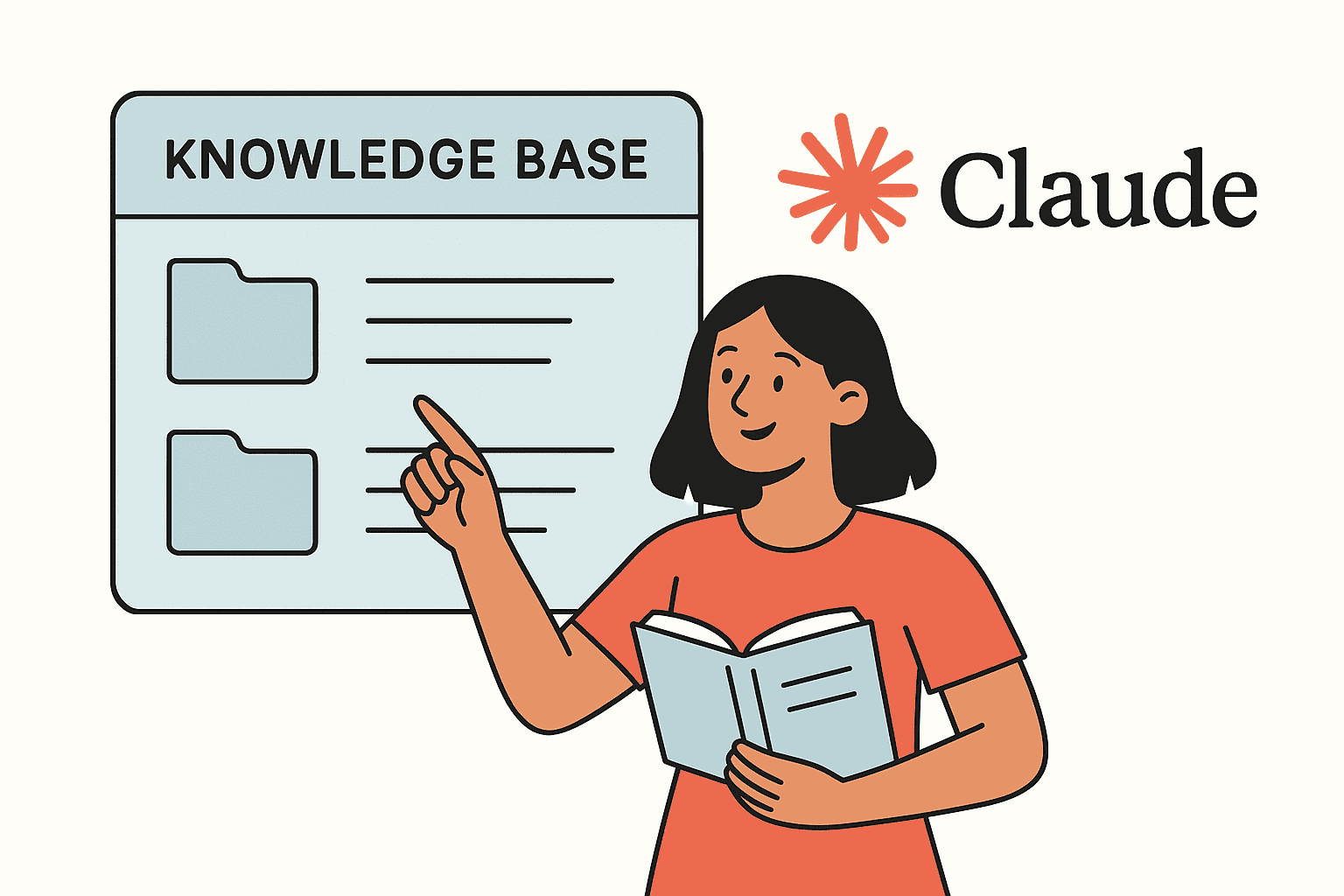

Building an internal knowledge base powered by Claude can dramatically improve how your team accesses information. This guide provides a step-by-step workflow to create a Claude-driven knowledge base – from organizing your documents, to ingesting and summarizing content, to enabling question-answering (Q&A) with retrieval-augmented generation (RAG), and finally keeping the system up-to-date.
We’ll cover how to leverage Claude’s Web UI, API, and CLI for different parts of the process, with a focus on internal documentation (runbooks, SOPs, API docs, etc.). By the end, you’ll have a blueprint for using Claude as an intelligent interface layer on top of your organization’s knowledge.
Use Cases and Knowledge Base Types
This approach is primarily geared toward internal knowledge bases used by engineering, DevOps, and support teams. For example, you might use Claude to help query:
- Internal team documentation: On-call runbooks, standard operating procedures, incident playbooks, etc.
- Product and API docs: Technical specs and API guides that developers or support engineers reference.
- Company FAQs and process docs: Internal FAQs, onboarding guides, and process documentation for employees.
Secondary use cases: The same techniques can apply to customer-facing content (like help center articles or user manuals) by building an internal Claude assistant that draws on those documents to answer support questions. The framing remains: Claude serves as an AI assistant on top of your docs, retrieving and synthesizing answers from your knowledge base for faster support and debugging workflows.
Claude’s Interfaces for Knowledge Bases
Claude can be used in multiple ways to build and interact with your knowledge base. We will use each interface for different purposes:
Claude Web UI (Conversational interface)
The Claude web interface is a great starting point for manual workflows and prototyping. It allows you to upload or paste documents and have natural language conversations with Claude about them. In the Web UI, you can create separate chat sessions for different knowledge domains (e.g. one session for “DevOps Runbooks”, another for “API Documentation”) and keep relevant files or context in each. Key capabilities of the web UI include:
- Document uploads: You can attach PDFs, Markdown files, or text (up to 30 MB or ~20 files per chat) for Claude to analyze. Claude on paid plans supports a large 200k-token context window (roughly 500 pages of text) in each session. This means you can load a significant amount of reference material directly into the chat without running into context limits.
- Interactive prompting: You can iterate by asking Claude to restructure content, summarize sections, or answer questions using the uploaded knowledge. The Web UI is ideal for tasks like designing your KB structure or testing how Claude responds with certain document context before automating it.
- Structured prompts in chat: By crafting a clear initial prompt (or using Claude’s system message), you can make the chatbot behave like a KB assistant. For example, you might instruct: “You are an internal documentation assistant. Answer questions only using the provided documents, and say ‘I don’t know’ if the info isn’t in our knowledge base.” This primes Claude to focus strictly on your content even in the informal chat setting.
Claude API (Automation and integration)
Claude’s API is the primary tool for automation and integrating the knowledge base into your internal tools. With the API, you can build a custom service or bot (for example, an internal /kb/ask endpoint) that answers queries using Claude behind the scenes. Use cases for the API include:
Batch processing content: Automate the ingestion of documents by writing scripts that send content to Claude for summarization or Q&A. You can call Claude programmatically to process hundreds of files (we’ll see how in Step 2). Anthropic’s API supports up to 200k tokens of context in models like Claude 2/Claude 4, which is great for large docs, and also offers a batch processing API for asynchronously handling many requests with 50% cost savings.
Retrieval-augmented Q&A: The API allows you to implement a RAG pipeline – retrieving relevant doc snippets from a database and inserting them into Claude’s prompt for each question. This is essential when your total content exceeds the context window. We’ll cover an example of using a vector database + Claude API to answer questions in Step 3.
Embedding Claude in workflows: You can integrate Claude’s outputs into Slack bots, internal dashboards, or ticketing systems. For instance, a support chatbot could use Claude API to draft an answer and cite the KB article where the answer came from. The API gives the flexibility to format Claude’s responses (e.g. always in Markdown or JSON) and to enforce rules via system prompts.
Claude CLI (Command-line tool for scripting)
If you have access to Claude’s CLI (a command-line interface tool provided for Claude Pro/Enterprise users), it can be a handy way to run local tasks and automation scripts. Think of it as a way to use Claude from your terminal or in CI pipelines:
Local batch processing: Using the CLI, you can process files (Markdown, PDF, HTML, log files, etc.) in bulk. For example, you might write a shell or Python script that loops over all .md files in a folder and calls Claude (via CLI or API) to summarize each one. This is useful for initial ingestion – e.g., generating cleaned Markdown versions or extracting key points from each doc.
Generating structured outputs: The CLI (backed by Claude’s API) can be prompted to output results in specific formats. You could ask Claude via CLI to output a JSON for each document containing the title, summary, and tags, then capture that output to build your knowledge base index.
Automation via scripts: By integrating Claude CLI into scripts, you can automate nightly updates. For instance, a cronjob could find new or updated docs in your repository and use Claude CLI calls to re-summarize them or highlight changes (we’ll discuss update workflows in Step 4).
Note: The Claude CLI isn’t mandatory – you can achieve the same with direct API calls – but it can simplify development and quick tests. Ensure you have Claude API credentials set up, and you can run CLI commands to interact with Claude models right from your terminal. This can be faster than coding an entire API client for one-off tasks.
With these interfaces in mind, let’s dive into the step-by-step process of building your knowledge base.
Step 1: Content Structuring and Preparation
The first step is structuring your content – designing how your knowledge base will be organized and converting your source documents into a clean, consistent format. A well-structured knowledge base makes it easier for Claude to navigate and for your team to maintain.
1.1 Design the information architecture: Start by defining the content model of your KB – the topics, categories, and metadata that will organize your documents. Identify the major areas of knowledge (e.g. “On-call Procedures”, “API Reference”, “Troubleshooting Guides”) and any tags or attributes you want to assign (like product names, team names, or document dates).
Leverage Claude for brainstorming: You can feed Claude a list of your document titles or an export of your wiki and ask it to propose a hierarchy. For example, “Here are 50 document titles from our internal docs… Can you group these into logical categories and sub-categories for a knowledge base?”. Claude may suggest an outline that you can refine. This helps ensure your KB covers all topics and has a logical grouping.
Normalize titles and taxonomy: Consistency is key. If different docs refer to the same concept in various ways, decide on standard naming. You can ask Claude to “Normalize these document titles and produce consistent slugs”. For instance, it might change “On-call Guide_v3” to “On-Call Guide” and suggest a URL-friendly slug on-call-guide. Having a consistent taxonomy (titles, slugs, tags) will later help with retrieval and user navigation.
1.2 Convert and clean documents: Chances are your source content comes in varied formats (Google Docs, Confluence pages, PDFs, etc.) and styles. The goal is to convert these into a uniform format (like Markdown or HTML) with clear structure (headings, sections, lists). Claude can greatly assist in this content cleaning:
Document format conversion: Paste or upload a document in Claude’s Web UI and prompt it to reformat the content. For example: “Convert the following document into clean Markdown with proper H2/H3 headings, bullet points, and code blocks where appropriate.” Claude’s large context window allows you to drop in lengthy docs and get well-structured Markdown back. It will preserve the content while standardizing formatting (fixing broken numbering, adding proper headings, etc.).
Structural consistency: Ensure each article has a clear title and section hierarchy. You can instruct Claude to add a top-level H1 title (the document name) if missing, or to ensure all procedures have sections like “Steps” or “Example” formatted similarly. This might involve some trial and error in the prompt, but Claude is quite adept at following formatting instructions.
Cleaning up text: Remove any irrelevant text that could confuse the model (outdated notices, private info, etc.). You might prompt Claude: “Remove any footer text or legal jargon from this document and just keep the instructional content.” This helps reduce noise. Also consider breaking very long documents into smaller files if they cover multiple distinct topics – it’s better to have focused documents for each topic than one gigantic file.
1.3 Define metadata and storage: Decide what metadata to capture for each document. Common fields include the title, slug, author, last updated date, tags (topics), and possibly a short summary. Claude can help generate some of these:
Summaries: Ask Claude to produce a short summary or abstract for each document (we will do this in the next step during ingestion). A one-paragraph summary can be stored as metadata to quickly recall what a document covers.
Tags and keywords: You can have Claude suggest tags: “List 3-5 keywords or tags that describe this document.” This can be done during ingestion as well. Consistent tags help with filtering and search.
Storage format: Plan where to store the processed knowledge base content. Options include a database, a set of Markdown/HTML files in a repo, or even an internal wiki. For prototyping, storing everything as JSON objects in a file or simple NoSQL DB is convenient. Each JSON entry might look like:
{
  "title": "On-Call Guide",
  "slug": "on-call-guide",
  "category": "Runbooks",
  "tags": ["incident response", "operations"],
  "summary": "Guide for on-call engineers handling incidents, including triage steps and escalation policies.",
  "content": "(Full markdown or HTML content of the article)",
  "last_updated": "2025-11-30"
}
Decide on this schema upfront. We will use Claude to help fill in the summary (and potentially to double-check last_updated by comparing versions in Step 4).
By the end of Step 1, you should have an outline of your knowledge base structure and a set of cleaned, consistently formatted documents (or at least a plan for converting them). Now it’s time to ingest this content with Claude’s help.
Step 2: Ingestion and Summarization of Content
Once your documents are structured and cleaned, the next step is to ingest them into your knowledge base system with the help of Claude. Ingestion here means: breaking documents into chunks, summarizing or extracting key information, and storing the results (text and metadata) in your knowledge base storage (which could also include a vector index for search).
2.1 Chunk large documents for processing: Claude can handle very large inputs, but for maintainability and retrieval it’s wise to split documents into logical chunks or sections. Common practice is to chunk text into sections of a few hundred tokens each. For example, if you have a 50-page runbook, split it by its natural section headings or every ~500 words. Each chunk should ideally represent a self-contained topic or subtopic.
- Why chunking? This is important for RAG later: we will be embedding these chunks for semantic search. Using smaller chunks (e.g. 256–1024 tokens each) improves retrieval granularity. Also, Claude’s summarization tends to be more accurate when focusing on one section at a time rather than an entire long doc.
- Use Claude for splitting if needed: If your docs don’t have clear sections, you can ask Claude to help find split points. For instance: “Here is a long procedure document. Propose a way to split it into distinct sections with titles.” It could output a list of section breakpoints or even perform the split by outputting each section separately. However, often simpler regex or rule-based splitting by headings in the source text works too.
2.2 Summarize and extract key info: For each chunk or document, use Claude to generate useful representations. This typically includes summaries, and could also include extracting FAQs or procedures which you might want to store for quick reference.
Section summaries: Prompt Claude to summarize each chunk or section. For example, using the API, you might send a prompt: “Summarize the following section in 2-3 sentences, focusing on the main point and any important steps or values.” Claude’s answer will be a concise summary of that chunk. By doing this for all sections and concatenating, you can also form a hierarchical summary of the entire doc (Claude is very good at producing outlines and section-wise summaries).
Full document summary: In addition to section summaries, get an overall page summary. For instance: “Provide a one-paragraph summary of the entire document.” This can serve as the document’s abstract or description in your knowledge base.
Extract FAQs or Q&A pairs: Claude can identify common questions answered by a document. You might ask: “List 3 possible questions someone might ask that this document answers, along with brief answers.” This essentially creates FAQ pairs from the content. Store these as they can directly fuel a Q&A system or appear in search results. Claude’s ability to interpret the document allows it to guess likely queries, which is useful for support knowledge (for example, from an API guide it might extract Q&As like “Q: How to authenticate API requests? A: Use the API key in the Authorization header as described in section 2.”).
Structured JSON output: To streamline ingestion, consider having Claude output all needed info in one go in a structured format. For example, you can prompt Claude with something like:
“Analyze the document below and output a JSON with the fields: title, slug, tags, summary, sections. Under sections, list each section title and a short summary. Also extract any key FAQs as a list of Q&A pairs if present. Here is the document: …”
Claude will then generate a JSON object string that you can parse. Using structured outputs ensures you capture everything consistently (title, summary, etc.) in your knowledge base. Always double-check the JSON is valid (Claude is usually good at it, especially if asked to output only JSON). This approach can save time versus making separate calls for summary, then tags, etc.
2.3 Store content and embeddings: After summarization, you’ll have for each document (or chunk) a set of text fields (like summary, content, etc.). Now, prepare for enabling semantic search by computing embeddings:
- Vector embeddings: For each chunk (or each document if small), generate a vector embedding that captures its meaning. Anthropic is expected to offer an embeddings API in late 2025, but in the meantime you might use a third-party embedding model (for example, OpenAI’s text-embedding-ada-002, or open-source models) to encode your chunks. The embedding is a numeric representation used for similarity search. Store these in a vector database along with an ID/reference to the original text. Common vector stores include Pinecone, Weaviate, Milvus, or even Postgres with pgvector. For instance, the pgvector extension allows you to store vectors and do similarity queries in SQL (as demonstrated by TigerData for Claude RAG on AWS).
- Chunk metadata: Alongside each vector, store metadata like the document title, section heading, or tags. This allows filtering search results by category or recency if needed. For example, you might tag embeddings with
{"doc": "On-Call Guide", "section": "Escalation Policy", "category": "Runbooks"}. - Persistence of raw content: Keep the original text of the chunk somewhere (either in a database or accessible by an ID), because at query time you’ll need to retrieve the actual text to feed into Claude’s prompt. Some vector DBs let you store a snippet of text with the vector. Alternatively, store a reference (like a filename or document ID and section index) so you can fetch it from your knowledge base storage.
2.4 Example – using Python for ingestion: Here’s a high-level pseudo-code of how an ingestion script might look using Claude’s API and a vector library:
from anthropic import Client  # (Assume Anthropics SDK is installed)
client = Client(api_key="YOUR_API_KEY")

for doc in documents:
    text = doc["content"]  # the cleaned full text
    # Split text into chunks by heading or size
    chunks = split_into_chunks(text, max_tokens=300)
    all_sections = []
    for chunk in chunks:
        prompt = f"""{doc['title']}\n\n{chunk}\n\nProvide a JSON with 'summary' of this chunk."""
        response = client.completion(prompt=prompt, model="claude-2", max_tokens=300)
        chunk_summary = extract_json_field(response.text, "summary")
        # Store chunk summary and content
        section = {"content": chunk, "summary": chunk_summary, "doc_title": doc["title"]}
        vector = embed_text(chunk)  # use an embedding model to get vector
        vector_db.insert(vector, metadata=section)
        all_sections.append(section)
    # Also get a full doc summary
    full_summary_resp = client.completion(prompt=f"Summarize the document '{doc['title']}' in 3 sentences.\n\n{text}", model="claude-2", max_tokens=150)
    doc_summary = full_summary_resp.text
    # Save document entry
    kb_store.insert({
        "title": doc["title"],
        "slug": doc["slug"],
        "summary": doc_summary,
        "sections": all_sections,
        "tags": doc["tags"]
    })
In practice, you might refine the prompt and handling, but this illustrates orchestrating Claude calls and storing results. Notice we split into chunks, summarize each, and also create an overall doc summary. The use of a vector DB (vector_db.insert) prepares for semantic search by storing each chunk’s vector and metadata.
2.5 Using Claude CLI or batch API for speed: If you have many documents, doing this sequentially could be slow. Two strategies to scale:
Claude’s batch API: Anthropic provides a Message Batches API to process many prompts asynchronously. You could package each chunk’s summarization as one “message” in a batch request. The batch API can handle up to 100k requests in one job and is ~50% cheaper. You’d submit a batch of messages like [ {"prompt": "...chunk1..."}, {"prompt": "...chunk2..."} ...] and poll for results.
Claude CLI scripting: Using the CLI, you might run local parallel jobs or simply loop through files. For example, a bash script could iterate over a directory of Markdown files and call the CLI for each:
for file in docs/*.md; do
    claude summarize --in "$file" --out "summaries/$(basename "$file" .md)_summary.md"
done
(This assumes a hypothetical CLI command claude summarize which you’d configure; if not available, you could pipe content into a prompt.)
The idea is to automate Claude’s summarization over all files. Some community tools wrap Claude CLI to do batch summarization or context compaction. If no CLI, you can do similar with a short Python script using the API (multithreading or asyncio can help parallelize calls).
After ingestion, your knowledge base storage should have for each document: the cleaned content, a summary, and a collection of chunk entries (each with text, summary, vector, metadata). This sets the stage for querying. Next, we configure Claude to use this data to answer questions accurately.
Step 3: Setting Up Q&A – Building the KB Assistant
Now comes the core of our system: enabling users (or other systems) to ask questions in natural language and get answers sourced only from your knowledge base. We achieve this by implementing a retrieval-augmented generation loop with Claude:
- Retrieve relevant content for the query from your knowledge store (using the embeddings and possibly keywords).
- Prompt Claude with the query + retrieved context, instructing it to answer using only that provided information.
- Return the answer, ideally with reference to source documents for transparency.
Let’s break down how to set this up, including prompt design and an example API workflow.
3.1 Implement retrieval of knowledge snippets: When a user asks a question, we need to find which documents or sections likely hold the answer:
Vector similarity search: Use your vector database to get the top relevant chunks for the query. For example, convert the user’s question into an embedding (using the same model as in ingestion) and query the vector index for nearest neighbors. Retrieve perhaps the top 3–5 chunks that have high similarity. Each chunk will come with its associated text and metadata (e.g. which doc it’s from).
Keyword/BM25 search (optional): Semantic search is powerful, but it can miss exact matches (e.g. specific error codes or names). It’s often beneficial to also do a keyword search through your documents (or an index like ElasticSearch or even a simple grep). For instance, if the query contains “Error 5021”, a BM25-based search might catch a chunk mentioning that exact error code even if embedding similarity didn’t. Some vector DBs (like Weaviate) support hybrid search, or you can do a separate keyword lookup. Combine results from semantic and lexical searches – take the union of top results (deduplicated). This hybrid approach improves accuracy for technical queries.
Rank and filter: If you got, say, 8 candidate chunks from the above, you might rank by relevance score and take the top 3–5 to feed into Claude. Ensure diversity (if they all came from one document, but a second relevant doc is slightly lower scored, you might include one chunk from that second doc too). This increases coverage. Also, if your docs have a date or version, you could prefer the latest version to avoid outdated info.
3.2 Craft the Claude prompt with context: The prompt given to Claude at query time is crucial. We use a system message (or instruction at the top of the prompt) to govern Claude’s behavior, and a user message that contains the actual question plus the retrieved context. Key guidelines for the prompt:
- Constrain Claude to the data: Make it clear that Claude should only use the provided content. This helps prevent hallucinations or use of outdated internal knowledge. For example, a system instruction could say: “You are a knowledge base assistant. Answer only with information from the provided documents. Do not use any external knowledge. If the answer is not in the documents, say you don’t know or that it isn’t in the KB.” This explicit restriction significantly reduces hallucinations.
- Ask for source citations: To increase trust, you can instruct Claude to cite the source. For instance: “Include the title of the document for any facts you cite, in parentheses.” Claude can then produce answers like “… as described in On-Call Guide (Runbooks).” If your documents have section titles, you can even have it mention those. This was demonstrated in Amazon’s Bedrock integration where Claude can output references to document pages. Even without an automated citation feature, Claude will follow instructions to mention the source name.
- Structured response format: You might want answers in Markdown (for a chat interface) or in HTML (if integrating into a web app). You can tell Claude the desired format in the system prompt (“Give the answer in markdown.” or “Respond with a concise paragraph followed by a bulleted list of supporting points.”). For our purposes, a direct answer in markdown with any relevant bullet points is usually good for readability.
Next, the user message will contain the query and the retrieved content. A common pattern is to label sections of the context for clarity. For example:
User:
Question: How do I reset the database password?

Knowledge:
[Document: "Database Guide", Section: "Password Reset"]
- To reset the DB password, log in as an admin and navigate to the credentials page...
- ...

[Document: "Security Policy", Section: "Password Requirements"]
- Passwords must be at least 12 characters...
Essentially, you inject the text from the top relevant chunks. You can prepend each with a title or identifier so Claude knows which doc it came from. This also helps if you want Claude to cite the doc name. Make sure the amount of context stays within the model’s limit (e.g., Claude 2 has 100k or 200k token context, so you have plenty of room, but don’t overstuff irrelevant text). Usually a few paragraphs of relevant text are enough for Claude to synthesize an answer.
3.3 Example: Q&A API call format: Suppose we have an internal endpoint /kb/ask that our front-end or Slack bot hits with a user question. The backend would do something like:
- Perform vector search on the question to get top chunks.
- Build the prompt messages for Claude.
- Call Claude’s API with those messages and return the answer.
Here’s how the API payload might look (using Claude’s messages API format):
POST /v1/chapters/complete  (Anthropic API endpoint)
{
  "model": "claude-2",
  "messages": [
    {
      "role": "system",
      "content": "You are an internal knowledge base assistant. Answer the user's question using **only** the information from the provided knowledge snippets. If the information is not available or is outdated, say \"I’m sorry, I don’t have that information.\" Always include the document title in parentheses when citing facts from a document."
    },
    {
      "role": "user",
      "content": "Question: How do I reset the database password?\n\nKnowledge:\n1. **Database Guide – Password Reset**:\n\"To reset the DB password, log in as an admin and go to the Credentials page. Click 'Reset Password' and a temporary password will be emailed...\"\n2. **Security Policy – Password Requirements**:\n\"All passwords must be at least 12 characters and include...\""
    }
  ],
  "max_tokens_to_sample": 300,
  "temperature": 0
}
In this payload:
- The system role provides rules: only use provided info, mention source, etc.
- The user role contains the actual query and the knowledge base content to use (two snippets in this example, each labeled with a source name).
- We set a temperature of 0 for a factual answer (this reduces randomness).
max_tokens_to_sampleis set to limit answer length as needed.
When Claude receives this, it will produce an answer such as:
Answer: “To reset the database password, you must log in as an administrator and navigate to the Credentials page of the database management interface. There you can click “Reset Password,” which triggers an email with a temporary password for the account. (Source: Database Guide – Password Reset). Remember that any new password must meet the security requirements (at least 12 characters with a mix of characters) as outlined in the Security Policy – Password Requirements.”
Claude has combined info from both snippets and followed the instruction to cite the document titles. This answer is ready to show to the user.
Tip: During development, test Claude’s responses with known questions to ensure it isn’t drifting outside the provided content. If you find it hallucinating, tighten the instructions (e.g., emphasize “if unsure, say you don’t know”) or consider adding an extra verification step (Claude can double-check each answer by searching the snippets for the content of its answer).
3.4 Handling unknown or unsupported queries: Your system should handle cases where the knowledge base doesn’t have the answer. If the vector search returns nothing useful (or below a relevance score threshold), you might decide to tell the user “Sorry, I don’t have that information.” Claude, when instructed properly, will also do this on its own as shown above.
Allowing Claude to explicitly say it doesn’t know something is a good practice – it prevents it from guessing. You can even have a fallback like: if confidence is low, the question could be forwarded to a human or to a broader model (that has internet or broader knowledge), but that’s beyond scope here.
3.5 Continuous improvement – feedback loop: Over time, you’ll gather actual queries and see where Claude’s answers might falter. Use that to improve:
- If answers are irrelevant, check if the retrieval pulled the wrong docs – you may need to fine-tune your embedding model or add specific keywords to certain documents.
- If users ask things not covered in the KB, consider adding new documents or writing an article to fill that gap (and then ingest it through Step 2).
- You can also log Claude’s answers with the sources it used. This provides an audit trail (important for internal trust) and helps identify if any source document is leading to confusion (e.g., outdated info being cited – which you’d then update or mark obsolete).
By the end of Step 3, you have a working Q&A system: users query, relevant knowledge is fetched, and Claude formulates a helpful answer with sources. The final step is to ensure your knowledge base stays current as content changes.
Example: A standard Retrieval-Augmented Generation (RAG) architecture combining vector embeddings and BM25 keyword search to retrieve relevant document chunks, which are then fed into Claude for answering. This hybrid retrieval approach ensures both semantic context and exact matches (like error codes) are captured in the information given to the model.
Step 4: Updating and Versioning the Knowledge Base
Documentation is never static – new pages get added, and existing ones are updated. A good knowledge base workflow includes regular updates and version control so that Claude’s answers remain accurate over time. Claude can assist in identifying changes and incorporating new information seamlessly.
4.1 Automate regular ingestion of new/updated docs: If your docs reside in a repository or a wiki, set up an automation (e.g., a nightly job or CI pipeline) that detects changes. For example, you might use a Git commit hook or a scheduled script to find any doc files modified since the last run.
New documents: For each new file, run through the ingestion process (Step 2) – i.e., chunk it, summarize it, generate embeddings and add to the vector index. Claude’s API can be used here to generate the summary and any other structured data. Doing this in batch is efficient. This ensures new knowledge is available for queries usually within 24 hours or whatever interval you choose.
Updated documents: If a document has changed, you have two options: reprocess it entirely (replace the old entry in your KB with a new one), or do a smarter diff. Claude can actually compare versions of a document and highlight changes. You could prompt Claude with the old text and new text and ask: “List the changes between version A and B of this document.” It might output something like “Section 3: Updated configuration steps for X. Section 5: Added new troubleshooting tip about Y.”. This is useful to generate a changelog or summary of updates.
Selective re-ingestion: If changes are minor, you might just update the affected chunk rather than re-embedding the whole document. For instance, if only one section changed, replace that section’s embedding and text in the store. However, for simplicity, re-embedding the whole doc is fine if it’s not too large – especially since vector search systems can overwrite or version entries easily.
4.2 Versioning and context for Claude: It’s wise to keep metadata about document versions or dates. If multiple versions of a document exist (e.g., “API v1 vs v2”), include that in the metadata and possibly in the content fed to Claude. You don’t want Claude citing outdated info. One approach is to tag embeddings with a version and also include in the snippet text something like “(This content is from API Guide v2, updated 2024)”.
Then if a user asks about an older version, you could filter or explicitly ask Claude to confirm which version they need. In the system prompt you might add: “If the user’s question seems to refer to an older version or a deprecated feature, mention that and ensure to note the version of the info you provide.” This way, Claude can clarify context: e.g. “This answer is based on API Guide v2 (2024); for v1, the process was different.”
4.3 Using Claude to identify related updates: When one document updates, often related docs might need changes too. Claude can help here by analyzing the content for dependencies:
- You could ask: “Given that Document X was updated with feature Y, which other documents in the KB might need updating to stay consistent?” If you supply Claude with a summary of the change, it might respond with a list of document titles that mention that feature. This is a more open-ended task, and success may vary, but it can hint at what to double-check.
- Another approach is to use keyword search in your docs for certain terms that changed (outside of Claude). For example, if a parameter name changed in an API, search the KB for that term to find all occurrences and then update those docs (and re-run ingestion for them).
4.4 Continual evaluation: Periodically, it’s good to evaluate the Q&A performance. You can maintain a set of test questions (especially for critical procedures) and use Claude to answer them via your pipeline, then verify the answers are still correct. This can be automated. In fact, Anthropic provides an evaluation tool and even a method to do batch test queries. If an answer starts failing (e.g., because something changed in reality), you’ll catch it and can update the KB accordingly.
4.5 Example: Update script pseudo-code: Imagine you have a Git repo of docs. A simplistic update script might:
updated_files = get_files_modified_since(last_run_time)
for file in updated_files:
    content_new = read_file(file)
    content_old = get_old_version(file)
    if content_old:
        diff_summary = client.completion(prompt=f"Compare these two versions and summarize changes:\nOLD:\n{content_old}\nNEW:\n{content_new}", model="claude-2")
        print(f"Changes in {file}: {diff_summary.text}")
    # Reprocess the file entirely
    process_and_store_document(file, content_new)  # reuse Step 2 logic
This would log changes (which a human can review or attach to the doc’s metadata as a changelog) and then update the knowledge base with the new content. By automating this nightly or on each merge to main, your KB stays in sync with documentation.
4.6 Maintaining quality over time: As your knowledge base grows, consider these best practices (many align with general KB management):
Remove outdated content: If a document is deprecated, decide whether to keep it (marked as archived) or remove its embeddings from the search index so it doesn’t confuse answers. If kept, have Claude’s prompt explicitly prefer current info (e.g., system prompt: “Prefer information from the latest docs. Only use archived content if the question specifically asks for historical info.”).
Scaling context window usage: Claude’s large context can tempt you to stuff a lot of text in each query. But more isn’t always better – it can introduce irrelevant info. It’s usually optimal to only include the top few relevant chunks. Monitor Claude’s behavior; if it starts to include incorrect details from a less relevant chunk, consider reducing how many you pass in.
User feedback: If this KB assistant is used by your team, gather feedback. If they flag an answer as unhelpful or wrong, use that case to improve the system (maybe the document was incomplete, or maybe you need to refine the prompt). Claude can even help analyze a bad answer if you feed it the Q, the context, and the correct info – it might explain what went wrong.
Finally, keep an eye on Claude’s model updates. New versions (Claude v3, v4, etc.) might handle formatting or context differently. Always test after a model upgrade. Anthropic’s release notes often highlight improvements or changes that could affect your KB (for example, better adherence to instructions or new features like function calling which could be leveraged in the future for tool integration).
Limitations and Considerations
Before we conclude, it’s worth noting some limitations and how to mitigate them:
Hallucination risks: While we heavily constrain Claude with prompts and context, no AI is perfect. Always encourage a culture of double-checking important answers against the source material (Claude’s citations help with this). In high-stakes domains, consider requiring human review for Claude’s answers initially until trust is built.
Security and privacy: If your documents contain sensitive data, ensure your use of Claude complies with privacy requirements. Anthropic’s Claude for organizations provides data retention controls (0 retention if needed). Use the on-prem or VPC options if available, or at least ensure encryption in transit (the API uses TLS) and at rest.
Cost management: Large context AI calls can be expensive. Use prompt caching if possible – Anthropic supports a 1-hour cache for identical prompts, and more cleverly, their prompt caching feature can store embeddings of knowledge so you don’t resend the whole doc every time. This is advanced, but keep in mind cost-saving measures like batching queries and using smaller models (Claude has smaller tiers like Claude Instant or Claude Instant 1.2 which are cheaper) for less critical tasks.
Claude vs. fine-tuned models: This guide avoided fine-tuning – we used Claude’s general model plus our context. For most cases, that’s sufficient and more flexible than training a custom model. Claude’s knowledge cutoff (e.g. Feb 2025 for some versions) doesn’t matter since we provide the latest info in context. If you ever consider fine-tuning (Anthropic’s Claude cannot be fine-tuned by end-users as of writing, unlike open-source LLMs), weigh that against simply improving your retrieval. In our experience, a robust retrieval system and good prompting cover 95% of needs without model fine-tuning.
Frequently Asked Questions (FAQs)
Do I need to use a vector database, or can I rely on Claude’s 100k token context for searching my docs?
If your knowledge base is small (under ~200k tokens, about 500 pages), you could theoretically concatenate all docs into one huge prompt for Claude. Anthropic even provides prompt caching to make reusing that large prompt more efficient. However, this doesn’t scale well as the KB grows. Using a vector database for semantic search is the recommended approach for anything beyond a few hundred pages. It keeps query times fast and costs down by only sending relevant info to Claude. That said, for a proof-of-concept, you might start by giving Claude a handful of docs directly in the prompt.
What if Claude still makes up an answer that seems plausible but isn’t in the documents?
This is the hallucination problem. We tackled it by strict prompting (only use provided info, and say “I don’t know” if unsure). If you still catch Claude fabricating, try adding more explicit checks. For example, after Claude gives an answer, you can ask it (in a new prompt) to find exact sentences in the docs that support each statement. If it can’t, that part might be hallucinated. You could automate this verification in critical workflows. Also, make sure the knowledge snippets you provide are sufficient and unambiguous; if they’re too brief, Claude might be forced to fill gaps with its own training knowledge.
How do we handle multi-step questions or follow-up questions?
If using the Web UI Projects feature, Claude maintains memory of the conversation, including previously provided knowledge. In an API scenario, you’d need to include context from previous turns if you want it to remember follow-ups. It might be easier to treat each question independently: extract context and answer fresh. If you want conversational memory, you can accumulate a running summary of the dialogue and provide that as additional context (or use Claude’s conversation ID threads feature if available in API). But be cautious: long conversational history can consume context window and sometimes lead to drift. Often for internal KB Q&A, each query is standalone (users ask one question at a time).
Can Claude search the knowledge base by itself if it doesn’t know the answer?
Out of the box, Claude won’t automatically query your data (unless you use Claude’s Tools/Plugins or the new Projects RAG mode in the Claude web UI which automatically searches the project files). With the approach in this guide, your system is handling the search step. You might consider implementing a simple “I don’t know” trigger: if Claude says it doesn’t have the info, you could attempt a broader search in your KB (or even an internet search if allowed) and then call Claude again with those results. Anthropic’s future roadmap hints at more integrated vector search and file linking, which might allow the model to do this retrieval internally. For now, though, the safest method is to explicitly retrieve documents via external tools (your code and databases) and provide them to Claude.
How do I integrate this with our existing tools (Slack, Jira, etc.)?
Integration typically happens through the API. For Slack, you could write a bot that listens for a command (like /askkb) and then calls your Claude Q&A endpoint with the user’s question, then returns Claude’s answer. Many companies also integrate such a system into chatops or an internal portal. Since Claude API just returns text, it’s quite flexible – you can format the response for any frontend. Just ensure to sanitize inputs and perhaps add user authentication if the knowledge is sensitive (so not everyone can query everything). Also consider rate limiting the queries to manage cost.
Conclusion: Building a knowledge base inside Claude involves structuring your documentation, using Claude to digest and summarize content, and setting up a robust retrieval and Q&A mechanism. By following the above steps, developers and platform engineers can create an internal “AI librarian” that delivers accurate, context-specific answers to your team within seconds – saving time and improving productivity.
The combination of Claude’s large context understanding and a well-organized internal corpus turns your documentation from static pages into an interactive Q&A assistant. With careful setup and ongoing curation, Claude can become an invaluable part of your support and engineering workflow, interfacing with your internal knowledge so your team members can focus on solving problems faster. Happy building, and may your internal KB always have the answers!