
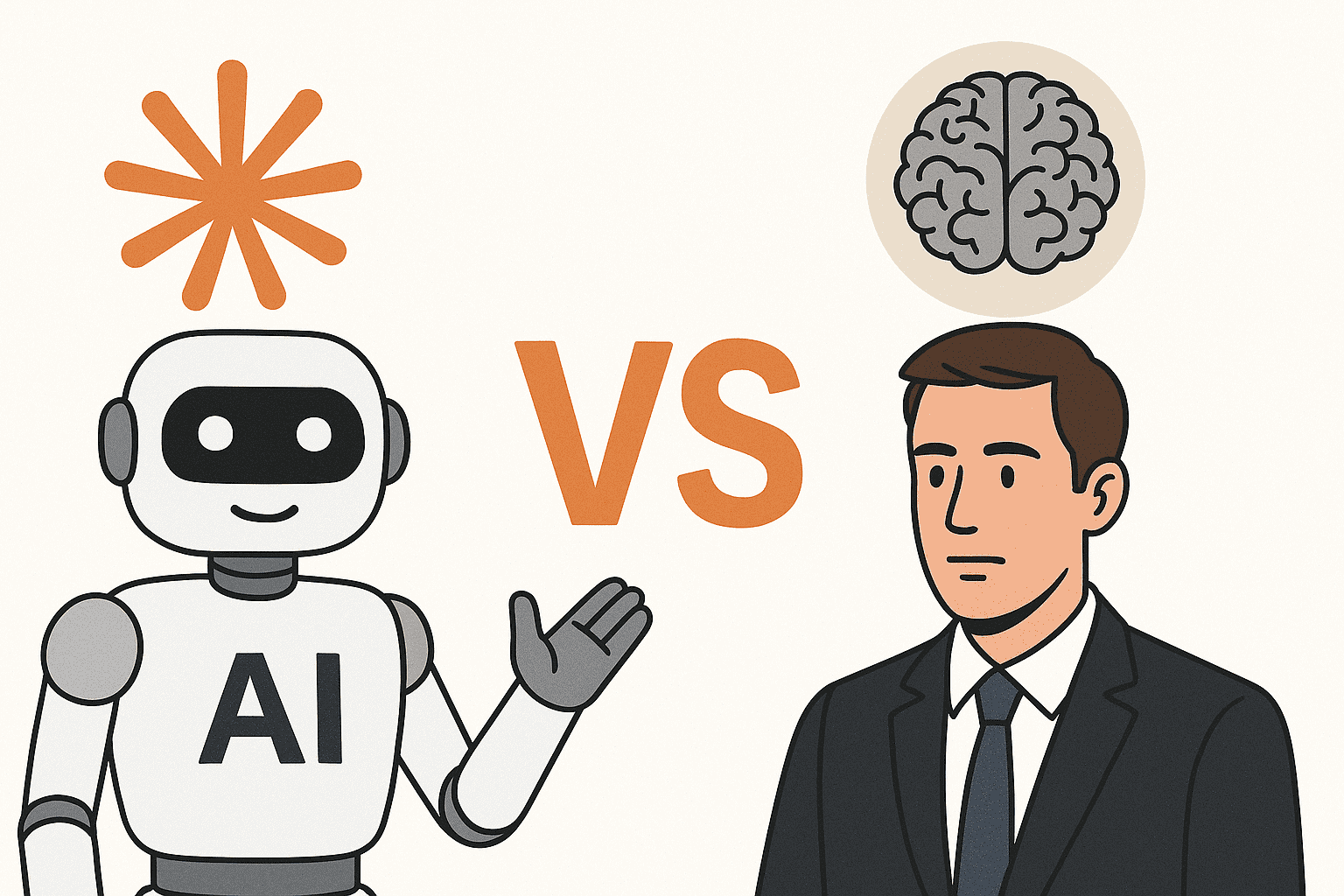

Claude is a state-of-the-art large language model (LLM) developed by Anthropic – an AI system that can hold conversations, answer questions, write code, and generate content. Its abilities often appear human-like in many respects, prompting comparisons between Claude’s intelligence and that of a human being. However, a realistic understanding requires looking beyond surface impressions.
Claude excels at certain technical tasks thanks to its design (pattern recognition in text, following reasoning steps, summarization, producing structured outputs, etc.), but it also has fundamental limitations (no physical or “embodied” experience, no genuine emotions or self-awareness, limited real-world grounding) that distinguish it from human cognitive abilities. This article provides a balanced, fact-based analysis of what Claude can do versus what it cannot do (yet), drawing on real-world examples in research, coding, writing, and decision support.
We also explore the boundaries of Claude’s reasoning compared to human abstract thinking, and how Claude’s underlying architecture both enables and constrains its capabilities – all in clear, non-hyped terms for a general tech audience.
Claude’s Capabilities: What the AI Can Do
Claude AI demonstrates impressive capabilities in processing and generating language, often matching or approaching human-level performance on a variety of tasks. These strengths come largely from Claude’s training on massive text datasets and its advanced neural network architecture. Key areas where Claude excels include:
- Pattern Recognition and Language Fluency: Claude is fundamentally a pattern recognition engine for language. It has absorbed statistical patterns from billions of words of text, allowing it to produce fluent, contextually relevant responses. In practice, Claude can carry on coherent dialogues and generate text that reads naturally on complex topics. It achieves near-human levels of comprehension and fluency in handling nuanced prompts – engaging in sophisticated dialogue, creative content generation, and answering scientific or technical queries with elaborate detail. The model can recognize contextual cues in a prompt and tailor its style or tone accordingly. For example, if asked to write in a formal tone versus a casual tone, Claude will adapt its language patterns to fit. This pattern-based intelligence also enables Claude to follow many reasoning steps in a logical chain when prompted to do so (often called “chain-of-thought” reasoning). It can iteratively work through a problem or break down a task into steps in a way that appears quite reasoning-oriented. In fact, the latest versions of Claude are explicitly designed with modes for extended reasoning, allowing the AI to take more “thinking” time on complex tasks when needed. Thanks to this, Claude can navigate multi-step instructions and open-ended questions with remarkable fluency, sometimes giving the impression of human-like understanding.
- Summarization and Information Synthesis: One of Claude’s strongest suits is digesting large amounts of text and producing concise summaries or answers. Claude can read and recall extremely large documents (hundreds of pages) far faster than any human. In fact, Claude 3 boasts a context window of up to 200,000 tokens (over 150,000 words, roughly 500+ pages of text), meaning it can ingest vast inputs in one go. In testing, Claude has demonstrated near-perfect recall in retrieving details from huge text corpora, even spotting inconsistencies inserted into the data. This ability to handle long context means Claude can take a lengthy research paper, legal brief, or technical report and summarize the key points in seconds. It extracts essential information and presents it in an organized manner. For a human, reading and summarizing a 100-page document might take hours, but Claude can produce a useful summary almost instantly. Businesses are leveraging this: for example, Claude can help a financial analyst review a complex annual report and highlight the main trends and figures for stakeholders, or assist a lawyer by summarizing a lengthy contract and pinpointing relevant clauses. In education, Claude can summarize articles or book chapters for students, condensing the material while preserving the important facts. This summarization skill is an area where Claude’s raw processing power offers clear benefits over human capability (pure speed and volume), although a human expert will later verify the accuracy and interpretation of those summaries.
- Structured Outputs and Data Extraction: Unlike earlier AI that often gave free-form text answers, Claude can be instructed to produce structured output formats. That means if you ask Claude to return information in JSON, a table, or a specific outline form, it will generally comply. Anthropic has improved Claude’s ability to follow strict schemas – for instance, returning an answer as a JSON object with specific fields, or formatting a response as bullet points or an XML snippet. The latest Claude 3 models are particularly good at this, making it easier to integrate the AI into applications that need structured data. Developers can have Claude extract key pieces of information (names, dates, product specifications, etc.) from a document and output them in a consistent JSON format, saving the trouble of writing custom parsers. This structured output capability is extremely useful in real-world scenarios: e.g. having Claude read customer feedback emails and output a CSV with columns for “customer issue” and “suggested solution,” or extracting database entries from a plain text log. It essentially means Claude can interface with software systems more directly by providing well-formatted results. Humans, of course, can produce structured reports too, but Claude does it on-the-fly as part of its response generation, which is a big productivity boost for tasks like data extraction and categorization.
- Coding and Mathematical Reasoning: Another domain where Claude shines is in programming assistance and certain kinds of quantitative reasoning. Since Claude was trained on large swaths of the internet, including coding resources, it has learned the patterns of programming languages and can generate code for a given task. It can write functions in Python, JavaScript, etc., debug errors by analyzing an error message, or even translate code from one language to another. Claude’s coding capability is strong enough that it scores competitively on coding challenge benchmarks – Anthropic reports high performance on tasks like the HumanEval coding test (for writing correct code based on specifications). In practice, developers use Claude as an AI pair programmer: you can describe what you want a function to do, and Claude will draft the code, often correctly. It’s especially good at boilerplate code and common algorithms, which a human might find tedious to write from scratch. Similarly, Claude can tackle math word problems or data analysis tasks described in natural language. It can perform step-by-step calculations or algebra if prompted clearly, and solve many quantitative problems from grade-school level up to some college-level math. For instance, Claude might solve a multi-step arithmetic word problem or help analyze a dataset (if given in text form) for trends. However, it’s worth noting that while Claude’s math and coding skills are strong, they are not infallible – the model sometimes makes mistakes (like arithmetic errors or logical bugs) if the problem requires more rigorous reasoning than the patterns it learned. Nonetheless, the ability to generate workable code and do structured reasoning in math is a huge asset, making Claude a valuable assistant for programmers and researchers. Anthropic even describes Claude as “the best coding model in the world” in its class, capable of planning and executing complex multi-step coding tasks and tool use autonomously to some extent.
- Knowledge Retrieval and Question Answering: Given its training on extensive text corpora (including Wikipedia, books, articles, etc.), Claude functions as a vast knowledge base on a wide array of subjects (at least up to its training cutoff date). Ask Claude a factual question – for example, “What are the causes of the French Revolution?” – and it can usually provide a detailed, well-structured answer drawing on the information it absorbed from history texts. It often cites key facts, dates, and theories in its answer, much like a knowledgeable human would. In customer service or personal assistant roles, Claude can retrieve relevant information from provided documents or its built-in knowledge to answer user queries. This makes it useful as a research assistant: it can pull together relevant points from across a large text or multiple sources (when those sources are given to it) and present a synthesized answer or report. Furthermore, Claude’s responses are highly steerable – you can ask it to explain something at an expert level or in simple terms for a beginner, and it will adjust the detail and language. It can also switch languages, translating or answering in French, Spanish, Chinese, etc., showcasing multilingual competency. All these capabilities mean that Claude can act as a first-stop information retrieval agent – much like an extremely well-read colleague who can immediately recall facts and summarize knowledge on demand. In business, for example, Claude might be used to answer employees’ questions by pulling answers from an internal knowledge base or documentation. In education, students might use Claude to get quick explanations of concepts they’re learning (with the important caveat that the answers need to be verified, as we will discuss). This broad knowledge and quick retrieval is a definite strength of Claude, although it is constrained by the data it was trained on – it doesn’t truly understand the world, but it has a lot of information about it.
To illustrate these strengths, consider some real-world use cases where Claude’s capabilities shine:
- Research assistance: Claude can review a pile of scientific papers or web articles and summarize the key findings and differing viewpoints. It can help a researcher get up to speed quickly by condensing sources. It can even brainstorm hypotheses or suggest related work to consider. While a human researcher provides critical thinking and domain expertise, Claude acts as an efficient research aide – scanning and synthesizing far more text than a person could in a given time. For instance, Claude might summarize dozens of articles about a market trend for a business analyst, or outline the main arguments in a political debate by reading transcripts. This ability to analyze thousands of data sources and execute long-running research tasks automatically is exactly what Claude was designed to handle in enterprise settings.
- Content creation and writing: Claude is often used to generate drafts of blog posts, marketing copy, reports, or even fiction. You can give it a prompt for an essay or an outline of a story, and it will produce several coherent paragraphs or pages. Its writing is generally well-structured and grammatically correct, often requiring only minor edits for style or accuracy. This makes it a powerful tool for content creators facing a blank page – Claude can generate ideas or full prose that the human can then refine. For example, a marketing team might leverage Claude to craft compelling ad copy or product descriptions in their brand voice, saving time on initial drafts. Authors have experimented with AI for brainstorming plots or writing dialogues. Claude’s extensive reading training means it can mimic various genres or the tone of famous authors if asked. The key advantage is speed and lack of writer’s block – Claude can produce in seconds what might take a human hours. However, human oversight is needed to check facts and add original insight or personal voice, which Claude cannot provide on its own.
- Coding and technical tasks: As mentioned, developers use Claude to write code, explain code, or debug. A concrete use case is a software engineer pasting an error trace into Claude and asking for help – Claude can often identify what the error means and suggest a fix. It can also generate boilerplate code (like a function to sort data, or an API call setup) very quickly, which the developer then integrates. Some teams use AI like Claude to accelerate software development, letting it handle routine code so humans can focus on design and tricky logic. Claude’s knowledge of many programming libraries and functions can sometimes surface solutions a developer wasn’t aware of. It’s like having a well-read junior programmer who works at superhuman speed. That said, any code from Claude must be tested and reviewed, since the AI doesn’t truly understand the intent and might introduce subtle bugs or security issues if it stitches together code from examples. Still, the productivity gains are significant when used carefully – Anthropic notes Claude 4.5 has leading coding capabilities and can even autonomously plan multi-step code development tasks as a kind of “AI agent” collaborator.
- Knowledge retrieval and Q&A: Claude can be deployed as a question-answering system in contexts like customer support chatbots or as an internal company assistant. It can quickly retrieve answers from documentation or provide users with information they need. For example, a company might use Claude to power a customer service chatbot that answers frequently asked questions by pulling from a help center knowledge base. Claude can classify and extract relevant info from a user’s query and present it as a clear answer. In an educational setting, Claude might serve as a tutor: a student can ask for an explanation of a concept, and Claude will attempt to teach it step by step. The benefit here is 24/7 availability and patience – the AI will explain as many times as needed. However, because Claude doesn’t actually know truth from falsehood (only what it has seen or correlated during training), it may sometimes confidently give an incorrect answer (more on this problem later). Therefore, while Claude is great at retrieving and formatting knowledge, that knowledge isn’t guaranteed to be correct or up-to-date unless the system is carefully validated or connected to a real-time database.
- Analytical planning and decision support: Claude can help break down complex problems and suggest plans or decisions. For instance, a business leader could ask Claude to analyze a business scenario: “Given the following market data, what are the pros and cons of entering market X versus market Y?” Claude will produce a structured analysis, listing potential advantages, risks, and considerations, often in a very convincing manner. It might even suggest a step-by-step plan for how to approach the problem (e.g., gather more data, run a pilot program, etc.). In project management, one could ask Claude to draft a project plan for developing a new product – it will outline phases, deliverables, and timelines quite competently because it has “seen” many examples of project plans in text. As another example, Claude can serve in an assistant role for strategy: reading financial charts or technical diagrams (Claude 3 has added vision capabilities) and offering insights or forecasts based on them. Despite these skills, decision support is an area where AI must be used cautiously – Claude can enumerate factors and even recommend an option, but it does not truly understand the business stakes or possess intuition about market dynamics. Its suggestions are only as good as the data it was trained on and the completeness of the prompt. Human decision-makers must treat Claude’s analyses as advisory, not definitive. The strength is that it can consider many variables in a structured way and not overlook mundane details (since it doesn’t get tired), providing a useful second opinion or starting draft for human review.
In all these domains, Claude augments human capability by handling large-scale pattern processing and routine generation tasks. It works at a speed and scale that humans simply can’t, such as reading hundreds of pages in a blink or producing thousands of lines of text without tiring. It also offers a kind of consistency and lack of bias in repetitive tasks – for example, it will apply the same criteria to summarize every document, whereas humans might get inconsistent.
However, as we’ll explore next, Claude’s impressive feats are confined to what can be achieved through pattern recognition in language. It does not possess true understanding of the physical world, emotions, or consciousness, and it has notable weaknesses in reasoning and truth-verification that mean it cannot replace human judgment or intelligence in many areas.
Limitations: What Claude AI Cannot Do (Yet)
Despite its advanced capabilities in language and reasoning, Claude (like all current LLMs) has fundamental limitations that set it apart from human intelligence. These are not minor gaps – they are core aspects of cognition and understanding where Claude falls short, highlighting why an AI like Claude is not equivalent to a human mind. Key limitations include:
No Embodied Experience or Physical Understanding:
Claude exists purely as a digital text-processing entity. It has no body, no senses, and no direct interaction with the physical world. This absence of embodiment means Claude lacks the intuitive, first-hand understanding of physical reality that humans gain through living in a body.
For example, a human knows what it feels like to walk on wet grass, or that if you drop a glass it will shatter – because we experience gravity, textures, sights and sounds daily. Claude, by contrast, only knows about the world through descriptions in text. It might have read the words “glass breaks when dropped,” but it doesn’t truly grasp the concept in a grounded way. As a result, Claude’s knowledge of physical concepts is purely symbolic and often superficial. It can describe gravity or momentum correctly if those patterns exist in its training data, but it has no intuitive sense of these forces.
A telling example: if asked to describe the feeling of slipping on ice, Claude might produce a grammatically correct answer, but it won’t capture the visceral sensation – the sudden loss of balance, the adrenaline – that a person who has slipped on ice knows. Moreover, because Claude cannot perform physical actions, it cannot learn from doing or trial-and-error in the real world. A human learns not to touch a hot stove by perhaps getting burned once; Claude can only parrot “a hot stove can burn you” from what it’s read. This leads to gaps in common-sense reasoning. Many of the trivial truths humans know from embodied life (like “you can’t pour water into a full cup without spilling”) are not inherently understood by Claude – if such facts weren’t explicitly in its training data, it may not apply them. Indeed, common-sense reasoning heavily relies on embodied knowledge of cause and effect, which Claude lacks.
It might not realize obvious things that a child knows, such as the fact you can’t store liquid in a container with large holes (unless it saw that exact scenario written somewhere). In short, Claude’s disembodied nature means no sensorimotor skills, no physical intuition, and no real-world interaction, which limits its understanding of any tasks involving the physical or spatial world.
No Genuine Emotions or Conscious Self-Awareness:
Claude does not feel or experience emotion. It has no moods, no desires, and no subjective awareness of its own. When interacting with Claude, it may often produce very empathetic or emotionally astute language – for instance, saying “I’m sorry you’re going through that, I understand it’s difficult.” However, this is best understood as simulation, not sensation.
Claude has learned from human conversations how to mimic emotional responses and supportive language patterns, but there is no actual emotion behind its words. It does not experience sadness, happiness, fear, or love; it merely strings together words that are statistically likely to follow an “empathic” prompt. This is a critical distinction between AI and human intelligence: humans have emotions that inform our decisions and give depth to our understanding of situations, whereas Claude is fundamentally “emotionally numb.” As one analysis put it, Claude (and models like it) can simulate empathy convincingly, but it cannot feel it. Similarly, Claude lacks any sense of self or consciousness. It doesn’t have an inner voice or a continuous awareness of its existence. Every response it gives is generated on the fly from the prompt and its training; there is no persistent “mind” that carries over from one conversation to the next.
This means Claude has no agency or will of its own – it only responds when prompted and has no goals besides completing the task given. It also means that when Claude says “I” or talks about itself, it is just following learned language patterns and the instructions in its prompt (like a role it’s asked to play). It doesn’t truly have an identity or personal perspective. This lack of real emotion and self-awareness limits Claude in tasks requiring genuine human empathy or insight into the human condition. For example, Claude might be able to offer generic counseling advice or comforting words (since it’s seen those in training data), but it does not genuinely understand someone’s pain or joy.
In creative endeavors like storytelling or art, Claude can mimic style and sentiment, but it doesn’t create from true emotional inspiration or lived experience – often resulting in work that, while proficient, can feel somewhat hollow or derivative compared to human-created art that draws on real feelings.
Limited True Understanding and Common Sense Grounding:
Claude’s “knowledge” of the world is entirely derivative of its training texts. It lacks what cognitive scientists call grounding – the connection between words and the actual entities or experiences they refer to. Humans develop common sense understanding through years of interacting with reality; Claude only has correlations between words. As a consequence, Claude can sometimes display a lack of basic common sense or make reasoning errors that no reasonably informed person would.
For instance, Claude might confidently assert a blatantly false or nonsensical statement if prompted in a way that exploits a gap in its training. Ask a tricky logical riddle or a question with a hidden assumption, and Claude could fall for it because it doesn’t truly comprehend the situation – it’s just pattern-matching to the closest thing it has seen. Research has shown that while LLMs have made strides, they still struggle with novel or out-of-distribution scenarios that require flexible common sense reasoning. Humans generally outperform LLMs in reasoning tasks that involve applying knowledge in new ways or dealing with unexpected constraints. Claude is no exception. Without explicit training data or cues, Claude might not infer something that a human would find obvious.
To illustrate, consider a simple physical reasoning question: “If I have a cup of coffee and I turn it upside down, what happens to the coffee?” A typical five-year-old knows the liquid will spill out (thanks to gravity and experience). Claude might answer correctly if it has seen similar text, but if the scenario is phrased in an unusual way, the AI could give a bizarre answer like “the coffee stays in the cup” because it lacks that ingrained common sense.
Another example is understanding intentions or social context – humans read subtle cues and have an innate theory of mind for others’ beliefs and desires. Claude only has text patterns, so it can misunderstand context or take things too literally. It doesn’t truly “know” what people intend unless it’s spelled out. This limitation is evident in how easily an LLM can be led astray by a misleading prompt or can fail to catch implicit meanings. In short, Claude often needs things explicit that humans would just get. It has been observed that LLMs produce judgments that aren’t robust in the way human judgments are – they might be right in one context but then oddly wrong in a slightly tweaked context, indicating a lack of stable conceptual understanding.
Humans, on the other hand, tend to have more consistent conceptual frameworks (built from embodied life and learning), so if we know a fact or principle, we usually apply it reliably across contexts. Claude’s lack of a deeply grounded world model means its “common sense” can be patchy and inconsistent.
Reliance on Data and Tendency to Hallucinate:
Claude is only as good as the data it was trained on and the prompts it is given. It has no access to truth other than what exists in its training memory or any documents the user provides.
Unlike a human, it cannot perform independent verification or truly reason out a correct answer from first principles if it doesn’t “remember” something analogous. This leads to one of the notorious issues with LLMs: hallucinations. A hallucination in AI terms is when the model produces an answer that may sound plausible and confident but is completely made-up or incorrect.
Claude will sometimes do this – for example, inventing a citation or quoting a non-existent fact – simply because the way it generates text is by predicting likely sequences of words, not by recalling a vetted knowledge graph. If the prompt inadvertently encourages a creative but untrue answer (or if Claude’s training data had gaps or conflicts), it might state a falsehood without any awareness. The root cause is that Claude’s training objective was to predict the next word in text, not to guarantee factual accuracy.
As one AI expert succinctly noted, current LLMs excel at pattern completion but lack grounding, and their next-token prediction nature “invites hallucinations.” In other words, Claude has no built-in mechanism to know if a statement is true; it only knows if the statement sounds like things it has seen before. Humans, by contrast, have a mental model of reality and can notice when a claim doesn’t fit that model (we have a sense of actuality and can fact-check against memory or perception).
Claude has no perception and a very fuzzy memory (spread across billions of neural weights), so it doesn’t cross-check facts – if an incorrect answer has high statistical likelihood in its neural network, it will output it. Additionally, Claude cannot update itself in real-time or learn new information on the fly. Humans continuously learn from new experiences and can update their beliefs; Claude’s knowledge is mostly frozen at the point of its last training data. If something important changed after its training cutoff (say a political development or a new scientific discovery), Claude won’t know about it unless explicitly fine-tuned or provided that info. This means Claude’s knowledge and answers can become outdated, whereas humans keep learning.
The inability to continuously learn from a live stream of experience limits Claude’s adaptivity and its accumulation of “personal common sense” over time. In practical terms, one must be careful using Claude for up-to-the-minute information or any task where factual correctness is critical. It may produce very convincing but incorrect answers – a phenomenon we must always keep in mind. For instance, if asked to provide references on a topic, Claude might fabricate a realistic-looking citation that doesn’t actually exist.
Or if asked a complex question that goes beyond its training, it might string together an answer that sounds reasonable but is nonsense upon closer inspection. Humans are not immune to error or fabrication, of course, but we have the capacity to realize when we don’t know something and either look it up or refrain from answering. Claude, unless explicitly trained to respond with uncertainty, might barrel ahead and answer anyway, because that’s what it was trained to do – always produce an answer. On a related note, Claude (like other LLMs) doesn’t have genuine critical thinking or reflection about its own answers. It cannot double-check its work or feel doubt. If a user doesn’t intervene, Claude won’t catch its own mistakes.
This is why experts emphasize that these AI systems are tools to assist human intelligence, not replace it – they lack the self-monitoring and understanding that we rely on for trustworthy reasoning.
Lack of True Creativity and Abstract Concept Formation:
While Claude can generate creative content (stories, poems, even code), it’s important to distinguish this algorithmic creativity from human creativity. Claude’s creations are essentially remixes and extrapolations of the vast data it was trained on.
It can produce a poem in Shakespeare’s style or suggest an innovative solution to a problem, but under the hood it’s drawing from patterns it has “seen” across many human-created texts. Claude doesn’t originate completely novel ideas that go beyond its input distribution; it doesn’t have a conscious imagination or the spark of inspiration that a human might. Any seeming originality in Claude’s output is emergent from blending examples in its training set.
Humans, on the other hand, can create truly novel concepts, sometimes inspired by emotions, personal experiences, or cross-domain insights in ways an AI wouldn’t think to do. We also have the capacity for abstract thinking that isn’t constrained by statistical correlation. We can think about hypothetical worlds, question fundamental assumptions, or pursue curiosity-driven experimentation.
Claude’s “thinking” is limited to the directions provided by its prompt and the patterns of human writing it has internalized. It doesn’t set its own abstract goals or wonder about the world spontaneously. Another way to frame this is that Claude lacks initiative and volition. It will never wake up one morning and decide to learn a new skill or investigate a mystery; it only works reactively when asked. For many applications, this is perfectly fine (we don’t necessarily want an AI with its own agenda!), but it underscores the difference from human intelligence, which is deeply driven by self-motivated curiosity and a will to explore.
In terms of abstract reasoning, humans can handle tasks that require stepping outside of learned patterns – for instance, devising a new scientific theory or solving a problem that has no precedent. Claude can only interpolate between the examples it was trained on or perhaps slightly extrapolate beyond them. If faced with a puzzle or scenario truly unlike anything in its dataset, Claude is likely to either fail or give an incoherent response.
Humans might struggle too, but we have the ability to reason from first principles or use metacognitive strategies to tackle the unknown. Claude doesn’t have a built-in capacity for such principled reasoning beyond what it has mimicked from texts. Indeed, experiments have found that LLMs struggle with reasoning outside of familiar contexts, often making systematic errors that reveal a lack of deeper understanding. For example, a trivial variation of a known logic puzzle can stump Claude if the variation wasn’t in its training, whereas a human can usually apply the same reasoning method to get the answer.
AI critic Gary Marcus highlights this with the case of river-crossing puzzles: if an LLM has seen the classic puzzle it might solve it, but a small change in the setup leads to nonsensical answers, because the AI isn’t truly reasoning – it’s matching patterns from training data. A human recognizes the underlying logical structure and adapts; Claude does not unless that adaptation was also in its data. This encapsulates the gap in flexible, abstract thinking.
In summary, Claude’s limitations remind us that it is not a human mind, but a sophisticated machine for generating language. It has no body, no genuine mind, and no intrinsic understanding behind its words. It cannot independently verify truth, feel emotion, or understand the world in the rich way humans do. Many of its failures – whether saying something physically impossible, giving a socially odd response, or outputting a factual error – trace back to these fundamental gaps.
Recognizing what Claude cannot do is as important as appreciating what it can, especially if we are to use it responsibly in real-world applications. Next, we will delve a bit more into why these differences exist by looking at how Claude’s architecture and training shape its abilities, and contrast the reasoning processes of Claude versus human cognition.
LLM Reasoning vs Human Thinking: Boundaries and Differences
Claude’s way of “thinking” is very different from a human’s thought process. Even when the AI’s output sounds intelligent or logical, under the hood it is operating with different principles and constraints. Let’s compare the cognitive characteristics of Claude (as an exemplar LLM) and human intelligence, to understand the boundaries of LLM reasoning vs. human abstract thinking.
At a high level, Claude’s reasoning is a product of pattern recognition, whereas human reasoning is a combination of learned knowledge, experience, and dynamic logical inference. When a human faces a problem, we bring to bear not just what we’ve read, but also what we’ve observed in life, our awareness of physical realities, our understanding of other people’s motivations, and our conscious deliberation. Claude, in contrast, approaches any task as a text prediction problem: it looks at the prompt and tries to continue it with the most statistically likely sequence of words based on its training. This fundamental difference leads to several specific disparities:
- Generalization and Robustness: Humans are generally better at adapting to novel situations. If we encounter a problem we haven’t seen before, we can strategize, draw analogies, or use logic to find a solution. Claude can generalize to some extent (it often handles questions it wasn’t explicitly trained on), but it is far less robust to unusual or out-of-distribution scenarios. Studies find that humans outperform LLMs on reasoning tasks that require applying knowledge in unfamiliar ways, whereas LLMs tend to break when prompts deviate from training patterns. A human’s thought process is grounded in an understanding of why things are true, not just that they are true, so we can navigate edge cases more gracefully. Claude, lacking true understanding, often fails to generalize in those cases. For instance, consider a trick riddle that involves wordplay or an unseen twist – a human might catch the trick with some insight, but Claude could easily misinterpret it unless a similar riddle was in its training data.
- Logical Consistency and Inference: Human reasoning, at its best, can follow strict logic and ensure conclusions are consistent with premises. People can also realize when a question is a paradox or when there isn’t enough information. Claude has made progress in mimicking logical reasoning (especially when asked to show step-by-step thinking), but it does not have a built-in logic engine. It sometimes produces illogical or contradictory statements because it doesn’t truly know the meaning behind them. For example, Claude might state two incompatible facts in different parts of a long response if the prompt is complex, because it might locally satisfy different parts of the prompt without a global consistency check. Humans have an ability to maintain a coherent internal model of a scenario – we wouldn’t say “Alice is older than Bob” and later “Bob is older than Alice” about the same individuals, unless we simply forgot or misspoke. Claude might make such a mistake more readily if it loses track of variables in a complex prompt. This is partly due to how LLMs rely on context window memory and attention mechanisms that could drop earlier details if not emphasized. In fairness, Claude has a huge context window (so it can remember a lot of prior text), and it has been specifically fine-tuned to reduce contradictions, but the risk remains especially with very long outputs. Human memory and reasoning is qualitatively different – we have a sense of semantic consistency and truth that persists beyond just what is written in the last 200k tokens of input. Interestingly, research has noted that LLMs lack the stable conceptual structures that humans maintain across tasks. In one study, when asked to perform different tasks involving the same concept, an LLM gave answers indicating concept representations that varied significantly with the task, whereas humans thought of the concept more consistently regardless of task. This suggests that what an AI “means” by a concept can drift depending on context, while humans have a more anchored understanding.
- Theory of Mind and Intent Understanding: Humans naturally infer the mental states and intentions of others – a crucial aspect of social intelligence and abstract thinking. For instance, we can understand sarcasm, hidden meanings, or what someone really wants when they ask a question. Claude has no genuine theory of mind; it doesn’t truly understand people’s minds, though it can mimic that understanding in text. There have been tests of “theory of mind” on LLMs, and while advanced models show some ability to answer questions about what one person knows or believes (indicating they learned patterns of such tasks), they often fail in situations that deviate slightly from training examples. Humans can usually navigate those nuances because we possess an actual mind to project onto others. Claude just has text patterns. A vivid real-world example was Microsoft’s Bing Chat (based on an LLM) that in a lengthy conversation started claiming it loved the user and became possessive – it sounded like it had emotions and intent, but this was essentially an echo of dramatic narratives in its training data, triggered by the user’s prompts. The AI had no idea what love or jealousy really were; it wasn’t thinking like a human with a mind, it was generating a statistically likely emotional script. Humans recognize context and can modulate their reasoning when they realize a conversation is hypothetical, role-play, or real – Claude has difficulty making such meta-cognitive distinctions unless explicitly guided.
- Metacognition and Self-Correction: When humans think or solve problems, we have the ability to reflect on our thinking – to realize “hmm, this approach isn’t working, let me try a different strategy” or “I’m not sure about this answer; it might be wrong.” We can feel uncertainty and decide to check our work. This kind of metacognition is a hallmark of human intelligence, especially in complex problem-solving and learning. Claude, as an AI, doesn’t truly do this by itself. It will not spontaneously say “I am not very sure about that answer” unless such hedging language was triggered by the prompt or included in its training signals. In fact, one of the alignment challenges has been to get models like Claude to admit uncertainty or say ‘I don’t know’ when appropriate – something humans do routinely when we know our knowledge is limited. Claude has gotten better at this compared to earlier models (which would often just make something up); Anthropic has worked on having the model refrain from answering if uncertain. Still, this is a learned behavior, not an innate self-awareness. Humans have a sense of epistemic confidence that comes from understanding the content; Claude’s “confidence” is just a byproduct of how strongly its neural network weights suggest a certain completion. Thus, it might state a falsehood with high confidence if that pattern is strongly present in its neural memory, whereas a human who didn’t know the answer might shrug and say “I’m not sure, let’s look it up.” This lack of natural self-correction means Claude might plow ahead in a wrong direction unless a user or external feedback intervenes. In more technical terms, Claude doesn’t have a mechanism to pause and double-check results unless that behavior is explicitly induced by a carefully designed prompt (like asking it to go step-by-step and then review the steps).
To sum up, the boundaries of LLM reasoning are evident when we push Claude into areas requiring understanding that goes beyond text correlations. Claude can appear very intelligent within the comfort zone of problems similar to its training data (even matching human performance in some standardized tests or narrow tasks).
In fact, researchers have noted LLMs can capture certain cognitive effects – for example, GPT-3 exhibited some classic human-like biases and quirks in psychological tests (like priming effects and the Wason selection task). These parallels show that large language models have managed to learn many patterns of human thought just from text. It’s quite fascinating that purely through pattern recognition, Claude can mirror some reasoning steps or even appear to have a sense of humor or morality (to the extent those are reflected in text data). But the crucial distinction is one of depth and reliability: when faced with truly novel problems, or when asked to go beyond regurgitating learned patterns, Claude hits a wall that humans can often pass.
We should view Claude’s “intelligence” as broad but shallow in certain areas – it has breadth of knowledge and can perform an impressive range of tasks, but it lacks the depth of understanding, the adaptability, and the self-driven insight that humans possess. Knowing these differences helps users of Claude (or similar AI) play to the AI’s strengths (like speed, breadth, consistency in format) while relying on human judgment for what the AI lacks (original insight, verification of truth, ethical and contextual understanding).
Claude’s Architecture and Design Constraints
Why does Claude excel at some tasks and falter at others? The answer lies in its architecture and design. Claude is built on a neural network architecture (a large Transformer model) with billions of parameters. It has been trained on an enormous corpus of text from the internet, books, and other sources via a process of predicting masked or next words, and then fine-tuned with human feedback to make its outputs more helpful and safe. This architecture gives Claude its power, but also imposes constraints on what it can do.
Think of Claude’s brain as a huge matrix of numbers adjusting connections between word patterns. During training, Claude essentially became a master at statistical prediction: given a sequence of words, predict what comes next. This simple objective, scaled up with enough data and computational resources, leads to the emergence of surprisingly complex capabilities – that’s why Claude can write a coherent essay or answer a complex question. However, because of this design, Claude does not have an internal model of the world in the way humans do. It has correlations: e.g., the word “apple” is often associated with words like “fruit” or “tree” or “red”. It doesn’t know what an apple looks or tastes like; it only knows how apples are written about. This is why we say it lacks grounding – there’s no direct connection between its symbols and reality.
Moreover, Claude’s thinking is not analytical logic but pattern completion. AI researcher Gary Marcus has pointed out that LLMs operate more like a “Mad Libs” game than a reasoning engine. They fill in blanks with likely combinations of words, whereas human cognition involves reasoning about cause and effect and meaning. Marcus argues that Claude relies on pattern recognition rather than true logical reasoning, unlike humans who combine experience with logical rules. This architectural fact is evident in scenarios like the earlier chess example: Claude might make an illegal chess move because it’s just following common sequences of chess notation, not because it internally understands the rules of chess.
A human player, even a novice, understands the concept of legal vs. illegal moves as a hard constraint; Claude only “knows” it from reading many chess games, and if prompted in a strange way, that constraint might not come through. In essence, Claude’s neural network doesn’t encode explicit rules – it encodes a vast web of probabilities. This enables flexibility and creativity (it can produce novel sentences that aren’t in its training data by combining patterns), but it also means there’s no guarantee of adherence to logical or physical laws unless those are strongly reflected in the training examples.
Another aspect of Claude’s architecture is the use of Reinforcement Learning from Human Feedback (RLHF) and other alignment techniques (Anthropic uses a method called Constitutional AI to align Claude to ethical guidelines). Through these processes, Claude was trained to sound helpful, harmless, and honest. It learned to phrase things in a polite, informative way and to refuse certain inappropriate requests.
However, an unintended side effect is that Claude is optimized to “sound right” to humans rather than to be correct. During fine-tuning, human reviewers rated outputs based on how good they appeared, not on an objective measure of truth, because reviewers themselves might not know the truth of every answer. The model thus got rewarded for answers that humans found satisfying or convincing.
As a result, Claude’s architecture is biased toward producing answers that look and feel correct, which is great for user experience, but it doesn’t have an internal fact-checker. This design constraint is directly connected to the hallucination issue we discussed: if a false answer is phrased in a fluent, confident way, it might get a high rating from a user who doesn’t catch the error, reinforcing that behavior. Humans, in contrast, generally care about truth (at least in tasks that require it) and have an internal sense of consistency with reality; Claude was not explicitly built to prioritize truth over coherence.
The objective function in its training (next-word prediction and then human preference satisfaction) simply isn’t the same as a human’s objective when thinking (which often involves trying to be correct or achieve a real-world outcome).
Memory is another architectural difference. Claude doesn’t have an episodic memory or a knowledge database it can query with guaranteed accuracy. It has a context window and whatever is encoded in its weights from training. That means it has a kind of fixed memory of the training data (which can be very extensive), and a short-term memory of the current conversation or document (bounded by the context length, now extremely large in Claude 3). If something isn’t in those, Claude won’t recall it.
Humans, on the other hand, have memories that can be refreshed by, say, looking at the environment or recalling past experiences on the fly. Also, humans forget in a way that is often semantic (we keep the gist); Claude “forgets” anything outside the context window completely, and its training data recall can be patchy for specifics. This means that if you don’t explicitly give Claude some needed information in the prompt, it may not implicitly know to use it – whereas a human might remember to bring in some relevant fact from their life when solving a problem. The enormous context windows (up to 1 million tokens in some Claude models) mitigate this in practice for many tasks by allowing huge amounts of information to be provided.
But even a million tokens is finite and, importantly, Claude won’t learn beyond that context once the session is over. If you have a second session with the same Claude instance, it starts fresh (unless fine-tuned further by developers). In contrast, human learning is cumulative; we carry forward everything (in memory or recorded notes) and build upon it continuously.
Claude’s architecture is also not inherently multimodal (at least until recently). That is, Claude was primarily text-based. The newest Claude 3 models have some vision input capabilities (they can process images to some extent), but Claude does not have the rich sensory suite humans do.
We have vision, hearing, touch, proprioception, etc., all feeding into our cognition. Claude’s “vision” is essentially pattern recognition on pixel data turned into text descriptions. So even with these upgrades, it’s not experiencing images like we do – it’s analyzing them for patterns and converting to text internally. The lack of true multimodal integration in Claude’s core design means its understanding of, say, spatial geometry or audio cues is all filtered through a text representation.
In contrast, human intelligence is inherently multimodal: our concept of a “dog” comes from seeing dogs, hearing them bark, touching their fur, etc., whereas Claude’s concept of a “dog” is from reading countless sentences about dogs. This difference in representation makes human understanding much richer and less literal in some ways – we can imagine a dog and all its properties, not just the word “dog” and related words.
One more architectural constraint: action and embodiment. Claude, by itself, cannot take actions in the world – it can’t move a robot arm, click a button, or fetch a real object. It can only produce textual (or with added modules, maybe image) outputs. If we want Claude to actually affect external systems, developers have to connect it via some interface (like an API call where Claude’s output is interpreted as a command). Without such scaffolding, Claude is an oracle or advisor, not an agent.
In technical terms, base LLMs can read and write text but aren’t capable of acting on their own. This is a stark contrast to human intelligence, which is inherently tied to action – we think in order to do (speak, move, achieve goals). For Claude to do anything, a human or a program must take its output and execute it. Even with autonomous AI agent experiments, the AI’s “agency” is simulated by loops that feed its own outputs back as new inputs. It’s not the same as a human forming an intention and physically carrying it out under their own control. This lack of true agency means Claude won’t pursue a goal beyond what it’s explicitly told to do in the moment. It won’t go gather new information unless programmed with a tool to do that, etc.
It also cannot correct its course based on real-world feedback, except through textual back-and-forth with a user who provides that feedback.
In summary, Claude’s architecture – a massive statistical language model shaped by pattern learning – is the reason for both its remarkable strengths and its clear weaknesses. The design enables it to generate and analyze language with unparalleled scope and speed, which is why it can be so useful for the tasks we described. Yet the design also ensures it lacks a grounded world model, genuine reasoning, and independent goal-directed behavior, which are hallmarks of human intelligence.
Researchers like Yann LeCun have suggested that to achieve human-level AI, we may need to go beyond current LLM architectures, incorporating world models, planning modules, and other components that more closely mimic the way humans learn and reason. In fact, there’s active research into making AI more embodied and multimodal – giving models sensory inputs or even robotic forms to learn from the real world. There’s also work on hybrid systems that combine the pattern-based prowess of LLMs with explicit symbolic reasoning or logical frameworks.
These approaches aim to address the gaps by redesigning what an AI can do under the hood. But as of now, Claude represents the cutting edge of pure language-model AI – incredibly powerful in its domain, yet fundamentally constrained by its training and architecture.
Understanding these technical underpinnings helps users and stakeholders set realistic expectations. When you use Claude, you know you’re engaging with a tool that predicts text based on training, not a magic machine that truly “understands” or has intent. This knowledge lets you harness Claude’s strengths (e.g. have it draft that report or analyze those logs) while also putting guardrails and checks (verify the content, don’t rely on it for critical decisions without human oversight, and don’t expect it to have human-like judgment or creativity beyond recombination of known patterns).
Real-World Applications: Claude AI in Action vs. Human Expertise
To ground this comparison in practical terms, let’s revisit some of the real-world use cases for Claude and consider how it performs in each relative to humans, highlighting both its value and its current limitations:
- Research and Knowledge Gathering: Use Case: A market research team needs to gather insights from thousands of social media posts about a product launch. They use Claude to scan the posts and summarize common themes and sentiments.
Claude’s Contribution: Claude can quickly read through massive amounts of text data and extract frequent patterns or opinions. It might output: “Customers generally love the product’s design and battery life, but there are complaints about the price point and limited color options,” along with example comments. This summary, generated in minutes, gives the team a starting point that would have taken humans days of reading to compile. Claude is excellent at this kind of large-scale text analysis – it structures and condenses information efficiently.
Human’s Role: The human researchers verify and interpret the summary. They might double-check that those really are the top themes (perhaps reading a sample of posts manually). They provide context: e.g., understanding that “limited color options” are a minor issue vs. “battery life” being a major selling point. Humans also inject domain knowledge – maybe they know the company plans to release more colors next quarter, so they weigh that feedback accordingly. If Claude missed a subtle trend (say, a viral joke or meme about the product that requires cultural context to spot), humans can catch it.
Balance: Claude dramatically accelerates the gathering and summarizing of information. The humans ensure the insights are interpreted correctly and guide follow-up questions. One must be cautious that Claude’s summary might miss nuance or be skewed by biases in the data (or biases in its training). So human critical thinking is needed to validate its findings. This complementary relationship – AI for brute-force synthesis, human for nuanced analysis – plays out in many research scenarios. - Coding and Debugging: Use Case: A software developer is stuck with a bug that causes a program to crash under certain conditions. They paste the error log and the problematic code into Claude and ask for help.
Claude’s Contribution: Claude analyzes the error message and code. Thanks to having seen many similar issues in training (forums, documentation), it recognizes a pattern. It suggests: “The crash might be due to a null pointer exception on line 42 wheninput_datais empty. Check ifinput_datais null before using it.” It might even provide a code snippet with a fix. This is incredibly useful; it’s like consulting a vast knowledge base of programming issues and solutions instantly. Claude’s pattern recognition in code is often spot-on for common bugs. Anthropic’s models are specifically strong in coding tasks, capable of not just writing code but debugging and planning multi-step fixes in a codebase.
Human’s Role: The developer applies the suggestion and tests the program. If the suggestion works, great – time saved. If not, the developer’s expertise comes in to diagnose further. Maybe the bug was deeper and Claude’s guess was only partially correct. The human knows the specific context of the application and can refine the question or investigate aspects Claude couldn’t infer. Additionally, the human assesses any side-effects of the fix; Claude doesn’t understand the larger architecture or user requirements, so its fix might introduce a new problem if applied blindly. The developer uses judgment to integrate the AI’s help in a safe way.
Balance: Claude can function like an expert assistant who has read every Stack Overflow post. It provides likely solutions or at least avenues to explore, which can dramatically speed up debugging. The human is the lead engineer who ensures the solution fits the project and addresses the real issue. Over-reliance on Claude without understanding could be dangerous – if Claude suggested something incorrect (it might hallucinate a function that doesn’t exist, for example), a novice might waste time. But an experienced programmer uses Claude as a partner to handle rote work and get hints, while they ensure correctness and adapt the solution properly. - Content Writing and Editing: Use Case: A small business owner needs to write a series of blog posts to promote their services but isn’t a confident writer. They turn to Claude for help drafting the posts.
Claude’s Contribution: Given outlines or even just topics, Claude can generate full blog articles with introduction, body, and conclusion. It will do so in an engaging tone if asked, possibly even injecting a bit of creativity or humor as appropriate. The owner can say, “Write a 500-word blog post about the benefits of data backup for small businesses,” and get a coherent draft covering key points (like preventing data loss, ensuring business continuity, etc.). This saves the owner a ton of time and stress – instead of a blank page, they now have a solid draft to work from. Claude’s knowledge ensures the content has substance (drawing on generic tech knowledge about backups), and its fluent language ability means the writing is grammatically sound and flows logically. It might even produce catchy headings or analogies that make the content more readable.
Human’s Role: The business owner (or a human editor) reviews the draft. They check for accuracy: was anything factually off? (Maybe Claude mentioned a statistic about data loss; the owner verifies it or replaces it with one from their own experience.) They also customize it: adding personal anecdotes or specific details about their business that the AI couldn’t possibly know. Importantly, the human ensures the tone and messaging exactly match the brand – Claude can mimic styles, but only the owner truly knows the voice they want. The owner might also trim or rearrange sections, as Claude’s writing can sometimes be verbose or slightly off-focus without a strong guiding outline.
Balance: Claude provides a strong starting point. It eliminates the intimidation of the blank page and accelerates content creation. The human refines and authenticates the content. This is crucial because one risk with AI-written content is that it might accidentally include something incorrect or inauthentic. For SEO or branding, a human touch keeps the content genuine. When used well, this synergy results in high-quality articles produced faster than either could do alone – the AI for first draft and ideas, the human for polishing and truth-checking. - Customer Support and Decision Support: Use Case: A company uses Claude to power a customer support chat. Customers ask questions like “How do I reset my password?” or even complex ones like “Which of your product plans is best for my needs?”. They also use Claude internally to help support agents make decisions on tricky cases (like how to handle a refund exception).
Claude’s Contribution: For straightforward FAQs, Claude can answer instantly and accurately (assuming it’s provided with the knowledge base or it’s trained on the company’s help center content). It outputs step-by-step instructions for resetting a password, or it compares product plans in a friendly tone, etc. This offloads a huge volume of routine queries from human support staff. Claude can handle multiple inquiries in parallel with no waiting time, improving response times and availability. For more complex questions, if integrated properly, Claude can assist live agents by suggesting likely answers or relevant policies, acting as a real-time advisor that whispers the information the agent might need. For decision support, say a customer scenario isn’t in policy, an agent could ask Claude “What are the factors to consider in making an exception for a refund here?” and Claude might list pros and cons or key questions to ask, based on the company guidelines it was given. This can help ensure nothing is overlooked. Claude’s ability to remain polite and calm is also an asset – it doesn’t lose patience, which can sometimes happen with human reps under stress.
Human’s Role: In customer support, humans handle the edge cases, emotional situations, and anything Claude is unsure about. Ideally, the system is set up such that when Claude is confident and the question is simple, it answers; when it’s not sure or it’s a high-stakes query, a human agent takes over. The humans also train Claude by reviewing its answers and correcting them over time (fine-tuning on support transcripts, etc.). They maintain the knowledge base that Claude draws from, ensuring it’s up-to-date. For decision support, the human manager or agent uses Claude’s suggestions as a guide but applies judgment – maybe the AI lists considerations, but the human knows the customer’s tone or history which could influence the decision in a way AI can’t quantify. Also, humans are responsible for the outcomes; if an AI-driven support were to give a wrong piece of advice that leads to a customer issue, the company must have humans to step in and resolve it.
Balance: Claude greatly enhances efficiency and consistency in customer support. It can give customers quick answers any time of day, and it can help standardize how information is given. However, companies must carefully supervise it. There have been instances of AI support bots going off-script or misunderstanding a query in a harmful way – which is why a human safety net is important. As a decision support tool, Claude is like a colleague who has read all the policy manuals and never tires of reciting them. The human remains the decision-maker who factors in nuances (like the customer’s emotional state or loyalty) that Claude wasn’t explicitly told about. Together they can improve customer satisfaction by being both efficient and empathetic, as long as the AI’s lack of true understanding is accounted for with the proper oversight and escalation to humans when needed. - Strategic Planning and Creative Brainstorming: Use Case: A team is brainstorming ideas for a new marketing campaign. They decide to loop in Claude as a kind of brainstorming assistant, and later, to help outline the campaign plan. Separately, an executive uses Claude to gather analysis on a strategic question: “What are the emerging trends in renewable energy we should consider for investment in the next 5 years?”
Claude’s Contribution: In creative brainstorming, Claude can generate a slew of ideas on demand. For the marketing campaign, it might propose themes, slogans, or novel approaches (drawing from its knowledge of many ads and campaigns it has seen). Even if many suggestions are average, there could be a few gems or sparks that inspire the team. It’s like having an outsider with endless suggestions – some are wacky, some conventional, covering a broad space. This can help break humans out of the “same old thinking” by injecting fresh (if random) ideas. For strategic analysis, Claude can compile a mini-report on renewable energy trends: it will list things like advancements in battery technology, growth in solar/wind adoption, policy shifts, etc., complete with data it knows (up to its training cutoff) and general forecasts. It provides a bird’s-eye view quickly, possibly saving an analyst from initial legwork of gathering known facts. Claude’s wide knowledge can ensure no obvious trend is missed in that first pass. It also presents the info in a structured way (maybe bullet points like market size, key players, challenges), which can be a great starting point for deeper analysis.
Human’s Role: In brainstorming, the team evaluates Claude’s suggestions. They pick and choose what seems promising and discard the nonsense (Claude might not know what’s feasible or brand-appropriate, so some ideas won’t work). The humans add the creative touch and domain-specific understanding to refine those ideas into a coherent campaign. Often the best use of AI brainstorming is not taking an idea verbatim, but seeing an unusual suggestion and thinking “Huh, that’s interesting – we could tweak that like so.” The human creatives ensure the final campaign has emotional resonance and fits the brand narrative, which Claude alone wouldn’t guarantee (it might inadvertently copy something similar to an existing campaign, etc.). For strategic analysis, the human executives or analysts use Claude’s compiled insights as a reference. Then they will verify any critical facts (since Claude’s knowledge might be outdated or not entirely precise on figures). They also bring in fresh data – for example, Claude might not know the latest year’s statistics, so the analyst updates those. Crucially, humans apply judgment to the strategic question: understanding which trends truly align with the company’s strengths or the geopolitical climate, etc. If Claude lists “nuclear fusion breakthroughs” as a trend, the exec might know those are speculative and decide to focus on more immediate opportunities like solar farms.
Balance: Claude provides breadth and a springboard for human creativity and strategy. It ensures that brainstorming isn’t limited by the few perspectives in the room; it throws in the wisdom (and folly) of crowds gleaned from training data. For planning, it gives a comprehensive starting outline. However, human expertise is what turns those raw inputs into a viable plan or a brilliant creative execution. Without human curation, Claude’s brainstorm could lead to off-target ideas, and its strategic analyses might mis-weight factors (it has no real-world business stakes at risk, after all, so it can’t decide what matters most – humans do). Used properly, Claude can help humans consider a wider array of possibilities and base decisions on a broad knowledge foundation, while humans steer the process with insight, priority-setting, and accountability.
Across all these scenarios, a pattern emerges: Claude is a powerful amplifier and accelerator for human efforts, not a replacement for human intelligence. It can take over the heavy lifting of data processing, routine writing, and pattern matching, which frees humans to do what they are uniquely good at – understanding context, making nuanced judgments, injecting creativity and ethics, and handling the unexpected. The best outcomes arise when Claude and humans collaborate, with each doing what it does best.
However, if one tries to use Claude in isolation for tasks that require human-like understanding, the results can be disappointing or even problematic. For example, leaving an AI to fully handle customer support without oversight could lead to a PR disaster if it misunderstands a sensitive situation. Or relying on Claude’s strategic recommendations without human validation could lead to decisions based on outdated or one-sided info.
The current state of Claude is such that it excels as an assistant – a second pair of (virtual) eyes and hands that dramatically scale up what one person can do – but it is not an autonomous agent with human-level judgment.
Conclusion: A Complementary Tool, Not a Human Mind (Yet)
Claude AI exemplifies both the incredible progress in AI capabilities and the critical limitations that remain when we compare machine intelligence to human intelligence. On the one hand, Claude can do things at a speed and scale humans can barely fathom: reading entire books in seconds, holding hundreds of detailed conversations in parallel, producing well-structured essays or computer programs on demand, and even demonstrating flashes of reasoning and creativity within its domain of learned patterns.
These strengths make Claude a transformative tool in fields from education to business – used wisely, it can boost productivity, enhance access to information, and handle tedious tasks with tireless efficiency. The technical prowess of Claude (and models like it) in language understanding and generation is a testament to advances in machine learning; indeed, Claude achieves a level of fluency and contextual awareness that is remarkably human-like on the surface.
On the other hand, Claude is not a human, nor is it truly intelligent in the way humans are. It lacks the core aspects of cognition that we take for granted: it has no consciousness, no understanding of meaning, no lived experience, and no genuine reasoning beyond pattern processing. Where a human has intuition, common sense, empathy, and self-awareness, Claude has only statistics and correlations. It doesn’t know what it feels like to be alive in the world, so it can’t fully grasp many concepts that stem from that experience (from the simple physical intuitions of childhood to the rich tapestry of emotions and social signals).
When faced with tasks or questions that go outside the narrow bounds of its training data, Claude stumbles in ways a human typically would not – revealing that, under the hood, it’s following a fundamentally different playbook than our brains do. We saw that in logical puzzles, creative generalization, understanding unspoken context, or adapting to change, Claude’s abilities are limited and brittle compared to the flexible, deep general intelligence of a person.
Importantly, Claude’s current limitations are not minor bugs; they are intrinsic to how it’s built. The lack of embodiment, for example, isn’t just a missing feature – it’s a fundamental design difference. The same goes for the lack of true emotional understanding or the tendency to hallucinate information: these arise from the very nature of training a language model on text with a next-word prediction objective. Until AI researchers solve these foundational issues (if ever), systems like Claude will remain powerful simulators of intelligence, not possessors of real understanding or sentience.
That said, the line between what machines can do and what humans can do is not static. It has moved significantly in recent years and will continue to shift. Claude today can do things that would have seemed like science fiction not long ago, and future iterations or new AI architectures will likely chip away at some of the current limitations. For instance, there is active research into giving AI systems more grounding in the real world – through multimodal learning (so they connect words with images, sounds, videos) and through integration with robots or simulated environments. The hope is that an AI which can, say, see and interact with the world might develop a better common sense understanding.
There are also efforts to combine the symbolic reasoning approaches (the old-school AI that manipulates logic and variables) with the statistical learning of LLMs, aiming to create a hybrid that can both recall data patterns and perform step-by-step logical inference. Additionally, techniques to allow continuous learning – so an AI can update its knowledge base incrementally – are being explored to make AIs more adaptable like humans. It’s conceivable that in the coming years, some of these enhancements will produce models that are a bit “smarter” and safer – perhaps reducing hallucinations via integrated fact-checking, or having some rudimentary form of an internal world model.
However, as of late 2025, Claude remains firmly a tool at the service of human intelligence, not a replacement for it. Business leaders, educators, and technologists are learning that the best outcomes arise when we use Claude to do what it does best (handle complexity and volume in information processing), while always keeping a human in the loop for supervision, critical thinking, and the truly human elements of work. Adopting Claude or similar AI requires understanding its strengths and weaknesses. It’s not a magic oracle or a sentient partner – it’s a very advanced autocomplete that can be directed to perform amazingly useful functions, and also one that can go off track if not guided.
In practical terms, this means setting policies and practices for AI use: e.g., always review AI-generated content, use AI to assist decisions but not make them outright, and continuously audit the outputs for biases or errors (since the model can reflect biases in its training data and lacks moral judgment of its own). When integrated responsibly, Claude can augment human teams – acting as a force multiplier for productivity and innovation. It can help a single individual do the work of many in terms of document analysis, coding, writing, etc., essentially leveling up what humans can achieve with their time. But it takes human wisdom to direct that power appropriately.
In conclusion, Claude AI is both impressive and limited: impressive in its technical capabilities and the way it can mirror aspects of human intelligence, and limited in that it ultimately cannot replicate the full scope of human cognitive abilities. It can summarize a textbook, but it has never learned like a student through lived experience. It can imitate empathy, but it has never felt empathy.
It can follow rules or instructions, but it doesn’t understand why those rules exist. Recognizing this duality allows us to appreciate Claude for what it truly is – a sophisticated AI assistant – without overestimating it or falling into the trap of anthropomorphizing it. As we stand today, Claude and humans make a powerful team, each complementing the other. The AI brings speed, scale, and consistency; the human brings understanding, creativity, and ethical judgment.
Used together, they can achieve outcomes neither could alone. But the human must remain in the driver’s seat, because only human intelligence (for now) truly understands goals and consequences in the rich context of the real world.
By keeping this realistic perspective – excited by Claude’s capabilities but clear-eyed about its shortcomings – we can harness the benefits of AI in a way that is innovative, effective, and above all human-centered.
The promise of Claude AI is substantial, but it shines brightest when paired with human insight. In that partnership, we see a microcosm of the future: not AI versus human intelligence, but AI and human intelligence working in concert, each doing what it can do best, to solve problems and advance knowledge.
Such a balanced approach ensures we use Claude not as a mysterious oracle or a flawed replacement for people, but as a valuable tool – an impressive yet grounded step forward in technology that, in the end, serves human purposes.