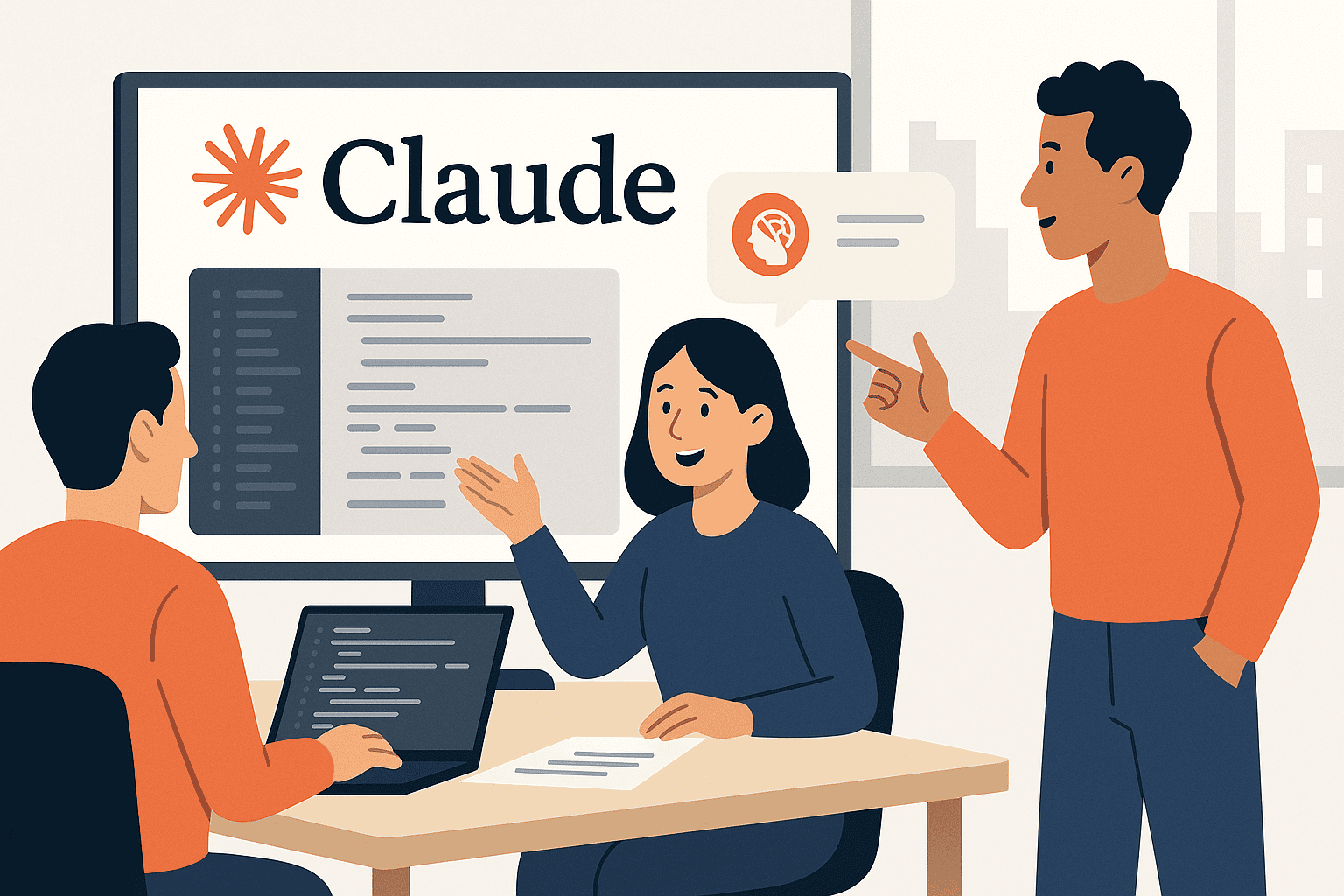

In modern software engineering, AI assistants like Claude have emerged as powerful teammates for developers. Claude is an AI-powered coding assistant developed by Anthropic, designed to help engineers write, understand, and improve code through natural language interactions. Unlike simple autocomplete tools, Claude is built for collaboration – it can explain existing code, suggest enhancements, and even help debug issues while keeping context in mind.
Anthropic’s use of a “Constitutional AI” framework guides Claude to produce helpful and honest answers, making it well-suited for real-world development tasks. The latest versions (such as Claude 2 and the Claude Opus 4 series) are among the most advanced coding models available, capable of handling complex, long-running coding workflows autonomously. In fact, Claude is positioning itself not just as a code generator but as a coding partner – able to generate entire CI/CD pipelines, write infrastructure-as-code templates, review configuration files, and reason through errors to assist engineers.
Why does this matter for software teams? Studies show AI coding tools can significantly boost productivity. At Anthropic, engineers now use Claude in roughly 59% of their daily work and report about a +50% productivity gain on average – more than double the impact compared to the previous year. Common uses include debugging, understanding code, and even implementing new features: 55% of Anthropic engineers use Claude for debugging on a daily basis, 42% use it for code understanding, and 37% use it daily to write new code.
These figures underscore how integral Claude has become in day-to-day development workflows. In this in-depth guide, we’ll explore how Claude can improve daily engineering tasks across the software lifecycle – from generating code and reviewing merge requests to debugging tricky issues, writing documentation and tests, and automating DevOps tasks like CI/CD pipelines and Docker configuration. Throughout, we’ll include real examples (with a bit of API usage) and practical tips to help you leverage Claude effectively in a team setting.
Code Generation with Natural Language Prompts
One of Claude’s most immediate benefits is code generation. Instead of writing boilerplate or repetitive code by hand, developers can ask Claude to produce it by describing the desired functionality in plain English. The model parses your request and generates the corresponding code in your language of choice. This drastically accelerates the implementation of new features or components.
For example, imagine you need a function to check if a string is a palindrome. With Claude, you can simply prompt: “Write a Python function called is_palindrome that checks if a word is a palindrome. It should ignore case and spaces.” In response, Claude will directly write the function code for you. In a tutorial example, Claude generated the following Python code based on that prompt:
def is_palindrome(word):
    cleaned_word = ''.join(word.lower().split())
    return cleaned_word == cleaned_word[::-1]
The code was inserted into the file (e.g. palindrome.py) without any manual typing. If the initial output doesn’t meet all requirements, you can refine it with follow-up prompts. For instance, after getting the basic is_palindrome function, you might realize it should also ignore punctuation. Instead of editing the code yourself, you can tell Claude: “Update the is_palindrome function to ignore punctuation as well.” Claude will then refine its solution, adding the necessary logic (such as filtering out non-alphanumeric characters) and returning an updated implementation. This iterative development loop – prompt, review output, prompt again for adjustments – allows you to evolve a snippet quickly to your needs.
Crucially, Claude doesn’t just dump code; it strives to produce clear, correct, and idiomatic solutions. As the Codecademy Claude tutorial notes, “Claude Code helps developers move from idea to implementation with just a prompt.” This means less time wrestling with syntax or looking up API usage, and more time focusing on higher-level logic. Engineers can offload routine coding tasks to Claude – whether it’s writing a data parsing script, creating a new React component, or scaffolding a backend endpoint – and then refine or integrate the AI-generated code into the project.
Real-world impact: Internal metrics from Anthropic show that implementing new features has become a common AI-assisted task – over a third of engineers use Claude daily to generate feature code. By letting Claude handle the heavy lifting of boilerplate and scaffolding, teams free up time to focus on designing better features and solving complex problems. It’s like having a junior programmer who can produce code on demand, at any hour, in any language.
Of course, the human developer still guides the process: you specify what to build and review what Claude writes, but the actual typing and syntax are taken care of. This can be especially useful for full-stack developers who might need a quick snippet in an area outside their expertise (e.g., a backend developer asking Claude to generate a snippet of frontend code or vice versa).
Tip: When using Claude for code generation, be as specific as possible about your requirements. You can mention the programming language, desired function or class name, any constraints or edge cases, and even the style (e.g. “using functional style” or “following PEP8 conventions”). Clear instructions yield better results. If the task is complex, break it into smaller prompts – generate one part at a time – to improve accuracy.
Code Review and Refactoring with Claude
Beyond writing new code, Claude excels at code review and refactoring tasks. In a team setting, code review is crucial for maintaining quality and consistency. Claude can act like an automated reviewer: it will analyze code for potential bugs, style issues, or deviations from best practices, and suggest improvements or fixes. This can be done interactively by prompting Claude in natural language, or even automated as part of your pull request workflow (more on that shortly).
Explaining and improving code: One of Claude’s strengths is providing clear explanations of code and the reasoning behind its suggestions. If you show Claude a piece of code (or point it to a file in your repository) and ask for an explanation, it will summarize what the code does in simple terms. Anthropic designed Claude to “provide clear explanations and summaries of complex code, helping teams quickly grasp project architecture, especially when dealing with legacy code or unfamiliar modules.” This is incredibly useful when onboarding new team members or trying to understand a large, unfamiliar codebase – Claude can act as a tutor that walks you through the logic.
Claude doesn’t stop at explaining; it can suggest improvements and perform refactoring. For example, after generating the is_palindrome function above, you could ask Claude to refactor it: “Refactor the is_palindrome function to make it more readable and efficient.” Claude will then return an improved version of the code. In the tutorial scenario, Claude’s refactoring introduced more descriptive variable names, combined operations for efficiency, and even inserted a docstring and comments for clarity. The refactored code might look like this:
def is_palindrome(text):
    # Clean the text: convert to lowercase and keep only alphanumeric characters
    cleaned_text = ''.join(char.lower() for char in text if char.isalnum())
    # Check if the cleaned text reads the same forward and backward
    return cleaned_text == cleaned_text[::-1]
Claude often accompanies such changes with an explanation of what was done and why. If prompted with “Explain what improvements were made and why,” Claude might respond with a bullet-point list: for instance, noting that it renamed the parameter for accuracy, combined the cleaning steps into one comprehension for efficiency, added a docstring and comments for clarity, and used more descriptive naming.
These explanations turn every refactor into a mini code review session, where you not only get better code but also learn best practices. It’s like having a knowledgeable senior engineer review your function and articulate the reasoning behind each suggestion.
Automated PR reviews: Claude can be integrated into your version control workflow to automate parts of the code review process. Anthropic provides an official Claude Code GitHub Action that brings Claude into pull requests and issues. With this in place, a developer can mention @claude in a PR comment, and Claude will analyze the diff or the new code, then provide feedback.
It can highlight potential bugs, point out inconsistent formatting, suggest refactored code, or even automatically make commits to implement simple fixes. According to the documentation, Claude can “analyze your code, create pull requests, implement features, and fix bugs – all while following your project’s standards.”. In practice, this means Claude respects guidelines you set (for example, a CLAUDE.md file or style conventions) and tries to enforce them during reviews.
Consider a continuous integration scenario: When a pull request is opened, Claude could be triggered to perform a review and leave comments. It might catch a null-pointer risk that human reviewers missed, or suggest adding a missing unit test for a new function. An article on Claude for DevOps describes this setup: Claude can be invoked in CI to “automatically review code in pull requests, suggest changes, and enforce standards before merges,” even generating unit tests for new code if asked.
This kind of AI-assisted review can act as a first pass, speeding up the review cycle. It catches obvious issues so that human reviewers can focus on more complex design considerations. It’s worth noting that Anthropic’s internal teams saw a 67% increase in merged pull requests per engineer after adopting Claude Code, indicating faster code iteration and review cycles.
Refactoring at scale: Claude is also useful for larger-scale refactoring or codebase improvements that teams often postpone. This includes things like renaming a widely used variable across a project, splitting a large function into smaller ones, or improving code consistency. Since Claude has a large context window (Claude 2 can handle up to 100K tokens of context in some cases), it can ingest multiple files or a whole module and perform coordinated refactoring.
A developer from Builder.io noted that “Claude Code handles large codebases better” than other AI tools – in one case, it successfully updated an 18,000-line React file, a task where other agents struggled. Claude was able to navigate and modify the large file without getting lost, showing the advantage of its robust context handling.
When performing such changes, Claude will typically ask for confirmation (to ensure it doesn’t make unwanted edits), unless run in a more automated mode. Always review bulk changes via diffs; Claude can generate a git diff of its changes for you to inspect before you commit, ensuring you have final say over the modifications.
Finally, Claude can help with those tiny cleanup tasks developers call “papercuts” – trivial fixes or refactors that improve code quality but often aren’t prioritized. Anthropic found that about 8.6% of Claude’s code tasks were these “papercut fixes” (like refactoring for maintainability), which are small changes that nonetheless accumulate to better code health.
With AI handling them quickly, teams are more likely to address these issues instead of deferring them. In short, Claude becomes a tireless reviewer and refactoring assistant, helping maintain a high bar for code quality across the team.
Debugging and Error Resolution
Debugging is one of the most time-consuming and frustrating parts of software development. Here too, Claude serves as a second pair of eyes that can significantly speed up finding and fixing issues. In fact, debugging assistance is the single most common daily use of Claude among Anthropic’s engineers. The model’s ability to analyze code and error messages, then reason about possible causes, makes it a powerful debugging companion.
Finding bugs: When you encounter a bug or an error, you can present the problem to Claude much like you would to a human colleague. This might mean pasting an error stack trace, describing unexpected behavior, or sharing the snippet of code that you suspect is problematic. Claude will interpret the error or read through the code, then suggest what might be wrong. For instance, suppose a function isn’t producing the expected output. You can say: “This function isn’t working correctly.
Can you debug it?” Claude will examine the function and highlight issues. In the earlier example with is_palindrome, we intentionally introduced a couple of bugs (using char.isalnum without (), and slicing the string incorrectly). Claude quickly identified the problems: it pointed out the missing parentheses on function calls (char.lower should be char.lower() and similarly for isalnum) and the incorrect slice notation (cleaned_text[:-1] was used instead of the correct [::-1] to reverse the string). It then provided the corrected code, fixing those mistakes.
This illustrates how Claude can pinpoint both syntax errors and logical bugs. Syntax errors (like missing parentheses, unclosed quotes, etc.) are straightforward for the AI to catch – it effectively acts like a linter or compiler assistant, but with the ability to explain the issue in plain language. Logical bugs (like using the wrong index or condition) require reasoning about what the code is intended to do, which Claude attempts by understanding your prompt and any context you provided.
Claude often explains why the code was wrong as well, e.g., “I changed cleaned_text[:-1] to cleaned_text[::-1] because the former excluded the last character instead of reversing the string”. Having an explanation helps ensure you understand the fix and trust that it’s correct.
Debugging strategies: To get the most from Claude in debugging, it helps to provide as much context as possible. Include the error message or exception text if you have it, and any relevant code around where the error occurs. Claude is adept at interpreting stack traces and cryptic error logs – one guide suggests that by pasting the full error and code, “Claude interprets cryptic errors and identifies the actual problem beyond symptoms.”. For example, if you supply a lengthy stack trace, Claude can summarize the chain of events and pinpoint the likely root cause (something even experienced devs can struggle with in unfamiliar code). It’s like having an expert debugger who never gets tired of combing through logs.
Claude can also use tools in some contexts (for instance, within the Claude Code environment it can run diff tools or simple tests). In the Codecademy tutorial, when asked to debug the is_palindrome function, Claude automatically performed a diff against a known correct version to highlight differences. The AI effectively showed a unified diff of the code, which is a very practical way to spot what changed that introduced the bug. This kind of tool use hints at Claude’s agentic abilities – it won’t just read the code, it can take actions like running a diff, or potentially executing a snippet in a sandbox if that’s supported, to verify behavior. While running code is not always available due to safety, the model can simulate what the code would do in its head and identify discrepancies.
Assisted troubleshooting: Beyond fixing known bugs, Claude can help with troubleshooting unknown issues. For example, if an application is misbehaving (say, a web service returning incorrect data), you can engage in a dialogue with Claude: discuss what you see, what you expect, and have Claude brainstorm possible causes. It might ask you for more information (just as a human might) – for instance, “Do you have a sample input and output?” or “What was the last change made to this function?”. By iteratively conversing, you leverage Claude’s broad knowledge: it might recall common pitfalls (e.g., off-by-one errors, encoding issues, concurrency problems) and suggest things to check.
Anthropic’s engineers have noted that Claude enables a sort of rubber-duck debugging on steroids – you explain the problem to Claude (like you would to a rubber duck or a coworker), and Claude not only listens but actively analyzes and responds with insights. Many engineers now turn to Claude first for questions that they used to ask teammates. This can reduce the “time to resolution” for bugs, as you’re effectively pair-debugging with an AI that has seen countless similar errors across many domains.
However, it’s important to validate Claude’s fixes. Just as you would double-check advice from a colleague, you should run the code after applying Claude’s suggestions or write a test to confirm the bug is resolved. Claude itself will often remind you of this, as it’s been trained to be cautious: it might say “the function should now work correctly” after a fix, but the onus is on the developer to verify. In practice, a good workflow is: use Claude to narrow down the issue and propose a fix, apply the fix in your development environment, run your test suite or reproduce the scenario to ensure the bug is gone, and then proceed.
Documentation Generation and Knowledge Sharing
Writing documentation is a task that many developers neglect, yet it’s vital for long-term maintainability and team knowledge transfer. Claude makes documentation much easier by generating docstrings, usage examples, and even high-level summaries from your code. This ensures that your code isn’t just correct, but also understandable to others.
Inline documentation (docstrings): Claude can automatically produce docstrings for functions, classes, or modules. After you’ve written or generated some code, you can prompt Claude with something like: “Add a docstring to this function explaining what it does, its parameters, and return value.” Claude will then insert a well-formatted docstring in the code. For the is_palindrome example, the AI generated a docstring that clearly describes the function’s purpose, parameters, and return value, including a few examples of usage. The result looked like:
def is_palindrome(text):
    """Checks if a string is a palindrome.

    A palindrome reads the same backward as forward when ignoring:
      - Case (upper/lowercase)
      - Spaces
      - Punctuation and special characters

    Parameters:
      text (str): The string to check for the palindrome property

    Returns:
      bool: True if the string is a palindrome, False otherwise

    Examples:
      >>> is_palindrome("racecar")
      True
      >>> is_palindrome("A man, a plan, a canal: Panama")
      True
      >>> is_palindrome("hello")
      False
    """
    # Clean the text and check palindrome...
    ...
This kind of rich docstring is invaluable for anyone who later reads the code (including your future self). It documents not just the “what” but the “how” and “why” in a concise way. Notice that Claude even provided example calls and outputs, which is a nice touch for clarity. Writing such detailed docstrings by hand can be tedious, but Claude does it in seconds, removing the friction that often leads developers to skip documentation.
Markdown and external docs: Claude can also generate markdown documentation or summaries of code which you can use in README files or wikis. If you ask, “Generate a Markdown summary of this function,” Claude might produce a snippet like:
### Function: is_palindrome(text)

**Description:**
Determines whether a given string is a palindrome by removing non-alphanumeric characters and comparing the cleaned version to its reverse.

**Returns:**
**(bool)** – True if the input is a palindrome, otherwise False.

**Usage:**
- `is_palindrome("racecar")`  → **True**
- `is_palindrome("A man, a plan, a canal: Panama")`  → **True**
- `is_palindrome("hello")`  → **False**
This is essentially a nicely formatted piece of documentation that you could include in a project README or an API reference. It’s generated directly from the code’s intent, ensuring consistency between the code and docs.
For larger projects, you can have Claude summarize entire modules or components. For instance, “Explain how the authentication module works and what each class does” could yield a paragraph or bullet-point summary of the auth module’s structure, which you might use in design docs. Claude’s ability to understand and rephrase code logic in natural language means it can serve as a real-time documentation generator whenever your team needs to disseminate knowledge about the codebase.
Keeping documentation up-to-date: An added advantage is that because generating docs is so easy, teams are more likely to keep documentation current. It’s a common problem that documentation lags behind the code. But if updating docs is as simple as prompting Claude, developers can regenerate docstrings or README sections after making changes to code. Indeed, Anthropic’s internal survey noted that AI assistance enabled about 27% more work to be done that otherwise would’ve been skipped, including “useful but tedious work like documentation and testing”. In other words, tasks like writing docs (or extensive tests) that might have been ignored due to time constraints are now getting done with Claude’s help. This leads to better documented, more reliable software without overburdening the engineers.
In summary, Claude helps capture knowledge in written form: it bridges the gap between code and human understanding. By producing docstrings and summaries, it ensures that the rationale and usage of code is clearly communicated to every team member and even external collaborators (in open source projects, for example). This can improve onboarding for new developers and reduce the “bus factor” risk, since more knowledge is documented rather than residing only in senior developers’ heads.
Test Writing and Quality Assurance
Writing unit tests and integration tests is another area where Claude can boost productivity. Tests are critical for ensuring code quality, but they require careful thinking of scenarios and often boilerplate code. Claude can assist by generating test cases and even entire test files given a piece of functionality to validate.
Generating unit tests: Suppose you have a function or module and you want to create a suite of unit tests for it. You can prompt Claude with something like: “Write unit tests for the is_palindrome function using pytest. Include tests for typical cases, edge cases, and unexpected inputs.” Claude will then produce test code in the requested framework. For the palindrome example, it might generate tests such as verifying that palindromes like “racecar” return True, non-palindromes like “hello” return False, mixed case and punctuation strings return True, and maybe some edge cases like an empty string or a one-character string. The output could be a Python file with multiple test functions using assert statements.
What’s impressive is that Claude can not only generate the happy-path tests but also think of corner cases. Large language models have been trained on many coding scenarios, so they often remember tricky edge cases. For example, it might include a test for a string with only punctuation (which should be considered palindrome by our logic, since after cleaning it’s empty). This kind of thoroughness ensures better coverage.
Anthropic’s tooling even allows Claude to be integrated into CI to generate tests on the fly. As mentioned earlier, the Claude GitHub Action can be used to generate unit tests on demand in a pull request. Imagine you open a PR adding a new function but you didn’t write tests. A comment trigger could ask Claude to add tests, and it could commit a new test file to your branch.
While you’d still review and possibly adjust these tests, it provides a solid starting point. Some teams have begun experimenting with “AI-assisted Test-Driven Development,” where they first ask the AI to generate tests for a feature and then implement the feature to make those tests pass – effectively using the AI as the test spec writer.
Improving test quality: Claude can also review existing tests. It might suggest additional cases that are missing or point out where a test isn’t actually asserting the right thing. Furthermore, because Claude can understand natural language, you can even give it a requirement (e.g., a user story or a function description) and ask it to propose test scenarios. For instance: “Given a function that parses user emails from text, what edge cases should we test?” Claude might enumerate things like “no emails in text,” “multiple emails in text,” “malformed email formats,” etc., which you or it can then turn into actual test code.
It’s worth noting research is ongoing in this area – different LLMs have varying strengths at test generation. Claude has been praised for its strong reasoning, which is valuable for envisioning test cases. Some third-party tools (like TestPilot by GitHub or internal tools at companies) wrap around models to systematically generate tests. But you don’t necessarily need a specialized tool – with a good prompt, you can get Claude to do it directly in a chat or coding session.
As with code generation, always run the tests that Claude writes. Ensure they actually pass (or fail when they should). Sometimes an AI might use an incorrect API for an assertion or a wrong expected value if it misunderstood the function’s intent. But those issues are usually easy to catch by executing the test suite. The key benefit is saving the mental effort of writing a lot of similar test boilerplate and reminding you of corner cases you might not have considered.
By automating parts of test creation, engineering teams can achieve higher test coverage with less grunt work. This not only prevents regressions but also encourages a culture of testing (since the effort barrier is lower). Given that documentation and testing were highlighted as “nice-to-have but often skipped” tasks that AI now enables, leveraging Claude for test generation can lead to more robust, reliable software.
DevOps Automation with Claude (CI/CD, Docker, and YAML)
DevOps engineers and SREs are also turning to Claude to automate infrastructure and deployment tasks. Claude’s ability to understand high-level goals and output configuration files (in YAML, JSON, etc.) makes it a great assistant for setting up CI/CD pipelines, Docker configurations, and Infrastructure-as-Code templates.
AI-generated CI/CD pipelines: Writing CI/CD pipeline definitions (like GitHub Actions workflows, GitLab CI configs, or Jenkinsfiles) often involves meticulous specification in YAML or similar formats. Claude can generate these pipeline files from a natural language description of your requirements. For example, say you need a GitHub Actions workflow that on each push will install dependencies, run tests, build a Docker image, and on main branch pushes will deploy that image to AWS. Instead of writing the YAML by hand, you can describe this to Claude.
The AI will produce a valid YAML workflow with jobs and steps for each task – setting up Node.js, caching dependencies, running tests, building the Docker image, and pushing to ECR (Amazon Elastic Container Registry) on main branch deploys. In testing, Claude’s output closely followed the correct GitHub Actions syntax, creating two jobs (build-test and deploy), using the appropriate actions (checkout, setup-node, etc.), and conditional deployment steps. All the proper indentation and schema were handled by the AI, which saved significant time compared to writing it manually.
To illustrate how this works in practice, here’s a Python snippet using the Anthropic Claude API to generate a pipeline YAML (as taken from a Claude DevOps example):
import anthropic

client = anthropic.Client(api_key="YOUR_ANTHROPIC_API_KEY")

human_prompt = """You are a DevOps assistant. Write a GitHub Actions YAML pipeline.
The pipeline should:
- Run on every push to any branch.
- Install Node.js dependencies.
- Run the test suite.
- Build a Docker image from the Dockerfile.
- On pushes to the main branch, push the image to Amazon ECR.
Use best practices for caching and specify Node.js 18."""
prompt = anthropic.HUMAN_PROMPT + human_prompt + anthropic.AI_PROMPT

response = client.completion(prompt=prompt, model="claude-2", max_tokens_to_sample=300)
print(response.get('completion'))
In this code, we constructed a prompt describing the CI pipeline. Claude’s API expects a special formatting (with HUMAN_PROMPT and AI_PROMPT tokens to delineate user vs. assistant), which the SDK handles. The model "claude-2" is invoked to generate up to 300 tokens of YAML. The resulting output would be a YAML text for the workflow file.
According to the example, Claude’s YAML included triggers on push, jobs for build/test and deploy, using official actions and proper if conditions for the main branch deploy. It even took care to cache Node dependencies (npm ci) and handle artifact upload/download for passing the Docker image between jobs. This level of detail shows how Claude acts as a CI/CD YAML generator, freeing the engineer from worrying about YAML syntax nuances.
Claude is platform-aware: whether you use GitHub Actions, GitLab CI, or Azure Pipelines, Claude knows the differences in syntax. For instance, GitLab CI uses a top-level stages: and specific job structure, whereas GitHub uses jobs: with nested steps. If you ask Claude for a GitLab CI pipeline, it will produce a .gitlab-ci.yml with the correct format (stages, only: rules, etc.). This knowledge base means you don’t have to memorize every keyword – the AI has that covered.
Infrastructure as Code (IaC): Claude can also generate Terraform, CloudFormation, or Kubernetes manifests based on high-level descriptions of infrastructure. For example, you could prompt Claude with: “Generate Terraform code for an AWS VPC with 2 public and 2 private subnets across 2 AZs, plus an Internet Gateway, NAT Gateway, a couple of EC2 instances in private subnets, and a multi-AZ PostgreSQL RDS database.” Claude will output a Terraform configuration with the appropriate aws_vpc, aws_subnet, aws_internet_gateway, aws_nat_gateway, aws_instance, and aws_db_instance resources, wired together with the correct IDs and references.
It basically acts like an infrastructure templating engine driven by English descriptions. This can dramatically speed up creating IaC templates, as noted by one engineer: “If you’re an experienced engineer, you don’t have to write yet another Terraform resource block… you can use an LLM to generate a template”.
Claude’s large context window allows it to not only generate new IaC code, but also analyze and modify existing infrastructure code. You could give Claude a long Terraform file and say, “Refactor this into modules and identify any inefficient configurations.” The AI might split repeated code into reusable Terraform modules and point out suboptimal settings (like an EC2 instance that could be replaced with a more managed service). It can even suggest optimizations, such as enabling encryption on resources, adjusting instance types, or adding missing monitoring. Essentially, Claude can perform a pseudo-architectural review of your infrastructure definitions.
Docker and configuration files: Need a Dockerfile for your application? Claude can write it if you describe your tech stack (e.g., “Node.js 18 app with Alpine Linux, expose port 3000, use a multi-stage build for production”). It will produce a Dockerfile with those requirements, saving you from Googling the best practices for multi-stage builds. Similarly, it can produce Kubernetes YAML for a deployment/service if you tell it the container image and desired replicas. Because YAML and JSON configurations are just text, Claude treats them like any other code – it can generate, explain, and refine them.
Autonomous workflows: Perhaps the most exciting aspect is using Claude to chain these tasks together. In a vision shared by DevOps experts, an AI agent powered by Claude can handle an entire deployment workflow from scratch. For instance, given a goal like “deploy a PostgreSQL-backed web service,” Claude could plan the architecture, generate the Terraform for the infrastructure, validate it (run terraform plan mentally or via integration), generate the CI/CD pipeline to deploy it, and even adapt to errors by revising the code.
One can imagine such an agent creating a fully working pipeline that goes from code to cloud deployment with minimal human intervention. Claude is not fully autonomous out-of-the-box – you typically run each step with guidance – but this agentic use of Claude is on the horizon of DevOps automation. Anthropic hints that Claude isn’t just a chatbot, but a potential DevOps engineer that can execute multi-step workflows and consider factors like security, scalability, and cost in its suggestions.
Always validate AI-generated configs: It’s important to highlight that AI-generated configuration and IaC should be reviewed and tested just like AI-generated application code. Claude’s suggestions are probabilistic; there’s a chance of minor errors or deprecated syntax, especially in something as strict as Terraform. Best practice is to “trust but verify”: run terraform validate or the equivalent linter on any generated code, run your pipeline with the YAML generated (perhaps in a dry run), and generally ensure it works as expected. There have been cases where LLMs hallucinate a resource attribute that doesn’t exist, or use an outdated API version.
The good news is Claude can assist in the verification loop too – if you do a terraform plan and it returns errors, you can feed those errors back to Claude, and it will suggest corrections to the Terraform code. This iterative refinement is very much like having an engineer who writes some code, tests it, then fixes it until the config applies cleanly. Still, you should always have human approval gates in your DevOps workflows for anything AI-generated. Incorporate manual reviews or require tests to pass before deployment, so that any AI mistakes are caught early. When used wisely, Claude can accelerate DevOps tasks that used to take hours of YAML fiddling or script debugging, letting you focus on higher-level architecture and reliability concerns.
Best Practices for AI-Assisted Development
Adopting Claude (or any AI assistant) in a software engineering team comes with a learning curve. Here are some best practices and considerations to ensure you get the most out of Claude while maintaining code quality:
- Be Specific with Prompts: The clarity of your instructions largely determines the quality of Claude’s output. Ambiguous prompts can lead to irrelevant or incorrect results. Provide context in your request – for example, instead of saying “optimize this code,” say “optimize this Python loop for speed and clarify the variable names.” Specific prompts yield more useful responses. If you need a particular style or library, mention it.
- Break Tasks into Smaller Chunks: Don’t ask Claude to overhaul your entire codebase in one go. It’s more effective to tackle one function or one module at a time. For complex systems, guide Claude step by step (e.g., first ask it to create a database schema, then separately to write API endpoints using that schema, etc.). This incremental approach improves accuracy and keeps the AI focused.
- Review and Test All AI-Generated Code: Claude is a tool, not a guarantee of correctness. Treat its output as if it were written by a human colleague – review it critically, run your test suites, and ensure it meets your requirements. Claude might sometimes produce code that looks correct but has subtle bugs or fails edge cases, because it doesn’t actually run the code internally. Always run the code or tests to verify. For infrastructure, always deploy to a testing environment or use validation commands (
terraform plan, linters, etc.) on Claude’s suggestions. Never blindly trust generated code in production. - Maintain Human Oversight and Standards: Use Claude to augment your development workflow, not completely replace human judgment. For instance, if Claude suggests a design pattern or architectural change, discuss it within the team if it’s a significant decision. Ensure that code style and architectural guidelines (which you can encode in a
CLAUDE.mdor similar) are being followed. Claude can adhere to style guides if you feed them in, but it doesn’t inherently know your project’s specific nuances unless told. - Use Claude as a Pair Programmer: The best results come when you collaborate with Claude interactively. Ask it to explain its solutions – “Why did you choose this approach?” or “What does this error mean?” – to deepen your own understanding. You can have it brainstorm alternatives (e.g., “Can you show a different way to implement this function?”). This keeps you in the loop and turns the AI into a learning tool, not just a code vending machine.
- Be Mindful of Context and Limits: Claude has a large but finite context window. If you feed in too much code or documentation at once, it might lose track of details at the beginning of the prompt. Provide only the relevant pieces needed for the task at hand. Also, Claude may not perfectly understand cross-file relationships unless you supply the necessary context (it might miss something defined in another file). So, if a change spans multiple files, double-check those connections yourself.
- Watch for Overconfidence: Sometimes Claude might present an answer with a confident tone even if it’s subtly wrong. This is a known behavior of AI models. Do not let the fluent explanations lull you into a false sense of security – always verify critical logic. If something seems off, question it or test it. It’s better to be skeptical of a too-good-to-be-true answer than to debug an issue later that arose from trusting an incorrect AI output.
- Security and Sensitive Code: Avoid sharing highly sensitive code or secrets with any cloud-based AI service unless you have proper agreements in place (Claude for Enterprise, on-prem instances, etc., can address this). While Claude can help with security reviews (e.g., scanning code for vulnerabilities), you must ensure compliance with your company’s policies about code privacy.
By following these practices, teams can harness Claude’s capabilities while mitigating risks. Many Anthropic engineers reported that they actively supervise and validate Claude’s contributions – they treat Claude as a constant collaborator that still requires oversight. This active involvement is key to successfully integrating AI into your workflow without compromising quality or your own skill development.
Conclusion
Claude is transforming software engineering workflows much like how calculators transformed math – it automates the routine, accelerates the difficult, and amplifies what each individual can do. From generating new code on demand, to reviewing pull requests and suggesting improvements, to hunting down bugs and writing missing tests, Claude serves as a versatile AI teammate for developers.
It’s particularly powerful for full-stack and DevOps engineers who juggle multiple languages and config files – Claude’s expansive knowledge means it can switch context from a Python function to a Dockerfile to a Terraform script all in the same session. This enables a more fluid development process where high-level intent (given in natural language) quickly turns into implementation across the stack.
The productivity gains are tangible: developers using Claude report completing tasks faster and even tackling “nice-to-have” improvements that previously would be dropped. By taking over boilerplate and grunt work, Claude frees humans to focus on creative problem solving, architectural decisions, and the “last 10%” polish that truly requires human insight. It’s like an extra pair of hands (and an encyclopedic memory) always available to help.
However, as we’ve emphasized, successful use of AI in coding relies on a human-in-the-loop approach. The strongest teams use Claude not to replace their expertise but to enhance it. They review its output, guide it with good prompts, and use the time saved to deepen other aspects of engineering (like more thorough testing, exploring new features, or mentoring team members).
There’s an emerging adage in the industry: “AI won’t replace engineers – but engineers who use AI will replace those who don’t.” In other words, embracing tools like Claude can become a competitive advantage. Teams that effectively integrate AI assistants can move faster and with more confidence, which in a fast-paced tech landscape can be the difference between leading and lagging.
In conclusion, Claude offers a practical, impactful way for software engineering teams to boost productivity and improve code quality. Whether you are a backend developer speeding up API development, a frontend engineer generating component tests, a DevOps specialist automating your pipelines, or an ML engineer documenting your data processing code, Claude can slot into your workflow.
By following best practices and maintaining oversight, you can safely leverage this AI assistant to handle the repetitive and mechanical aspects of coding, while you focus on creativity, design, and innovation. The end result is a more efficient development cycle and a codebase that benefits from the collective knowledge of your team plus Claude’s vast training on software. As AI assistants continue to evolve, they are poised to become standard issue in the developer’s toolkit – and Claude is at the forefront of this new way of building software.