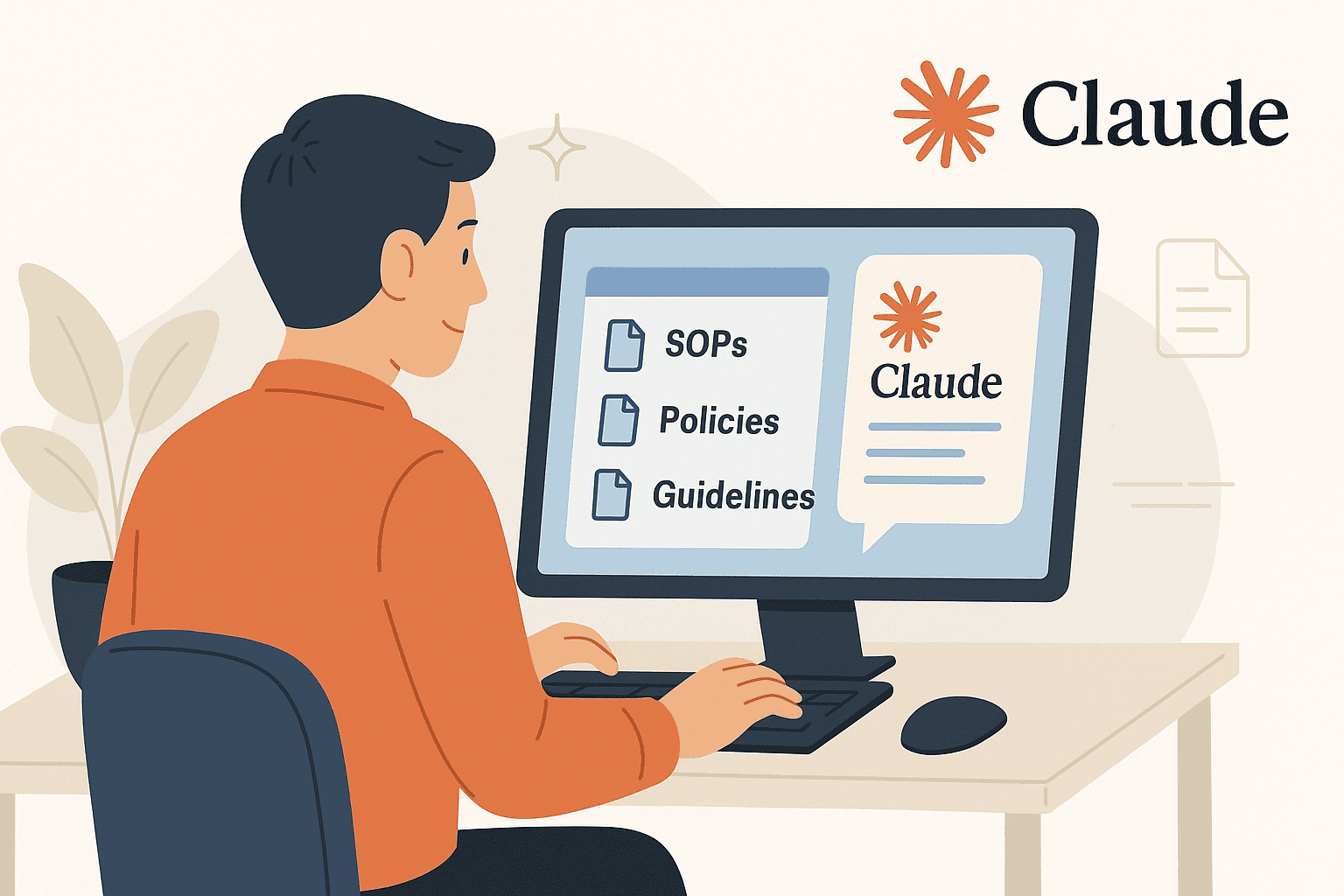

Standard Operating Procedures (SOPs) are the backbone of consistent and efficient operations in any organization. They reduce errors by providing step-by-step instructions for routine tasks, ensuring consistent quality across all business operations. By transforming complex processes into clear steps, SOPs act as a single source of truth that any employee can follow for reliable results. However, writing and updating these documents can be time-consuming and prone to human error. This is where AI – specifically Claude AI by Anthropic – comes into play.
Claude is a powerful AI assistant capable of digesting large volumes of text and generating well-structured content. Using Claude for SOP creation offers practical benefits: it speeds up document creation and improves efficiency, turning tasks that once took hours into minutes. It also reduces manual errors, replacing error-prone writing processes with streamlined, accurate outputs. In short, AI-driven SOP automation can save time, ensure consistency, and free your teams to focus on higher-value work.
This guide will show how to harness Claude for building and maintaining internal documentation. We cover the main types of SOPs applicable across industries, then dive into using Claude step-by-step – from drafting procedures and enforcing style guidelines using the Claude web interface to bulk-generating documents and updates with Claude’s API.
You’ll also find tips on structuring outputs (including JSON formatting for knowledge bases) and template examples (such as onboarding checklists, runbooks, RACI matrices, and change logs). The advice here applies whether you’re a startup building SOPs from scratch or an enterprise modernizing legacy manuals. (Even small businesses can benefit from these practices, though our focus is on fast-scaling startups and large organizations with complex documentation needs.)
Let’s begin by looking at common SOP types and how Claude can adapt to different industries and scenarios.
Key SOP Types (Applicable Across Industries)
While the specifics vary by company, several core types of SOPs are useful in most organizations. Claude can assist in creating all of the following:
- Employee Onboarding SOPs: Step-by-step guides for integrating new hires into the company. For example, a SaaS startup might document the onboarding process for a new developer (accounts setup, codebase overview, training tasks), while an enterprise’s HR team might standardize orientation procedures. Onboarding SOPs ensure every new team member receives consistent information and completes mandatory steps (HR paperwork, IT access, security training, etc.), improving ramp-up time and compliance.
- Incident Response Runbooks: These are emergency procedure documents, common in Tech/IT and Operations. For instance, a cloud software company could have an SOP for handling a server outage or cybersecurity incident, detailing how to escalate issues, communicate with stakeholders, and resolve the problem. Similarly, a manufacturing plant might have an incident response SOP for safety incidents or equipment failures. Claude can help draft clear, action-oriented runbooks so that during crises, teams have a reliable, pre-approved action plan.
- Product or Service Workflow Documentation: SOPs that capture how to execute core business processes or deliver services. In a marketing agency, this could mean a workflow for launching a client campaign – from creative brief to publication – documented stepwise. In a tech company, a product workflow SOP might outline the steps for releasing a new software feature (design, code review, deployment, QA, release notes, etc.). By using Claude to document these workflows, companies ensure consistent quality control at each step (which is crucial for meeting safety or quality standards in industries like manufacturing).
- Internal Communication Procedures: Guidelines for how information is shared internally. Examples include an SOP for company-wide announcements, escalation matrices for support issues, or approval processes for sending external communications. While less technical, these SOPs enforce consistency and clarity in communications. Claude can assist by formalizing such guidelines (e.g. writing a procedure for managers to request IT support or a protocol for handling customer feedback internally).
- Customer Support and Operations Runbooks: Playbooks that support teams use to handle common scenarios. For example, a customer support SOP could instruct how to troubleshoot common client issues or how to escalate tickets. In a marketing agency, a client delivery SOP ensures each deliverable passes required review steps. Using Claude, support documentation can be generated or updated quickly as products change, ensuring that even new support agents follow the latest standard process for a high-quality customer experience.
- Engineering and Quality Checklists: These are specialized SOPs in checklist format, often used in engineering, manufacturing, or DevOps. Examples: a pre-deployment checklist for software releases, a quality-control inspection checklist on a factory line, or a safety procedure checklist for operating machinery. Claude can produce checklist-style SOPs that are concise and easy to follow, including any safety or compliance points that must be verified each time (e.g. “verify machine guard is in place” or “run automated tests and document results”).
Industry-Agnostic Approach: Importantly, the approach to creating SOPs with Claude is industry-neutral. Whether it’s Tech, Marketing, Manufacturing, or general Operations, the steps to outline a process, document it clearly, and enforce consistency are similar. For instance, SaaS/Tech companies will focus on technical onboarding and incident handling, marketing agencies on creative workflow SOPs and client delivery standards, and manufacturing/operations on safety procedures and production steps. We will provide examples from these sectors, but the methods can be adapted to any field. Now, let’s explore how to actually use Claude to craft and manage these documents.
Claude Workflows: Creating and Refining SOP Content
Claude can assist at every stage of the SOP development lifecycle – from initial drafting to periodic updates. Here are key workflows and techniques to use with Claude:
1. Structuring and Outlining SOPs: Begin by breaking down the target process into major steps or sections. Provide Claude with a brief description of the task or process and an initial list of steps. Ask Claude to analyze this workflow for completeness and logical order. For example, you might prompt: “I’m breaking down the task of deploying a new software build into sequential steps for an SOP. Here’s what I have so far: [list of steps]. Can you help me identify any steps I may have missed or suggest ways to make the sequence clearer?” This approach uses Claude as a second set of eyes to catch missing actions or re-order steps for clarity. Claude’s feedback can ensure your SOP covers all critical steps in the right order.
2. Expanding Steps into Clear Instructions: Once the outline is set, have Claude generate a detailed description for each step. You can prompt Claude with something like: “Using the list of steps, please generate a clear and concise description for each step, aimed at making the SOP easy to follow for all employees.” The AI will elaborate on each step in straightforward language. The result is a fleshed-out draft where every action is explained. Claude excels at writing in an active voice and imperative tone, which is ideal for SOPs (“Do X, then Y”). If any step is too vague, you can ask Claude for more detail or examples until each instruction is unambiguous and actionable.
3. Defining Roles and Responsibilities (RACI): Many processes involve multiple roles (who does what). Claude can help define these. Prompt it to identify the key roles involved and their responsibilities within the process. For instance, for a product launch SOP, roles might include Product Manager (Accountable), Developer (Responsible for code changes), QA Engineer (Responsible for testing), DevOps (Consulted for deployment), Support Lead (Informed). Claude can generate a section in the SOP that clearly states each role’s duties. In complex processes, you might even create a RACI matrix (Responsible, Accountable, Consulted, Informed). A RACI chart helps teams document roles and responsibilities for every task at a glance. Claude can either populate a RACI table or list the R, A, C, I for each step. This ensures accountability is built into your documentation.
4. Incorporating Quality Checks and Metrics: A great SOP doesn’t just list steps; it also notes how to verify the task was done correctly. Claude can suggest Key Performance Indicators (KPIs) and quality control measures to include. For example, in a manufacturing SOP, Claude might propose adding a step to record a measurement reading and acceptable ranges (to ensure quality). For a customer support SOP, it could suggest noting a target resolution time or customer satisfaction check. By asking Claude questions like “What quality checks or metrics should be included to ensure this procedure’s success?”, you enrich your SOP with built-in validation points. This leads to procedures that not only standardize process execution but also standardize how success is measured and maintained.
5. Rewriting and Standardizing Existing Documentation: Many enterprises already have SOPs or process docs that are outdated, inconsistent, or overly verbose. Claude can take a “messy” document and rewrite it in a clean, structured SOP format. You can paste in an old procedure (or several bullet points from meeting notes) and instruct Claude to output a formal SOP with proper sections (Purpose, Scope, Steps, etc.). The AI will follow your guidelines to produce a polished draft. This is extremely useful for updating legacy procedures – instead of starting from scratch, you feed Claude the raw material and let it generate a unified, concise SOP. In doing so, Claude also helps standardize tone and terminology across documents. For example, if some documents say “customer” and others say “client”, or one uses future tense and another imperative, Claude can normalize these choices based on your preferred style.
6. Ensuring Tone and Style Consistency: Companies often want internal documentation to follow a certain style guide (formal tone, active voice, clarity, etc.). Claude can consistently apply these rules. When prompting, you can include instructions like “use a formal documentation style with concise bullet points” or “follow our style guidelines (imperative voice, no jargon, clear headings).” Claude can even be given a sample SOP or style guide as reference. By grounding its output in your internal knowledge and style preferences, Claude produces content that feels like it was written by one hand. Anthropic’s Claude is particularly good at following such instructions. In fact, Claude’s Projects feature allows you to set custom instructions (e.g., “Write in the tone of our company handbook”) that persist across sessions. This ensures every SOP draft adheres to the voice and format your organization expects.
7. Versioning and Updating SOPs: SOPs are living documents – they need periodic updates (for new regulations, new tools, process changes, etc.). Claude can assist in two ways: (a) Summarizing Changes – If you feed Claude the old SOP and a list of updates or new info, it can integrate them and even generate a change log entry describing what changed. For example, “Version 2.1 – Updated step 4 to include new compliance check; revised responsibilities for QA.” This can be done by prompting Claude to compare two versions or simply to produce a revision summary. And (b) Consistency Checks – if multiple SOPs share dependencies (say a policy changed that affects several procedures), Claude can be asked to review all related SOP texts (with its large context window) and identify where updates are needed, ensuring nothing is overlooked. By automating these maintenance tasks, enterprises keep their documentation current with minimal effort.
Finally, after drafting any SOP content with Claude, it’s wise to have a human expert review it. Claude provides speed and structure, while your team provides the final layer of accuracy and approval (especially for compliance-critical steps). Next, we’ll see how to implement these workflows through Claude’s interface and API.
Using Claude’s Web Interface for SOPs and Documentation
Anthropic provides an easy-to-use web interface for Claude (accessible via Claude.ai for authorized users). This interface allows non-technical team members – from HR to Operations – to interact with Claude in a chat-like environment to create and refine documentation. Key ways to use the Claude Web UI for SOPs include:
- Interactive Drafting and Q&A: You can chat with Claude in natural language to build your SOP. Start a new conversation for each SOP or documentation project. Then iteratively: ask Claude to draft a section, review its output, and ask follow-up tweaks. For example, “Claude, draft an SOP for our client onboarding process. It should include Purpose, Scope, Responsibilities, and Step-by-Step Procedure.” Claude will produce a first draft. You might then say, “Great, now ensure the tone is formal and remove any overly friendly language,” or “Add a step about sending a welcome email to the client.” In this way, the Claude.ai chat becomes a collaborative writing tool where you steer the content. Unlike manual writing, using Claude can often complete a full SOP document in a single interactive session that might last minutes instead of days.
- Uploading and Analyzing Reference Materials: Claude’s interface supports file uploads, which is invaluable for internal documentation. You can upload multiple files (PDFs, Word docs, etc.) containing existing procedures, guidelines, or any reference Claude should consider. Claude will take those into account when answering your prompts or writing content, effectively acting as if it “read” your internal knowledge base. For instance, you could upload a company policy PDF and an older SOP document, then ask Claude to “Draft a new SOP that complies with the policy (from the PDF) and covers the procedure described in the old SOP, but in our updated format.” Claude can synthesize across documents. This multi-file capability means you avoid copy-pasting large texts; instead, you let Claude retrieve facts and wording from the uploaded knowledge as needed. It can even suggest changes that harmonize information across files.
- Claude Projects and Knowledge Base: For Pro and Enterprise users, Claude offers a Projects feature, where you can organize chats and add a knowledge base of documents to a project. Each project can have a huge context window (up to 200K tokens, roughly a 500-page book) for Claude to work with. This means you can load all relevant SOPs, manuals, style guides, etc. into the project’s knowledge base. Claude will then use these as context for every response, ensuring answers or new documents align with your stored knowledge. Essentially, Claude can be “trained” on your internal documentation library without retraining the model – it just references the data when generating outputs. As Anthropic explains, Projects allow Claude to ground its outputs in your internal knowledge, whether it’s style guides, codebases, or transcripts. For SOP writing, this means you can trust Claude to follow your existing processes and terminologies.
- Summarization and Restructuring: If you have a lengthy policy or technical document that needs to become an SOP, you can use Claude’s summarization abilities. Upload the document (or paste it in sections) and prompt Claude to “Summarize the key actionable steps as an SOP.” Claude can distill a 30-page manual into a one-page procedure outline, for example. Conversely, if an SOP is too high-level, Claude can expand it: “Here’s a brief procedure outline. Elaborate each point into a full SOP section.” This flexibility makes Claude an excellent editor and reformatter. It’s also useful for creating multiple document formats: e.g., take a detailed SOP and ask Claude to create a one-page checklist version for quick reference, or vice versa.
- Tone and Style Enforcement: Using the Claude UI, you can easily apply a consistent tone by giving instructions or using custom project instructions. For instance, set a project-wide instruction: “All outputs should use a formal, instructional tone and our company terminology (use ‘client’ instead of ‘customer’, etc.)”. Claude will then maintain this style in every answer. If an output’s tone is not quite right, a quick user message like “Please rewrite the above in a more formal style and in the third person” can adjust it. This is far faster than manually editing dozens of pages for tone. It ensures your internal documentation reads uniformly, which is important for training and compliance.
- Collaborative Review with Claude: Another neat use of the Claude interface is to have Claude review a draft SOP. If a human writes a draft, you can paste it and ask Claude questions: “Do you see any unclear steps or ambiguities in this procedure?” or “Suggest improvements or simplifications to this SOP.” Claude might catch things like passive voice sentences, missing prerequisites, or inconsistent term usage. This mirrors having a knowledgeable editor on call. It’s particularly useful for teams that don’t have a dedicated technical writer – Claude can fill that role to an extent, by proofreading and improving clarity.
The web interface approach is ideal for interactive, one-off document creation or editing sessions, and it doesn’t require programming. Operations teams, knowledge managers, HR, or engineers can all use it directly. For broader scale and automation (e.g., generating dozens of SOPs or integrating with your systems), Claude’s API provides further capabilities, which we discuss next.
Leveraging the Claude API for Scalable SOP Automation
Claude’s API allows developers to integrate this AI assistant into your company’s workflows and tools. With a bit of coding or scripting, you can automate the generation and maintenance of SOPs on a large scale – useful for enterprise knowledge management or when SOPs need frequent updates. Here are some advanced use cases and best practices using the Claude API:
- Bulk SOP Generation: Startups often need to create many SOPs quickly as they establish operations. Using the API, you could programmatically feed Claude a list of processes and get back draft SOP documents for each. For example, suppose you have identified 20 key processes across departments. You can write a script that sends each process name or a short description to Claude and asks for a structured SOP in return. Each API call could include a prompt like: “You are a documentation assistant. Please produce a standard operating procedure for the process: X. Follow this format: Purpose, Scope, Responsibilities, Procedure Steps, etc.” The responses can then be saved as documents. This batch generation accelerates the initial documentation effort dramatically. Instead of writing each SOP from scratch, your team receives first drafts to review and refine. Bulk generation can also be done for updating SOPs – e.g., if a regulation changes and dozens of SOPs need a new section, you can script Claude API calls to modify each document accordingly.
- Automated Updates and Pipelines: Enterprises can integrate Claude into their DevOps or knowledge management pipelines. For instance, imagine a scenario where a new software deployment automatically triggers an update to a technical SOP: with the API, your deployment script could call Claude with the changelog and existing SOP content, and Claude would return an updated SOP section or an addendum to append. Another example: integrating Claude with a content management system (CMS) or knowledge base (like Confluence or SharePoint). You could build a tool where employees submit requests or raw notes for an SOP update, and behind the scenes, Claude’s API transforms those inputs into the official SOP format, posting it to the knowledge base for approval. These pipelines ensure SOPs stay current without relying on manual writing. Claude essentially becomes part of the documentation toolchain.
- Enterprise Knowledge Base Integration: Many companies maintain an internal knowledge base or intranet for SOPs and policies – essentially a repository of all internal documentation. Claude’s API (especially with large context windows) can be used to ingest this repository and answer questions or produce new docs based on it. Anthropic provides a Files API to upload documents to Claude’s storage and reference them via
file_idin prompts. You can upload dozens or hundreds of SOP files, then ask Claude questions like “Using our stored procedures, draft a master process standardization guide” or “Check if any step in the ‘Data Backup SOP’ contradicts the ‘Disaster Recovery Policy’.” Because Claude can handle very large contexts (up to 100K tokens in some versions, and 200K in Claude 3.5 for projects), it can truly synthesize knowledge across your documents. This opens possibilities for enterprise knowledge bases: you could build a chatbot for employees that, powered by Claude, answers how-to questions by pulling from all your SOPs, or automatically generates a first draft of a new SOP by drawing on similar ones in the repository. In short, the API enables Claude to function as an enterprise knowledge partner, not just a text generator. - Structured Output (JSON/XML) for Documentation Systems: When integrating with IT systems, it’s often useful to get Claude’s output in a structured format (for example, JSON) rather than plain text. Fortunately, Claude’s API has features to enforce structured outputs. You can define an output schema and ask Claude to fill it. For instance, define a JSON with fields:
{"Title": "...", "Purpose": "...", "Steps": [ ... ], "Roles": [...], "LastUpdated": "..."}and instruct Claude to output exactly that format. Anthropic’s documentation suggests precisely defining the desired output format (JSON, XML, or custom templates) so Claude understands the structure required. Even better, Claude offers a “Structured Output” mode that guarantees the response conforms to your schema. By using these capabilities, the SOP content generated by Claude can be directly ingested by your systems. For example, your knowledge base could store SOPs as JSON objects; with Claude’s structured output, you won’t need to do error-prone parsing – the AI will deliver machine-ready data. This is ideal for building automated documentation pipelines where consistency is key. (Developers should refer to Anthropic’s Structured Output docs for details on setting up the schema andoutput_formatparameters.) - Processing Multiple Files and Ingestion Workflows: Suppose you have a folder full of existing procedure documents that need consolidation. Using the API, you can script a folder ingestion workflow: the script reads each file, sends its content (or a link via file ID if uploaded) to Claude with instructions to summarize or standardize it, and then saves the result. You could even have Claude cross-reference documents – for example, “Combine the information from File A and File B into a single SOP”. The ability to handle multiple documents simultaneously is one of Claude’s strengths (especially compared to earlier-generation models). As noted, at Claude.ai and via API you can provide multiple files for context, and Claude will integrate them in its response. A practical use-case: uploading a policy document and a process document together and asking Claude to generate an SOP that complies with the policy while executing the process. The API could handle this in one call by referencing both files in the prompt. This dramatically reduces manual effort in verifying consistency between documents – the AI does the heavy lifting.
- Scaling with Enterprise AI Platforms: Claude is also available through enterprise AI platforms (like AWS Bedrock, Google Vertex AI, etc.), which means it can fit into enterprise architecture with security and scaling considerations taken care of. If you’re an enterprise looking to automate SOPs at scale, you might integrate Claude via these services to benefit from features like data encryption at rest, access controls, and monitoring. Claude’s Enterprise plan also offers higher rate limits and possibly on-prem or VPC hosting options for sensitive data. With these, a large company could implement real-time SOP generation and updates as a service within their network.
In summary, the API unlocks Claude’s SOP automation capabilities fully: bulk generation, continuous updates, integration with other apps, and structured outputs for databases. Technical teams can tailor these tools to the organization’s needs, creating a robust process standardization pipeline that ensures knowledge is always documented and up-to-date.
Next, we’ll look at some template frameworks common in SOPs and how Claude can help populate them.
SOP and Runbook Templates (and How Claude Fills Them)
Effective SOPs usually follow a standard structure. By establishing templates, you make it easier for Claude (and humans) to produce consistent documentation. Below are some common templates and how Claude can assist with each:
- Standard SOP Template: A typical SOP contains sections such as Title, Purpose, Scope, Definitions, Roles and Responsibilities, Materials (if applicable), Procedure Steps, and References/Appendices. For example, an SOP might start with a brief purpose (“This document describes the procedure for handling customer refund requests to ensure consistent service quality”) and scope (“Applies to all support staff at Company X, for product lines A and B”). It then lists any definitions or prerequisites, outlines who is responsible for the procedure, and then details the step-by-step process. Finally, it may include references to related documents and a revision history. According to best practices, elements like header info, purpose, scope, roles, procedure, and revision history should all be included. You can feed Claude a list of these sections as a template, and it will fill them out. In fact, you might prompt: “Fill out this SOP template. Title: __, Purpose: __, etc.” with some guidance, and Claude will maintain the format. If your company has its own SOP template document, uploading it to Claude as a style reference will encourage the AI to mimic that structure in its output.
- Runbook Template: A runbook (often used for IT or DevOps incident responses and other operational workflows) is a type of SOP that emphasizes quick action and decision points. A runbook template might include sections like Incident Description, Assumptions, Immediate Actions, Escalation Contacts, Step-by-Step Resolution, Verification, and Post-mortem/Follow-up. Runbooks often use lists, checkboxes, or flowchart-style steps to facilitate rapid use under stress. Claude can help generate runbooks by ensuring that the steps are succinct and action-oriented. For instance, you could instruct Claude: “Create an incident response runbook. Use a numbered list for actions, include an ‘If issue not resolved, escalate to X’ branch, and provide a verification step at the end.” The AI can format conditional steps and even suggest escalation thresholds (perhaps drawn from similar incidents it knows or patterns you provide). Because runbooks may involve technical details, ensure Claude has access to any technical documentation (via uploaded context) so it can incorporate accurate info (like server names, contacts, etc.) in the runbook.
- Onboarding Checklist/Template: Onboarding often lends itself to a checklist or timeline format. A template might break the onboarding process into phases (Before First Day, First Day, First Week, First Month) each with a list of tasks. For example: “Before Day 1: Prepare workspace, create accounts; Day 1: Tour office, Introduce to team, Safety briefing; Week 1: Complete training modules X, Y, Z; etc.” Claude can generate a comprehensive onboarding plan by drawing on general HR best practices combined with your company specifics (which you provide). You might prompt: “Generate an onboarding checklist for a new software engineer joining our company. Include pre-start preparations and a timeline of activities up to 30 days.” Because Claude has been trained on a wide range of business content, it can suggest items you might forget (like setting up 2FA, scheduling a 30-day feedback session, etc.). You can then customize those to fit your culture. The result is an SOP that ensures every new hire has a structured, welcoming, and complete onboarding experience.
- RACI Matrix Template: As discussed, RACI is a framework to clarify responsibilities. A RACI matrix is often formatted as a table with tasks on one axis and people/roles on the other, marking who is Responsible, Accountable, Consulted, and Informed for each task. While Claude cannot create a spreadsheet by itself, it can generate a text representation of a RACI chart. For example: TaskProduct ManagerEngineerQA LeadSupport LeadDraft feature specA (Accountable)RCICode implementationIA,RCITesting and QAIRAIUpdate user documentationACIR Claude could produce something akin to this in Markdown or as a list if asked: “Provide a RACI assignment for the tasks X, Y, Z among roles A, B, C.” Often, it’s easier to have Claude list each task with the R, A, C, I roles spelled out in text. For example: “Task: Deploy new release – Responsible: DevOps Engineer; Accountable: CTO; Consulted: QA Lead; Informed: Customer Support Team.” You can format that into a table later if needed. The key is that Claude ensures you haven’t left any task without an owner and that only one person is marked Accountable per task (a common rule for RACI). This contributes to clearer SOPs where everyone knows their part.
- Change Log Template: SOPs should include a revision history or change log at the end. A typical change log entry notes the version, date, author (or approver), and a brief description of changes. For example: “v2.0 – 2025-12-01 – Updated procedure to include new compliance requirements (Author: J. Doe).” Claude can help maintain this by appending a formatted entry each time you ask it to update an SOP. You could say: “Add a change log entry: version 1.1, today’s date, changes: updated Section 3 with new workflow, approved by [Name].” Claude will produce a line in the style you specify. This ensures that when SOPs are updated via Claude, the updates are properly documented. Some organizations use a table for revision history; Claude can fill that too (e.g., as Markdown or CSV text if needed). By keeping change logs, enterprises track the evolution of processes and maintain compliance (many quality standards require documentation of changes).
In practice, you might maintain a library of template prompts for Claude. For instance, a prompt for “New SOP Template” that includes placeholders for each section. With the Claude API, you could even store these as canned prompts to prepend to user input for consistency. This way, whether a human or an automated process triggers the SOP creation, the output follows the template every time.
Lastly, remember that Claude learns from your instructions. If you generate multiple SOPs and consistently correct certain things (e.g., moving a section, rephrasing titles), you can bake those preferences into future prompts or project instructions. Over time, Claude’s assistance combined with good templates can lead to an enterprise knowledge base of SOPs that is thorough, well-structured, and readily maintainable through AI.
Frequently Asked Questions (FAQs)
How can startups use Claude to build SOPs from scratch?
Startups often lack formal processes at the beginning. Claude can serve as a swift SOP writer – founders or team leads can simply describe how they currently do a task, and ask Claude to generate a formal procedure. For example, a founder might outline how they handle customer onboarding in a few bullets, then prompt Claude to “turn this into a standard operating procedure.” Claude will output a structured SOP with a clear sequence of steps, which the team can then tweak. This jump-starts documentation without investing hours. As the startup grows, those AI-generated SOPs ensure new team members have guidance and the company can scale operations smoothly.
How do enterprises benefit from Claude for updating existing documentation?
Enterprises typically have many SOPs, often written over years by different people. This can lead to inconsistencies and outdated information. Claude helps by quickly harmonizing and updating these documents. An enterprise user can feed Claude an old SOP (or multiple related ones) and ask for an updated version that reflects current policies or systems. Claude’s ability to handle large context means it can read a 50-page policy and update all relevant SOP sections accordingly. It also standardizes language and format across documents. In essence, Claude can serve as an AI documentation assistant working through the backlog of outdated docs, freeing up human experts to focus on validating content rather than writing from scratch.
Is the output from Claude reliable and consistent enough for official SOPs?
Claude is designed to produce coherent, logically consistent text, especially when guided with good prompts or examples. It can follow templates and schemas to enforce consistency (Anthropic even provides modes for guaranteed JSON/schema compliance in outputs). In many cases, companies find Claude’s first drafts are 80-90% ready to go, requiring only minor edits. That said, for any official SOP, human review is important – to verify factual accuracy, compliance nuances, and company-specific correctness. Think of Claude’s output as a well-written draft. It stays consistent (no sudden style shifts) and if you’ve set instructions, it will adhere to them across documents. Over time, as you refine your prompting and perhaps develop a library of example SOPs for Claude to mimic, the reliability further improves. Many organizations report that AI-assisted documentation can be completed 5x faster with similar or better quality than manual writing. Always double-check critical details, but expect the heavy lifting of writing to be handled by Claude quite capably.
Can Claude handle confidential internal information safely?
Claude has features to support privacy and confidentiality, which is crucial for internal documentation. By default (as of 2025), Anthropic does not use your conversation data for model training unless you opt-in. In other words, your internal SOP content isn’t feeding back into the public model’s knowledge. Enterprise and Team plans even allow turning off chat history or setting short data retention windows. Furthermore, any files you upload or projects you create can be restricted to your team, and Anthropic states that files and project data are never used for training unless explicitly permitted. For additional safety, you can avoid including ultra-sensitive data or use techniques like replacing real names with placeholders when giving Claude prompts. Anthropic has a strong focus on privacy-by-design, meaning Claude is built to be used as an internal assistant without leaking your proprietary information. Of course, it’s wise to follow your company’s data security policies – for example, use the Claude API via secure channels, and leverage on-premises solutions if available for highly sensitive documentation. But generally, Claude is considered safe for business use, and many enterprises (including those in finance and healthcare) are using it for exactly tasks like internal documentation.
Does Claude provide ready-made SOP templates or do we need to create our own?
Claude doesn’t come with “built-in” company-specific templates out of the box – it generates content based on the prompts and examples you give it. However, it has been trained on a broad range of text, which includes standard formats for procedures. This means if you ask for an SOP with certain sections, Claude will likely know what you mean and produce them. For instance, if you say “write an SOP with header, purpose, scope, steps, and revision history,” it will do so, even if you didn’t provide a physical template file. That said, it’s a good practice to provide your preferred template (even in text form) to Claude. You might store a generic SOP template in your Claude project or prepend it in a prompt like: “Use this format for the SOP: 1) Purpose: … 2) Scope: … 3) Procedure: … etc.” By doing this, you ensure the output matches your expectations exactly. Over time, Claude can adapt to your templates. Think of it as you set the standard, and Claude fills it in. Many teams create a few template prompts for different needs (one for a simple checklist SOP, one for a detailed policy SOP, one for a runbook, etc.) and reuse them. In summary: Claude doesn’t force a template on you – you remain in control of structure – but it can definitely generate content in a templated style when instructed, effectively automating your documentation standards.
What are some best practices for prompting Claude to get the best SOP results?
To get high-quality SOPs from Claude, consider these practices:
Be clear about the format: Tell Claude upfront the sections or style you want. e.g., “Write the SOP in numbered steps under a ‘Procedure’ section, and include a short Purpose statement at the top.” Specific instructions yield more structured outputs.
Provide context or examples: If you have an existing SOP or even a part of one that you like, give it to Claude as a reference. For instance, “Here is an example of our SOP style [paste snippet]. Now write a new SOP for X in the same style.” Claude will pick up on formatting, tone, and level of detail.
Iterate with Claude: Don’t be afraid to ask for revisions. If the first draft is too verbose, you can say “Make it more concise and use bullet points for the steps.” If something is missing, “Add a step about performing a safety check at the end.” Claude responds well to iterative refinement, much like a human writer.
Use high-level guidance: Claude has some understanding of acronyms and frameworks. You can say, “Use the SMART criteria for any goals in the SOP” or “Ensure compliance requirements are highlighted.” It will attempt to follow suit. Higher-level instructions like “follow OSHA guidelines” might be too broad (unless you provided those guidelines), but stylistic and structural guidance is beneficial.
Review for accuracy: While Claude can format and draft quickly, double-check factual content. If an SOP involves specific numbers (like a threshold or a regulatory code), verify those. You can even ask Claude to cross-verify within provided documents, but final responsibility lies with the human overseer.
Following these practices leverages Claude’s strengths (speed, structure, linguistic clarity) while mitigating its limitations (domain-specific factual accuracy without provided data). Over time, you’ll find an approach with Claude that fits your organization’s workflow, making SOP creation almost as easy as having a conversation.
By combining your team’s expertise with Claude’s AI capabilities, creating and maintaining company SOPs and internal documentation becomes a faster, more efficient process. The end result is a robust, up-to-date knowledge base that drives consistency, quality, and compliance in your operations – all achieved with the help of a collaborative AI assistant. Whether you’re documenting how to onboard a new engineer at a startup or refining a safety procedure at an enterprise, Claude can be a valuable partner in achieving process excellence.